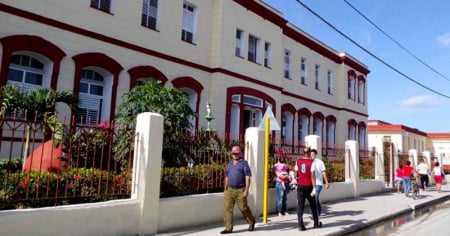
Residents of the municipality of Old Havana reported that entire families have fallen ill with chikungunya, while authorities acknowledge the situation is "critical" and are intensifying fumigation efforts in certain areas without providing clear numbers on the outbreak.
The capital municipality is currently among the municipalities with the highest epidemiological risk for the transmission of chikungunya.
Testimonials collected by Canal Caribe show the speed at which the virus has spread among entire families.
"First, it was the pains in the joints... then I fell ill, followed by my son-in-law, my daughter, my grandson, and even the smallest one," recounted Lorenza Núñez, a neighbor, still bearing the aftereffects and difficulties in walking.
According to healthcare personnel, the increase in fever cases necessitates the deployment of fumigation and survey brigades in the most affected blocks.
The areas are defined according to the "movement of fever cases," explained a worker from the anti-vector campaign, who stressed that the population must report every patient to activate the teams.
Without that information, he stated, "they cannot send the fumigation."
Dr. Magdiel Molina, also recovering, recalled that the illness causes a significant temporary disability and emphasized the urgency of seeking medical attention at the first symptoms.
Authorities have established protocols for the most vulnerable groups, such as hospitalization for young children and pregnant women, and special monitoring for older adults, many of whom live alone.
The background in other municipalities confirms an equally fragile situation.
In Marianao, officials from the Ministry of Public Health (Minsap) recently acknowledged that “the exact cases are not being calculated”, which makes it difficult to understand the true scale of the outbreak.
Although they claim to have incorporated adulticidal brigades, targeted work, and quadrant surveys, they did not provide figures to assess their impact.
While the fumigation focuses on the community councils with the highest number of fevers, concerns are growing over the lack of transparency.
The lack of concrete data on infections and the progression of the outbreak leaves the population without a clear compass to understand the seriousness of a disease that continues to affect home after home.
According to the national director of Epidemiology at Minsap, Doctor Francisco Durán García, more than 30% of Cubans have been infected with chikungunya, which would amount to around 3 million people on the island.
In several neighborhoods of the capital, residents report that fumigation is irregular and that mosquito breeding sites persist in critical areas, worsened by the accumulation of garbage, the scarcity of drinking water, and the precarious management of waste.
By the way, the government of Old Havana plans to implement starting Monday, November 17, a system whereby neighbors and private businesses must put out their solid waste only when the truck passes, at a scheduled time starting from 7:00 p.m., and not leave it on the street.
The province of Holguín is experiencing a significant epidemiological downturn marked by the circulation of chikungunya and serotype four of dengue, amidst an increase in febrile syndromes following the passage of Hurricane Melissa.
Cases of dengue and chikungunya have also surged in Sancti Spíritus as well as in Camagüey, where health authorities describe the increase as "exponential".
Filed under: