
Related videos:
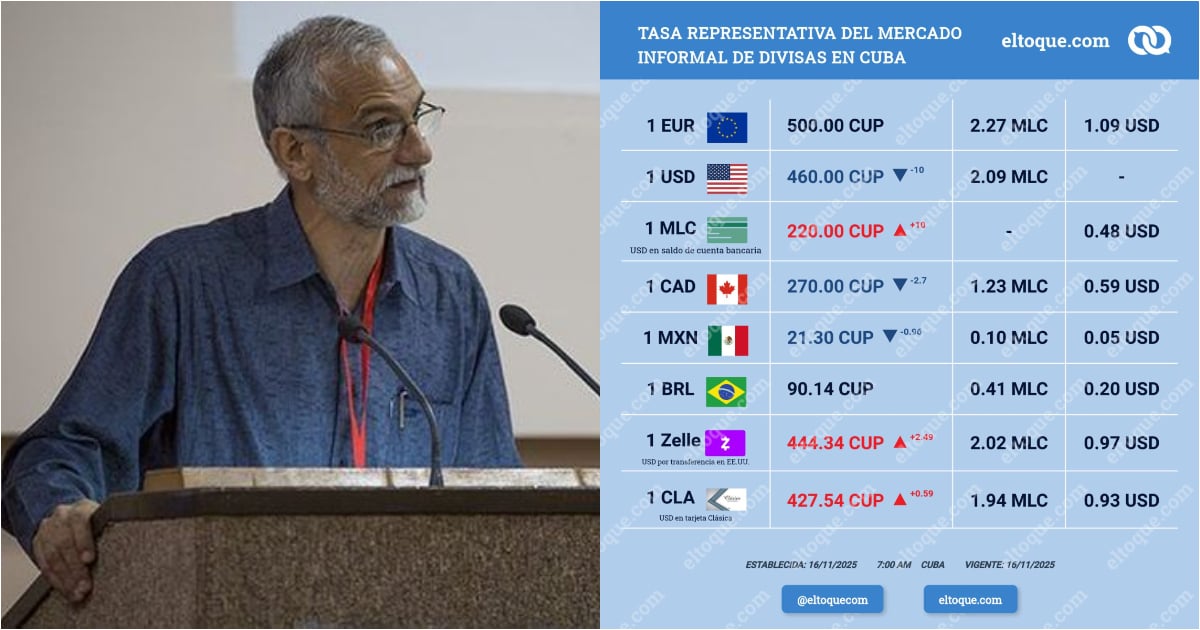
The official journalist Ariel Terrero stated this Sunday that the uncritical acceptance of the official Cuban discourse regarding El Toque's ability to influence and distort the Cuban exchange market is “grotesque, lacking any economic basis.”
"The manipulation of these markets in any country requires overly expensive interventions by powerful economic agents—a central bank or a global financial conglomerate—to achieve reactions in interest rates, reactions that tend to last only for a short time," emphasized Terrero in a detailed analysis published on his Facebook profile.
In his opinion, the Hungarian-American businessman and investor George Soros "would envy José Jasán (Nieves, founder and director of the digital outlet) if the capabilities attributed to El Toque were credible."
He, also the dean of the Faculty of Communication at the University of Havana, described the media's financial observatory as a "too small" team without technical validation to measure a fragmented and opaque market like the Cuban one.
While acknowledging that the Representative Rate of the Informal Market (TRMI) has become a reference point due to the lack of similar information, “a simple walk and dialogue with internal markets reveals daily differences between what El Toque reports and the rates that sellers apply when they convert currency with their customers.”
The former vice president of the Union of Journalists of Cuba lashed out at the media, questioning its receipt of U.S. funding and its collaboration with the U.S. Embassy in Havana on various programs aimed at civil society.
However, he admitted that blaming El Toque for movements in the informal rate lacks economic logic: to influence exchange rates, there need to be actors with real financial capacity, not a medium that collects data from social networks.
He also acknowledged that the Central Bank of Cuba (BCC) left an informational void that the media took advantage of, due to the State's inability to create a flexible and transparent foreign exchange market.
In this regard, Terrero's critique directly points to the responsibility of the Cuban government for the economic collapse and its inability to create a functional currency market after years of unfulfilled promises.
"The authorities have continued to cling to official rates that operate on one side while the real market -misleadingly termed informal- functions on another. The promise to create a 'functional and transparent' foreign exchange market, reiterated by the BCC these days, has been officially in place for over three years. We will keep waiting," he argued.
The comments section revealed a stark contrast with the official discourse. The contributions from economists and specialists directly pointed to the internal causes of this phenomenon.
The economist Ileana Díaz Fernández recalled that everything happening today is a consequence of an informational void that the State itself created and that other actors simply filled.
Another colleague, Oscar Fernández, was more explicit: someone in the government has been blocking any attempt to formalize the currency market for at least three years, and no matter what they do now, "the damage is irreversible."
The historian Félix Julio Alfonso dismantled another pillar of the official narrative by stating that the exchange rate published by El Toque “is not the cause of any of the serious problems facing the Cuban economy, starting with the issue of wages, which for decades has been absolutely insufficient to fulfill its functions, and ending with the dollarization of consumption, which constitutes an offense to those who do not have access to that currency.”
The economist Hiram Marquetti added more technical details, such as that the architects of the Order Task did not consider "the necessity of preserving the exchange market, and this situation led to the weakening of CADECA (Currency Exchange Houses). Furthermore, despite the new complexities faced by the economy, the exchange rate of 1 to 24 was maintained, which significantly affects companies engaged in foreign trade.”
Other citizens were even more candid. "Talking nonsense is free, and in that, the Cuban government has no rival," remarked one. Another summed it up bluntly: blaming an external enemy is the classic tactic of a government that avoids looking in the mirror.
Amid the chaos, a comment provided an uncomfortable dose of realism that Terrero did not mention: the current polycrisis—economic, social, and political—only worsens when the government insists on seeking external scapegoats and "refuses to acknowledge its own responsibility in creating the conditions for the current disaster."
Nieves rejected this Sunday the recent escalation of harassment by the regime in the past few weeks and publicly reaffirmed her political commitment to democracy in Cuba.
The escalation began on October 29, when Foreign Minister Bruno Rodríguez spoke of "evidence" regarding an alleged manipulation of the exchange rate.
Then, the official spokesperson Humberto López accused the media outlet of being part of a “comprehensive economic war program” and of operating a scheme of “financial terrorism,” even suggesting potential criminal proceedings and the inclusion of the project on lists of entities “linked to terrorism.”
The ruler Miguel Díaz-Canel directed his attacks against the media outlet, accusing it of receiving external funding to undermine the Cuban currency and act as part of an alleged "economic war" against the country.
Similarly, the Central Bank of Cuba (BCC) supported these allegations in a statement where it questioned the legitimacy of the Informal Market Representative Rate (TRMi).
The government's accusations and its network of spokespersons stand in stark contrast to the lack of a functional currency exchange market, a gap that has forced both citizens and businesses to rely on the reference value of the informal market.
Filed under: