
Related videos:
The growing migratory uncertainty experienced by thousands of Cubans in the United States has once again been reflected in a detention that raises alarm.
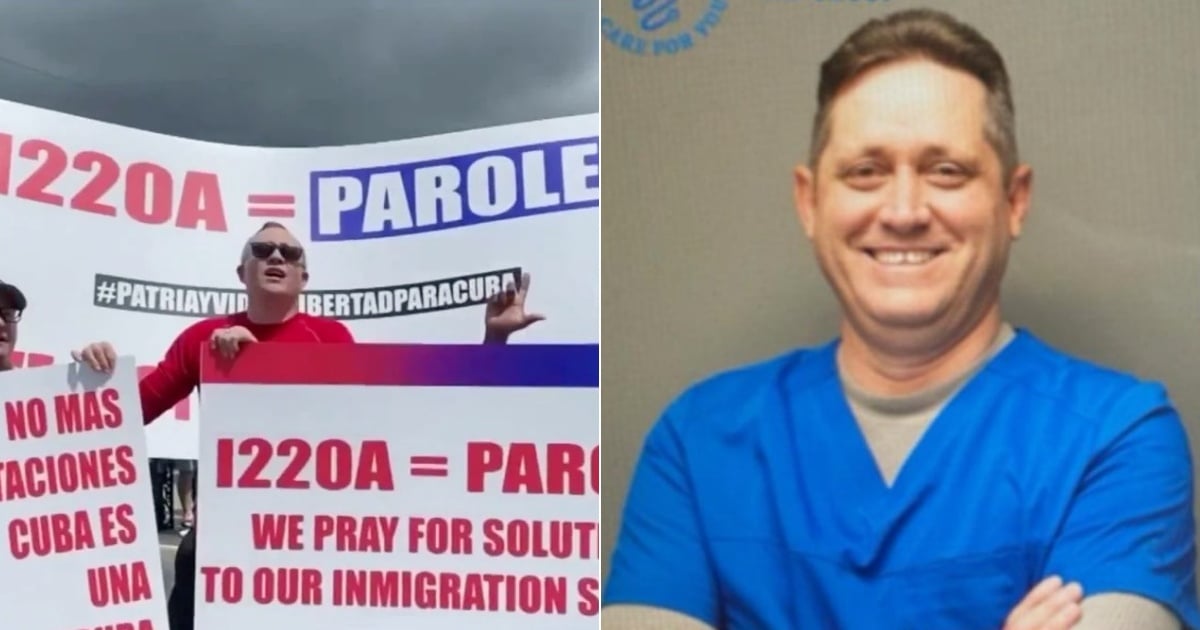
This concerns Dr. Miguel A. Alba, a healthcare professional who was arrested by Immigration and Customs Enforcement (ICE) on November 4 in Houston, Texas, after attending a routine appointment with immigration authorities.
Alba is part of the large group of Cuban migrants who arrived in the country under the I-220A status—a form of supervised release without parole—and despite leading a stable life, having no criminal record, and being employed, she now faces the possibility of deportation.
Miguel A. Alba arrived in the United States in 2022 and since then he had begun to rebuild his life.
He worked at a clinic as a medical assistant and lived with his wife—who was also a doctor—and their three minor children, all legal residents in the country.
In a message directed at the journalist from Univision, Javier Díaz, his wife expressed with deep anguish: "I know we always say that everyone is good, but he is special and an exemplary father; my children are suffering a lot."
Before emigrating, Miguel had participated in a medical mission in Brazil, which he chose to leave voluntarily, a decision that resulted in penalties within the Cuban public health system, where he never practiced again.
A question that challenges: "Why did the United States allow these families to enter?"
Javier Díaz, who has reported numerous similar cases, reacted with indignation:
“Why did the United States allow these families to enter only to deport them after several years of living in the country?” she questioned in her coverage.
And he added:
"The United States condemns the exploitation of Cuban doctors; the Parole program has already been suspended. Nonetheless, in the state of Florida and under the organization Solidaridad sin Fronteras, Governor Ron DeSantis approved law SB7016, allowing doctors to complete a residency period to practice in the state."
Despite these local advancements, the detention of professionals like Alba raises serious contradictions within federal immigration policy.
Another previous case: The drama of Doctor Batista
In June, Cuban doctor José Enrique Batista Méndez was detained by ICE in San Antonio, Texas. Since then, he has remained in custody, and after losing his final political asylum hearing, he is on the verge of being deported to Cuba.
Her mother, from the island, shared a brief yet painful message with the same journalist: “I am a Cuban mother who suffers, Javier.”
José Enrique had also begun to integrate into the U.S. medical system with the support of the organization Solidaridad sin Fronteras.
But the judge who reviewed his case dismissed the evidence and denied his asylum request, almost completely closing off the possibility of him staying in the country, except for an urgent appeal.
The figure of the I-220A: Between hope and risk
Both Alba and Batista were admitted under the I-220A form, an administrative procedure used by ICE to release certain migrants under supervision while their cases progress.
However, this status is not equivalent to parole and has left thousands of Cubans in legal limbo.
Immigration lawyers have warned that many judges do not understand the complexity of the Cuban context.
One of them said to Díaz, “Judges in other states don’t even know where Cuba is on the map, nor are they aware of the political situation.”
The lack of a firm legal status, combined with an increasingly restrictive policy, has made holders of a blank I-220A easy targets for detentions and deportations, despite not having committed any crimes or posing any threat.
The ACLU's Intervention: A Light Amid Uncertainty
In light of this situation, the American Civil Liberties Union (ACLU) has decided to take legal action to support Cubans with I-220A.
Their support was formalized by the submission of an Amicus Brief to the Eleventh Circuit Federal Court of Appeals in Atlanta.
The legal document supports the appeal against the ruling in the case Matter of Cabrera, in which the Board of Immigration Appeals (BIA) determined that the I-220A does not qualify as parole, thereby blocking the pathway to legal residency under the Cuban Adjustment Act.
The intervention by the ACLU came after a public campaign that gathered over 50,000 signatures and has been largely driven by Cuban migrants through social media platforms like TikTok.
Although the hearing is scheduled for December and an immediate decision is not anticipated, the support from an organization as legally and symbolically significant as the ACLU has provided new hope to thousands of families.
Meanwhile, the arrests continue
Cases like that of Miguel A. Alba continue to occur. Each new detention highlights the inconsistencies of a system that first allows the entry of migrants, and then threatens to expel them without clear or fair processes.
The participation of the ACLU not only represents a legal milestone but also reflects the growing consensus on the need to reform the mechanisms that regulate the immigration status of thousands of Cubans.
For many, more than a legal issue, it is a struggle for the right to live freely without the fear of being returned to the repressive system they fled from.
Filed under: