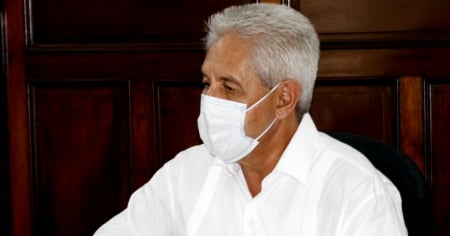
In the midst of the epidemiological collapse facing Cuba, Dr. Francisco Durán García, national director of Epidemiology at the Ministry of Public Health (MINSAP), denied this Tuesday on state television that there are any cases of the West Nile Virus (WNV) on the island.
“No cases have been diagnosed”, said Durán, emphasizing that the laboratories of the Institute of Tropical Medicine “process hundreds of samples” and that “none have tested positive” for that virus.
The epidemiologist tried to downplay the issue by describing West Nile as a disease “with milder symptoms” compared to chikungunya.
However, their explanation failed to convince some in the medical community as well as many Cubans both within and outside the country, who are questioning the lack of transparency and real scientific oversight in the face of a wave of fevers, sudden deaths, and neurological symptoms that do not fit the usual patterns of dengue or chikungunya.
A denial in the context of distrust
Durán's statements came after international media reported on the case of a foreign tourist who allegedly exhibited symptoms compatible with the virus after visiting the island. Instead of confirming or initiating an investigation, the official outright denied any possibility.
However, the scientific evidence contradicts its absolute safety. The West Nile virus —an arbovirus transmitted by mosquitoes of the genus Culex, different from Aedes aegypti but equally common in the Cuban climate— has been detected in several Caribbean countries, including the Dominican Republic, Puerto Rico, Jamaica, and Haiti.
In fact, Cuba has already recorded serological activity of the virus. A study by the Pedro Kourí Institute, published in Emerging Infectious Diseases (CDC, 2006), documented the presence of specific WNV antibodies in humans and horses in the central provinces of the island, evidence of previous exposure to the virus.
Another study from 2015 detected flavivirus antibodies compatible with WNV in Sancti Spíritus, although without confirmed viral isolation.
A virus that managed to enter through the same paths of silence
The West Nile virus is not foreign to the tropics. It originated in Africa, crossed the Atlantic at the end of the 20th century, and has since been advancing through the hemisphere like a discreet shadow.
In 1999, it triggered an unprecedented epidemic in the United States, and in the following years, its presence was documented in almost the entire Caribbean. Cuba, although it does not officially recognize it, is already mentioned in the international scientific literature as a territory where the virus has left serological traces.
In 2006, researchers from the Pedro Kourí Institute detected antibodies against the virus in humans and Cuban horses; a second study in 2015 confirmed prior exposure to the pathogen in provinces in the central part of the country.
Both findings, published by the journal Emerging Infectious Diseases (CDC) and the Journal of Emerging and Diagnostic Virology, suggest that the virus may have entered, circulated, and disappeared without being clinically diagnosed. In epidemiology, this is referred to as "silent circulation."
The current situation does not make a return unlikely. Cuba maintains a steady flow of travelers with Africa, where the virus is endemic.
Cuban doctors working in Angola, Mozambique, or Equatorial Guinea frequently return to the country; at the same time, hundreds of African students live in university residences on the island.
None of these routes have specific vector or health control protocols, despite the risks they pose for a nation that currently lacks epidemiological infrastructure.
The Pan American Health Organization (PAHO) has cautioned that the West Nile virus could become permanently established in the Caribbean due to climate change, bird migration, and the expansion of Culex mosquitoes, which are abundant in humid and urban areas. And if there's one thing in abundance in Cuba, it is mosquitoes, stagnant water, and official negligence.
Denying its possible circulation —as Dr. Durán does— without supporting molecular studies or systematic monitoring does not clear up the doubt; it only magnifies it.
Science cannot be based on blind faith in a state laboratory, but rather on replicable and open evidence. Because if the Nile virus has returned—brought back along the same paths of silence and negligence—the country wouldn't even know. And that, in an ill and misinformed nation, is a more dangerous threat than the virus itself.
Durán's statement—that the virus "has nothing to do with chikungunya" and only causes a "mild fever"—also distorts medical reality.
According to the World Health Organization (WHO), most individuals infected with WNV are asymptomatic, but up to 20% develop West Nile fever with rashes, vomiting, muscle pain, and general malaise, and less than 1% may experience encephalitis, meningitis, or acute flaccid paralysis.
These severe forms are more common in children, the elderly, and immunocompromised individuals, the very groups currently most affected by the ongoing wave of febrile infections in Cuba.
"What they don't investigate, they conceal."
The exiled Cuban doctor Alexander Figueredo Izaguirre, based in the United States, was one of the first to propose the hypothesis that the regime does not want to hear.
In a message posted on social media, he indicated that the pattern of deaths and symptoms reported by Cuban citizens "does not correspond with the arboviruses officially recognized" and that the West Nile Virus could be silently circulating in the country.
"High fevers, sudden deterioration, rapid deaths in the elderly, neurological symptoms, and death certificates disguised as 'natural causes' are not normal," Figueredo warned. "I'm not claiming that everything is the West Nile Virus, but the medical hypothesis exists, it is serious, and it is supported by the epidemiological reality of the Caribbean."
The physician also reported that, instead of investigating, the State "hides, minimizes, and blames the blockade," while continuing to manipulate figures so as not to affect the high tourist season.
A fragmented and under-resourced surveillance
International experts agree that the detection of the West Nile Virus requires entomological surveillance, molecular testing (PCR), and complex serological studies, tools that Cuba currently lacks in its overwhelmed healthcare system.
The WHO warns that the spread of the virus in the Caribbean is directly related to climate change, bird migration, and the lack of vector control. In Cuba, where mosquitoes thrive due to urban unsanitary conditions and deteriorating sanitation, the hypothesis of circulation is not far-fetched: it is epidemiologically probable.
However, the MINSAP insists on denying what it cannot diagnose. Without public data, without updated epidemiological bulletins, and without independent laboratories to verify results, the country risks living with a potentially deadly virus without even knowing it.
Science or propaganda
Doctor Durán's denial is more political than scientific. If the West Nile Virus is circulating—even if only to a limited extent—and the state is hiding it, Cuba would be facing a health threat that is not officially recognized, similar to what happened in the past with hemorrhagic dengue or oropouche.
Medicine, when it is subordinated to propaganda, turns into silence. And that silence, in times of epidemics, can cost lives.
Filed under: