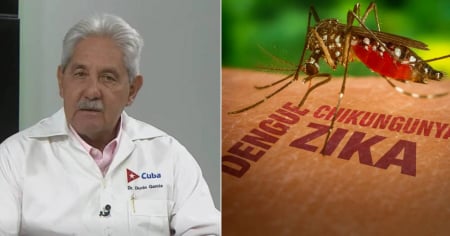
The Ministry of Public Health of Cuba (MINSAP) confirmed this Friday that the country is experiencing a chikungunya epidemic, with a widespread distribution of the virus throughout the national territory.
The announcement was made by Dr. Francisco Durán García, national director of Epidemiology, during his appearance on the television program Buenos Días, where he provided a detailed report on the complex epidemiological situation facing the country.
According to the official data presented, 31,513 people have been diagnosed with suspected chikungunya, a disease transmitted by the mosquito Aedes aegypti, the same vector as dengue.
The virus is currently circulating in 14 provinces, 99 municipalities, and 164 health areas, which, according to Durán, “indicates a sustained epidemic behavior”.
The official also reported that on the last day, there were 753 new suspected cases of chikungunya and 847 positive cases of dengue, highlighting the simultaneous occurrence of both diseases in the country.
“We are in an epidemic of chikungunya”, confirmed the specialist, explaining that this term is used when there is “an increase in the number of cases of a disease in a specific geographical area that is sustained over time.”
In contrast, it was specified that dengue has an endemic behavior, with continuous but stable presence.
Durán noted that 5,713 patients are currently hospitalized due to suspected chikungunya, with 5,607 of them at home and the rest in healthcare institutions.
Furthermore, 95 people are in intensive care units, 77 in serious condition, and 18 in critical condition. Of the seriously ill patients, 63 are under 18 years old, and among the critically ill, 16 are children.
The director of Epidemiology warned that the infestation rate of the Aedes aegypti mosquito remains high, at 0.73, a figure he described as a "high transmission risk."
In this regard, it was emphasized that the provinces with the highest rates are Camagüey, Pinar del Río, Sancti Spíritus, and Villa Clara.
The director of Epidemiology in Cuba acknowledged limitations in fumigation efforts. On the previous day, 142 teams were inactive, 109 due to a lack of personnel and 33 due to equipment breakdowns.
It also indicated that no outdoor adulticide treatments were carried out in Mayabeque, Matanzas, Camagüey, Las Tunas, or in the special municipality of Isla de la Juventud.
Durán emphasized the importance of increasing sanitation measures in homes and workplaces, as well as seeking health services at any sign of alarm, such as prolonged fever, dehydration, or loss of consciousness.
He clarified that chikungunya provides almost lifelong immunity, although it may cause sequelae and the reoccurrence of symptoms after improvement. He also noted that there is still no effective vaccine against this virus.
Durán acknowledged that the situation "remains very complex," but assured that the healthcare system "will continue to work to resolve it as much as possible."
His statements do not reassure the population, as reports about this virus had already been made for months. People believe that the government took too long to focus on the health crisis, especially given the collapse of the healthcare system in Cuba that has been occurring for years.
Filed under: