
Related videos:
The government of the province of Villa Clara announced special fairs featuring the sale of food, beverages, and agricultural products for the end of the year, as well as modules aimed at vulnerable groups.
According to the authorities, they are working to offer "different" celebrations despite the existing economic limitations.
During a meeting with various productive forms, led by the Vice President of the Defense Council, Milaxy Yanet Sánchez Armas, the authorities explained that gastronomic, recreational, and cultural activities are being organized, as well as the sale of beverages and food, reported the digital page of the provincial station CMHW.
The coordinator of provincial government programs, René Bacallao Figueroa, stated that, despite the economic situation, there is a "willingness" to coordinate a different year-end for the population.
Among the announced measures, the differentiated modules for families in vulnerable situations, pregnant women, children, and the elderly stand out.
The director of the Emilio Córdoba Agroindustrial Grain Company, Yanelis Saborido Pérez, explained that currently, two additional pounds of rice are being provided per household, and in the coming days, another two pounds will be distributed.
He also assured that at the December fairs, the sale of the cereal will be guaranteed at a price lower than 155 pesos per pound.
On her part, the director of the Villa Clara Beverage and Soft Drink Company, Milagros Heredia Moffs, stated that each household will receive a bottle of Decano Nacional rum, and that sales of soft drinks and syrup for children are being organized, products that will also be available during the fairs.
Furthermore, the Agriculture delegate in the central territory, Ihosvani Martín Peña, announced that agropecuary fairs classified as "giant" will be held in the 13 municipalities, featuring large volumes of root vegetables and produce for sale.
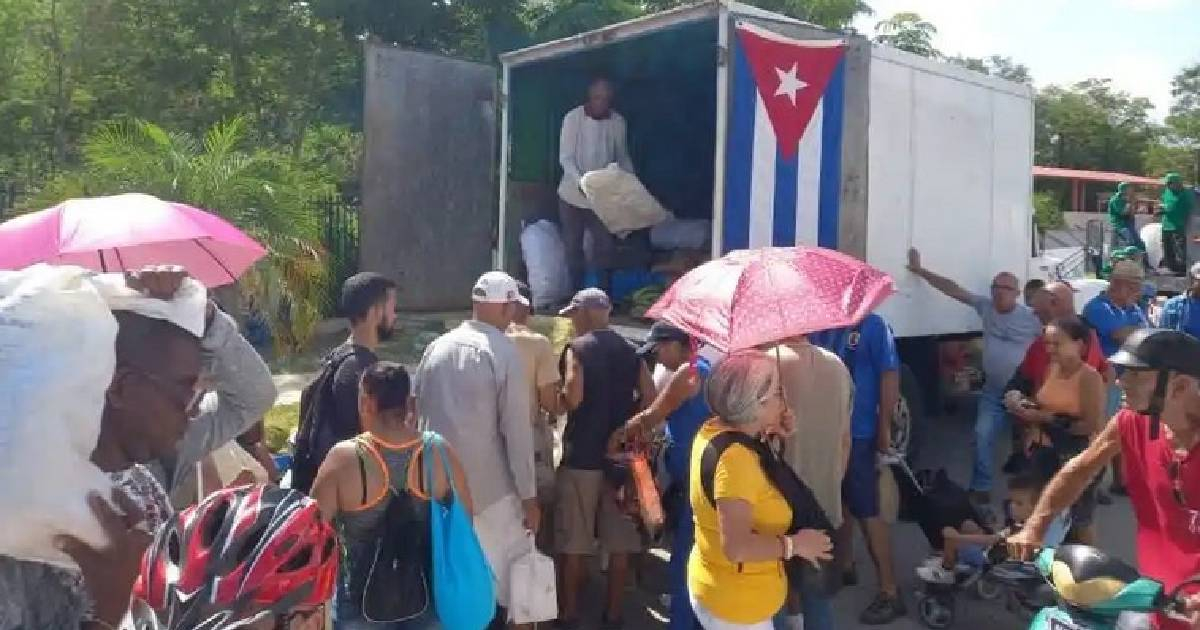
The economic crisis has transformed agricultural fairs into scenes of chaos, with high prices that are prohibitive for most Cuban families.
In many cases, these spaces are used for the sale of bones to the population, taking advantage of the severe food crisis in the country and knowing that many Cubans have no choice but to buy them, despite the high prices at which the government sells them.
Weeks ago, the secretary of the Communist Party in Matanzas, Mario Sabines Lorenzo, acknowledged irregularities in the agricultural fairs of the province, where violations of approved prices, failure to meet production plans, hoarding by resellers, and limited impact of digital sales are common.
Although he acknowledged these problems, he did not provide concrete solutions or timelines for resolving them, which reflects a disconnect between political discourse and the reality of Cubans.
Regarding the government's lack of control over the organization of this commercial activity, the official journalist Yuni Moliner reported in June 2024 that “the deception of the consumer is so evident that at times you don't know if you are at a fair or in the Wild West.”
In the case of Havana, the government implemented Resolution 148/2025, which establishes price caps for agricultural products and has conducted control operations that include fines and seizures of goods.
These operations have resulted in fines, confiscations, and restrictions for self-employed vendors, who often face challenges in complying with official regulations.
This situation has generated public criticism, as many relied on informal sales to make a living amid the scarcity and rising costs of basic goods.
Filed under: