The Archbishop of Santiago de Cuba, Monsignor Dionisio García Ibáñez, linked this Sunday the devastation caused by the cyclone, the lack of resources, and the deaths associated with multiple viruses to a central question: what is the meaning of life in the midst of these needs?
During the Sunday mass held at the Basilica Sanctuary of the Virgin of Charity of Copper, in the town of the same name, Monsignor García stated that the difficulties faced by the eastern region, from the damage caused by Hurricane Melissa to the limitations affecting whole families, lead one to question the meaning of existence.
He recalled that the eastern part of the country, historically less affected by cyclones, has suffered severe phenomena in recent years, the effects of which will last "months, if not years."
He also referred to the proliferation of viruses with “difficult to pronounce” names, whose circulation has caused deaths among individuals with underlying health conditions.
"What virus is it? We don't know. Strange names," he said, emphasizing the uncertainty among those affected.
The archbishop described the needs facing the country as "nonsense" and asserted that, although the best should be sought for living "in peace, in tranquility, in justice," that goal has yet to be achieved.
"We haven't achieved it," he asserted, posing direct questions: "Sir, is this life? Is this why you created us?"
In his homily, he contrasted human fragility and the injustices of the world with the Christian promise of meaning and salvation, insisting that life cannot be reduced to absurdity.
He took up the biblical figure of King David as a symbol of unity and leadership of the people, contrasting that image with the crucified Christ from the Gospel, before whom two attitudes confront each other: the arrogance of the thief who insults and the humility of the one who asks to be remembered in the kingdom.
Monsignor García stated that this duality reflects each person's stance towards their own life, their mistakes, and their sufferings.
He recalled that, according to the day's Gospel, Jesus promises the repentant thief: "Today you will be with me in paradise," a phrase that, he said, gives meaning to Christian life even amidst adversity.
The archbishop urged to hold on to hope, despite the "temporary" difficulties in the world, and to live with the conviction that "the word of God is fulfilled."
He concluded by asking for strength to face the current crisis without losing faith or clarity of judgment regarding what the country is experiencing.
A week ago, Monsignor García urged Cubans to strive for a fairer and more independent society, where personal effort and respect for others are the foundation of social life, a beautiful dream.
During his homily at the Basilica Sanctuary of Our Lady of Charity of El Cobre, the prelate reflected on the current situation in the country and reminded that faith should not be separated from a commitment to everyday reality.
Voices within the Catholic Church, such as that of the Camagüey priest Alberto Reyes, have raised concerns about the moral, economic, and human direction of the nation, characterized by poverty, migration, and distrust in institutions.
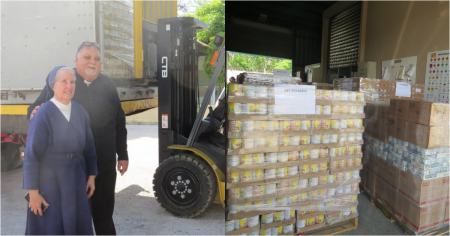
The Diocese of Holguín received this weekend a shipment consisting of approximately 20.3 metric tons of non-perishable food from the Archdiocese of Miami, aimed at supporting those affected by Hurricane Melissa.
The Catholic Church, through Caritas, is channeling aid for the victims of Melissa, distributing food and hygiene items.
Additionally, he is coordinating efforts to restore damages to the temples and provide spiritual and material support to the affected communities.
Filed under: