A Cuban mother, weakened by a virus that keeps her bedridden alongside her minor child, delivered a desperate message that portrays the health crisis the country is facing today.
In a video shared by the Facebook account Azúcar Cuba, the woman called for solidarity with those who fall ill and have no one to help them, amid a crisis where the lack of medicine and medical care leaves a large portion of the population to fend for themselves.
With a subdued voice and lying on a bed, she recounted that she doesn't even have the strength to get up, open a bottle of water, let alone take a shower.
"My whole body hurts. I have terrible diarrhea and vomiting," she explains, exhausted.
Beside him, his youngest son, with a high fever throughout the night, shakes uncontrollably.
Amid the pain, vomiting, and joint inflammation, the mother repeatedly expresses a thought that torments her: she does not want to imagine what it would be like to live with this illness alone, without anyone to hand her a glass of water or a painkiller.
"If you have a neighbor, a friend, or anyone who is going through this illness and is alone, lend them a hand," he urged.
She says she is lucky to have the support of family and a neighbor. But her concern is not for herself; it is for all the Cubans who are currently facing the same virus without medicine, ice to reduce fever, or help to get out of bed.
"That's the only thing that's been on my mind since I woke up. (...) I have help here from my family. Can you imagine being alone, without medication, going through this horrible virus? It's sad," he lamented.
His message encapsulates the healthcare abandonment experienced by millions of Cubans: getting sick means relying on luck, a family member, or a neighbor who might be able to help.
"When I recover, I will help everyone I can," she promised, believing that today the country survives thanks to the improvised solidarity among citizens, not because of the state health system.
"How many lonely people are out there with the virus, who can't even get out of bed to prepare a bite to eat? So please, I reiterate, everyone who can help someone who has it, don't hold back, because God will reward you in the end," he concluded.
A testimony that exposed the epidemic
This same mother had recorded another video days earlier, also from her bed, describing intense symptoms: chills, tremors, swelling in her hands and feet, and a total inability to move.
Although he is not precisely sure what illness he suffers from, he ruled out transmission by mosquitoes and suggested that the virus "is transmitted from person to person." His account coincided with a wave of infections that the State has been unable to hide any longer.
"And what about those who don’t have any pills?" he asked, aware that in Cuba today, even a simple painkiller is a luxury. That moment reflected a truth that thousands of families know: in a country without medicine, getting sick is almost a sentence.
The government admits the epidemic: children in intensive care
The Ministry of Public Health updated the figures and acknowledged that all 14 provinces of the country are experiencing a high incidence of arbovirosis, with 5,940 reported fever cases in 24 hours.
According to Dr. Susana Suárez Tamayo, minors are the most affected: 102 children remain in intensive care, 76 in serious condition and 24 in critical condition.
Dengue, chikungunya, and the oropouche virus are circulating simultaneously across the Island, with an increase in diagnoses and insufficient hospital capacity to manage them.
A specialist consulted anonymously indicated that hospitals are operating without reagents, inadequate resources, and without antipyretic medications to treat severe cases, particularly pediatric ones.
This confirms that the official figures fail to conceal the precarious situation: the epidemic is growing while the healthcare system collapses.
No fumigation, no supplies, no response
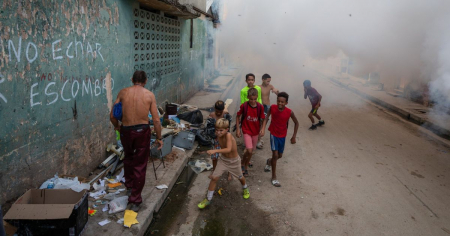
Even the Deputy Minister of Health, Carilda Peña, acknowledged that the government can no longer fumigate like before. There is no fuel, insecticides are scarce, and the machines are destroyed.
There are provinces where there is not even the technical capability for vector control. Authorities admit that without eliminating the mosquito, there will be no epidemiological control, but at the same time, they announce that they cannot do it.
Meanwhile, thousands of sick individuals are searching for medication in informal markets, on social media, or among neighbors who might have some pills stored away. The risk of dying from manageable diseases increases every day in deteriorating hospitals that are overcrowded and lacking resources.
The government insists on blaming the population: "cover your containers," "eliminate breeding sites." But without fumigation, without prepared hospitals, and without medicine, the mosquito advances faster than any Cuban with a bucket of water and a fever they have no way to bring down.
In this scenario, the cry of a sick mother demands not only compassion but also, inadvertently, highlights a country where health has ceased to be a right and has become an individual responsibility: the epidemic is faced by the people, alone and ill, while the State watches from a distance.
Filed under: