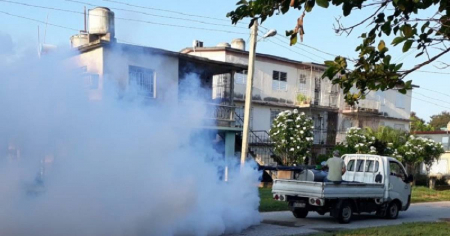
The Cuban regime publicly acknowledged that it cannot conduct large-scale fumigations in the country, as it did years ago, due to the shortage of fuel, insecticides, and the deterioration of the machines used in the vector control campaigns.
The confession took place during an appearance on state television, amid the chikungunya epidemic affecting a large part of the national territory.
Dr. Carilda Peña García, Deputy Minister of Public Health, acknowledged on the program Buenos Días that the government does not have the capacity to reach the entire country with fumigation efforts, as was done in 2017 and 2018, when the zika virus was ravaging the population.
He explained that current limitations in material and energy resources hinder the implementation of large-scale actions against the mosquitoes that transmit dengue, Zika, and chikungunya.
We will not reach the universe as we have done on previous occasions (...). This is related to the country's situation regarding fuel and insecticides,” declared the deputy minister during the television segment.
Peña also acknowledged that the spraying machines have been in use for many years and that their productivity is low, which limits the effectiveness of vector control campaigns.
The worker is not making progress in the field as much as a machine should,” justified the regime official.
During the briefing, Peña reported that Cuba is experiencing active transmission of chikungunya and dengue in almost all provinces, except for Isla de la Juventud and Mayabeque, although he clarified that cases have also been detected in those areas.
According to official data, more than 39,000 cases of unspecified febrile syndromes were recorded in the last week, along with 7,700 new suspected cases of chikungunya, "4,449 more than the previous week," confirming the spread of the disease.
"And 137 people who were confirmed by the PCR test also increased compared to the previous week," he added.
In that context, he acknowledged that current fumigations are being conducted in a limited manner, concentrated in "strata" or blocks with active transmission, due to the inability to cover entire urban areas as in previous campaigns.
The deputy minister stated that provinces such as Havana, Santiago de Cuba, and Granma were the ones that came closest to the established fumigation goals, exceeding 90% of the weekly plan.
However, even in those territories, it was not possible to cover 100% of the planned areas, while for the rest of the country, no figures or concrete results were provided, suggesting that the situation is even more critical in other provinces.
Despite the evident deterioration of the public health system and the lack of basic resources, the regime continues to blame the population for the proliferation of the Aedes aegypti mosquito.
"We urge citizens to eliminate water deposits in their homes," insisted the deputy minister, without offering a structural solution to the health crisis.
The public admission that Cuba is lacking fuel, insecticides, and equipment to combat the vector comes at the most critical time of the year, when the incidence of dengue and chikungunya skyrockets and hospitals report over a hundred severe and critical patients, most of whom are minors.
The country, caught in an epidemiological and material crisis, is facing a situation where the mosquito is advancing and the state has no means to stop it.
Filed under: