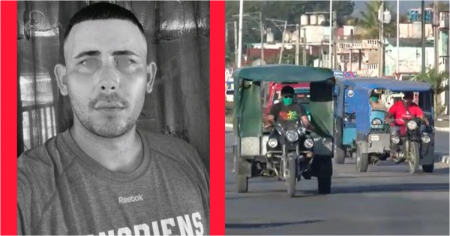
The Ministry of the Interior (MININT) expanded its offensive against informal financial networks this Tuesday by identifying two Cubans residing in the United States and Spain as alleged "financiers" of a scheme dedicated to diverting remittances and operating parallel payment systems outside of state control.
According to reports on the Canal Caribe, authorities claim that both are part of a scheme that moved hundreds of millions of pesos each week and that, according to the official version, poses a direct threat to the country's economic stability.
The accusation is part of case number 862 of 2025, opened in Santa Clara, where the Technical Investigation Directorate claims to have neutralized a network that was employing a mechanism of "illegal financial compensation."
In this scheme, the so-called “financiers” —one based in the United States and the other in Spain— were negotiating with holders of non-state management forms to pay foreign suppliers from abroad, while in Cuba the equivalent in pesos was distributed to the remittance recipients without going through official channels.
According to the television report, these operators relied on an organized structure within the country, led by a manager responsible for collecting the money in local currency generated by small and medium-sized enterprises (mipymes) and distributing it through an informal network that spanned provinces such as Sancti Spíritus (in the Trinidad area) and Las Tunas.
In these territories, two other citizens were involved in the transfer and delivery of cash, integrating into new subnetworks dedicated to distributing remittances.
Investigators stated that these operations generated “millionaire profits”, including commissions ranging from 8% to 12% on the value of each remittance and on the final price of products sold by individuals on the island.
They emphasized that the beneficiaries of these schemes "bypass the laws" of both Cuba and other countries, and that these practices "affect economic development programs" and have a direct impact on the daily economy of citizens.
Although the MININT insisted that this is not a "confrontation against non-state management forms," it warned that the growth of the private sector has facilitated the emergence of structures that operate outside the state bank.
The institution justified the operation by stating that these schemes are “modalities of the economic war imposed by the United States government,” and assured that criminal proceedings have been initiated against 10 people involved, some of whom are in provisional detention.
The offensive is not limited to Villa Clara. A second case, in file 1021 of 2025, pertains to Pinar del Río, where an individual operated a private currency exchange from his own home, using rates from the informal market and assisted by two collaborators: one responsible for delivering money to distant areas and another promoting the services on social media.
A third, larger network was detected in the 10 de Octubre municipality in Havana, with direct links to small and medium-sized enterprises that were demanding large amounts of national currency and foreign currency to sustain their operations.
The authorities assure that more than a hundred similar investigations are underway across the country, at a time when the island is facing a triple crisis: economic, energy, and epidemiological, exacerbated by the aftermath of Hurricane Melissa.
For the MININT, cutting these networks is essential to "preserve order and tranquility," as well as the financial flows that, they claim, should "contribute to the social and common interest."
The official version insists that these structures are responsible for Cuba receiving less than 10% of remittances through state channels.
However, critics argue that its proliferation is due to the collapse of the banking system, endless delays, and a lack of trust in official mechanisms, factors that force thousands of families to turn to alternative options.
As the investigation progresses, the regime continues to broaden the narrative against the "financiers" abroad, whom it portrays as organizers of a network that "loots" the remittances sent by emigrants.
However, for many Cubans who rely on these informal means to survive, the state offensive is nothing more than an attempt to regain control over a market that the State itself lost years ago.
Filed under: