
Related videos:
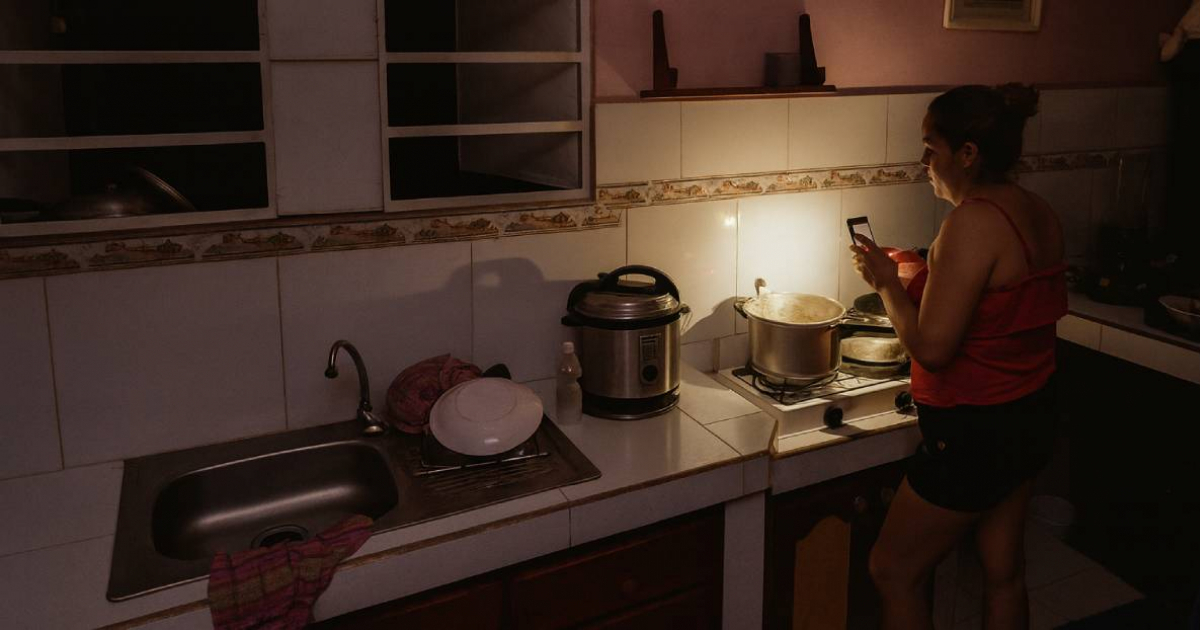
The National Electric System (SEN) began again on November 29 under the same critical conditions that have become the routine for millions of Cubans: deficits, breakdowns, lack of fuel, and prolonged blackouts affecting the entire country at any hour of the day.
The Electric Union (UNE) confirmed that on Friday there were outages for 24 hours, with a maximum of 1,789 MW offline at 6:00 PM, a figure that alone illustrates the extent of accumulated deterioration.
At 6:00 AM this Saturday, the national availability was only 1470 MW, compared to a demand that reached 2377 MW.
This means that the day started with 877 MW already offline, and the state-owned company announced a shortfall of 950 MW by noon.
A system sustained by patches
The official report describes an infrastructure at its breaking point.
Several generating units remain offline, with two due to breakdowns at the Nuevitas and Felton thermoelectric plants, and three blocks at the Mariel, Santa Cruz, and Carlos Manuel de Céspedes thermoelectric plants in Cienfuegos are pending maintenance.
Meanwhile, a significant portion of the thermal generation remains idle, amounting to over 500 MW that the country cannot utilize.
This is compounded by the direct impact of the lack of fuel and lubricants, a shortfall that leaves 97 distributed generation plants non-operational, representing a loss of 884 MW, in addition to another 67 MW that also cannot be integrated for the same reason.
In total, the figure amounts to 951 MW lost solely due to the supply crisis.
Although the UNE emphasizes that unit 5 of the CTE Nuevitas could contribute 55 MW during peak hours, the country will need far more than a one-time contribution to meet a nighttime demand estimated at 3200 MW.
The forecast indicates a deficit of 1,675 MW and an expected impact of 1,745 MW, figures that confirm the country will continue to face blackouts during the most critical hours.
Havana doesn't escape either
The Electric Company of Havana reported that the capital experienced 13 hours and 38 minutes of outages the previous day, with a peak of 234 MW without service in the late afternoon.
Although they claim that the early morning passed without interruptions, the situation is no different from the rest of the country: widespread blackouts, constant instability, and a service that is only restored momentarily before failing again hours later.
The inevitable consequence of a failed management
These figures are neither isolated nor surprising. They reflect what experts, sector workers, and citizens have been denouncing for years: an electrical system weakened by lack of maintenance, technological obsolescence, and the government's inability to guarantee basic fuel and spare parts.
While the UNE publishes daily reports that barely reflect the seriousness of the situation without offering real solutions, the country is experiencing a scenario where nearly half of the national demand cannot be met.
The population is facing endless power outages, damage to food and equipment, cuts in essential services, and a daily life marked by uncertainty.
Even the integration of 33 new solar parks, which on Friday contributed 2,456 MWh with a maximum power of 408 MW, is completely overshadowed by the general collapse of the system.
Renewable energy is unable to offset the deep deterioration of thermal plants or the lack of fuel that keeps them idle.
A country trapped in darkness
The energy landscape of Cuba is not the result of an isolated event or an unforeseen technical issue; it is the direct consequence of years of improvisation, scarcity, lack of investment, and policies that have failed to address the magnitude of the crisis.
The population suffers from it every day, while the government continues to issue reports describing an emergency that seems endless.
Instead of progress, the country is accumulating records of disruption, entire days without service, and an electrical system that stands on a precarious foundation.
Today, like yesterday, Cuba awakens with blackouts and without a clear horizon to envision a real recovery.
Filed under: