
Related videos:
In Cuba, a country where acquiring a lock or a bag of cement can turn into an obstacle course, the promise of a hardware store open 24 hours a day feels like an anachronistic advertisement. But it's not science fiction.
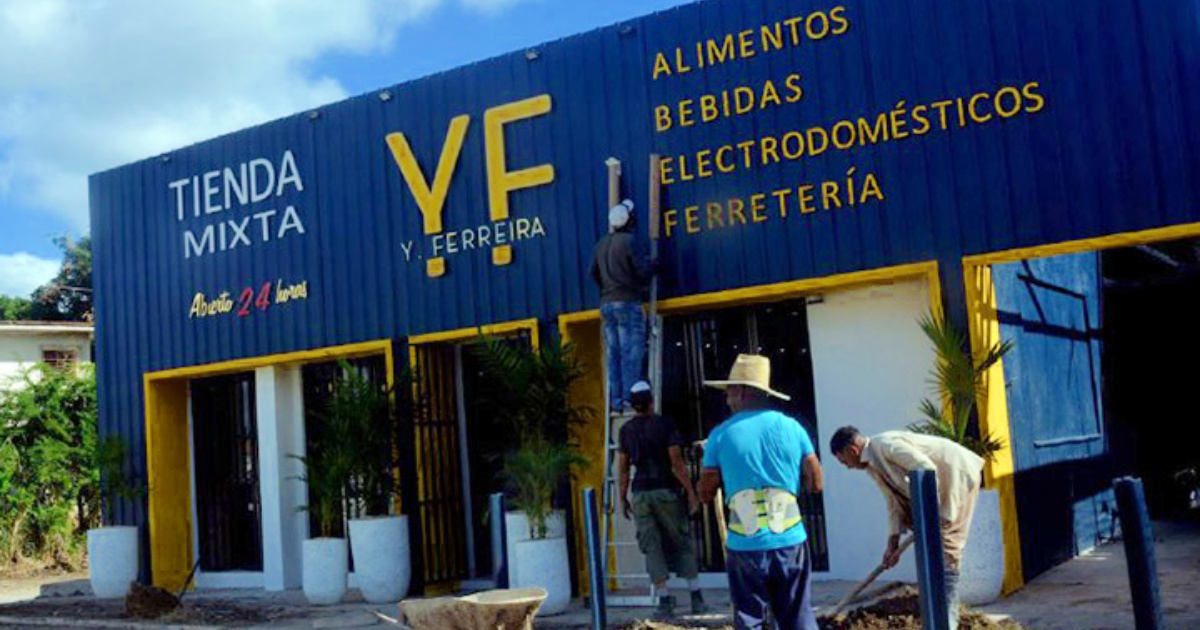
Before the end of 2025, the private company Y. Ferreira, based in Villa Clara, plans to inaugurate its fourth sales location in Santa Clara, this time focusing on the hardware business, in a renovated space across from the Antonio Maceo park, as reported by the Cuban News Agency (ACN).
The striking fact is that it will provide uninterrupted service, 24 hours a day.
Something unimaginable for the state-run trade network, rife with restricted hours, product shortages, outdated payment systems, and a bureaucracy that stifles any attempt at efficiency.
The hardware store will occupy part of a property that previously housed a state laundry, which is now divided into residential units and a local development project.
Without access to water and with the space in almost ruins, the restoration of the premises has been completely funded by the private sector.
In the words of Y. Ferreira's administrator, Norge Lugones Martín, "the goal was to revive the social purpose of times gone by, but the building no longer exists in its entirety."
The conversion responds, it says, to "a real need of the population, since today there are not many places in the city where these types of products can be purchased, or those that exist (like La Candonga, for example) are managed by resellers who even triple the prices."
The statement, though accurate, is still paradoxical. The official discourse has demonized the informal market for years while simultaneously creating the conditions for its existence.
Now, it is the private capital—authorized but monitored—that fulfills part of that demand, always under its own conditions: "competitive" prices, yes, but never within everyone's reach.
Import, sell, and survive: the logic of the market in an unequal economy
Y. Ferreira promises to make a strong entry: support for goods, "differential" pricing, and acceptance of all payment gateways.
“The idea is for the supply to become stable and not just be in the hands of resellers,” Lugones assures.
But who guarantees that the prices will actually be affordable? Who is this hardware store open 24/7 intended for?
Experience in other private sector stores suggests the opposite: products are available, yes, but at prices unattainable for most Cubans, whose average state salary is not enough to buy even a decent brush.
The company, which also specializes in the import of confections, even announces that it will have a small section for food.
And although the discourse seeks to position itself as an alternative to price gouging, the reality is that the private market operates under its own rules, without clear price regulations or effective oversight mechanisms.
The shortage in the state sector has opened the door to private businesses, but under conditions that perpetuate inequality.
Ruins rescued... for whom?
The transformation of the premises, which is 80% complete, has cost around 12 million pesos, according to the company itself.
The work has included floor and ceiling restoration, security, and ambiance, carried out by four local private companies.
At the same time, cleaning and beautification work has begun in nearby areas, as well as the repair of sidewalks and public lighting.
The contrast is striking: while state sectors remain paralyzed due to budget shortages, the private sector is leading the way, reconfiguring entire areas of the city.
But what some interpret as urban revitalization, others see as a covert form of gentrification, where access to services and products ultimately depends on the purchasing power of a minority.
“It is good that the space has been renovated, as it beautifies the surroundings and prevents the building from falling into nearly ruin,” said Damarys Ballate Machado, a resident of the area, to the mentioned outlet.
But other voices express skepticism: "Let the prices be a little more in line with the population," requested Lizie Esther García Díaz, concerned about the economic impact the new establishment will have on working families in the area.
A business that raises questions
The store, which will operate with a staff of about ten workers, presents itself as an alternative to the abuses of the informal market. However, at its core, it embodies the same dilemmas as always, with the most delicate issue being the persistent specter of prices that are inaccessible for the most vulnerable sectors.
While the State continues to fail to guarantee functional hardware stores without endless lines or empty shelves, the population is caught between Candonga resellers and private companies that "improve the environment" but do not necessarily enhance actual access to consumption.
The inauguration is scheduled to take place before the end of the year, although there is no specific date yet. What is clear is that the store will open in a country where, even with money, there are often no places to buy essentials. And when they do exist, not everyone can afford them.
Filed under: