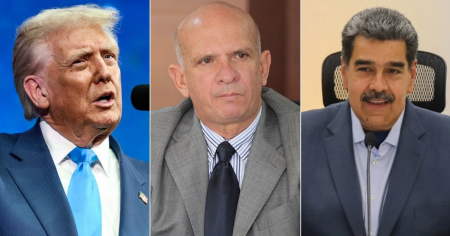
The Cuban government rejected any connection to drug trafficking this Thursday during an unusual press conference aimed at mitigating the political fallout from the explosive revelations made by former intelligence chief of Nicolás Maduro, Hugo "El Pollo" Carvajal, who directly linked Havana to the strategy of the Cartel of the Suns.
In addition, the official statements come at a time of strong regional tension and increasing U.S. military pressure in the Caribbean.
At the press conference held at the International Press Center, senior officials from the Ministry of the Interior (MININT) and the Ministry of Justice asserted that Cuba "is neither a producer nor a transit country for drugs." They emphasized the regime's policy of "zero tolerance" and highlighted that Havana has been actively cooperating with Washington since 2016 to combat drug trafficking.
The agency EFE, which covered the meeting, reported that the Cuban officials even highlighted the real-time information exchange with the U.S. Coast Guard.
But the message was not only aimed at defending the government's international image. It was also a direct attack against the United States. Colonel Juan Carlos Poey, head of the Antidrug Combat Organ of MININT, described the current U.S. military deployment in the Caribbean, focused on Venezuela, as "a serious threat to the security and sovereignty" of Cuba.
The Ghost of Carvajal over Havana
The regime's response comes hours after the letter from Carvajal to Donald Trump was made public from a federal prison in the U.S., where the former Venezuelan general claims that Cuba was the "strategic brain" that suggested Hugo Chávez use cocaine as a geopolitical weapon against the United States.
According to his testimony, revealed by The Dallas Express, Cuban agents allegedly helped to structure the criminal network that eventually led to the Cártel de los Soles and drug trafficking operations coordinated with groups such as FARC, ELN, and Hezbollah.
Carvajal asserts that Cuba not only participated in the conception of the strategy but also provided weapons, documents, and intelligence coverage for criminal organizations to operate from Venezuelan territory.
It also claims that the Island infiltrated spies into U.S. naval bases and that American diplomats were bribed to act as double agents in favor of Caracas and Havana.
The Cuban regime did not mention the letter or Carvajal's name, but the defensive tone of the appearance reveals the weight of the scandal.
So far this year, according to official figures, more than two tons of drugs have been seized, while domestic consumption continues to rise, especially among young people, a phenomenon that authorities continue to address as a matter of "public order."
Filed under: