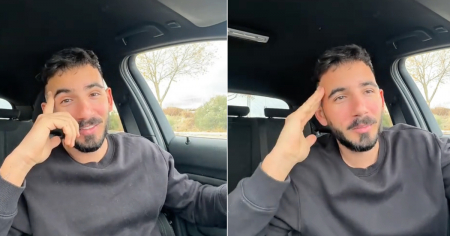
A Cuban resident in Spain firmly responded to an offensive comment she received on TikTok, where a user attacked her with prejudices against Cuban women.
In the video, the young woman, identified on the platform as @leyanetfrankedelp, read the offensive comment that a user had left her on TikTok, in which she attacked her with prejudices against Cuban women: “Were you better off as a jineter? [sic] So don’t complain, there from the age of 10 until death, on the street looking for clients. Jineterar 24 hours.” (The comment contains offensive expressions that are reproduced verbatim to contextualize the protagonist's response).
The Cuban woman responded calmly but with a clear message. She first clarified that the correct term is “jineteras” and criticized the lack of respect and ignorance in the comment. “How terrible it is to speak from ignorance and about a person you don't even know. I came to this country to work honestly and to have a decent future. How sad must your life be to make up insults about someone you don't even know!” she expressed.
The young woman added that she did not have to provide explanations to someone who only seeks to offend. "You write and write without knowing the people involved, without knowing if tomorrow my daughter will see this kind of comment. If your way of expressing your opinion is to offend and judge, that says more about you than it does about me."
She also defended the dignity of Cuban women: “Of the jineteras you claim exist in Cuba, many have more education than you. So think what you want, keep expressing your opinions, because I will continue to grow, advance, and fight for what is mine, while you will stay there, hidden behind a profile and a cowardly comment. Everyone reveals what they have inside, my love. A little kiss from me and all the jineteras of Cuba.”
The video has generated dozens of comments, mostly in support of the young woman and against the discriminatory message.
Among the responses, messages defending the dignity of Cuban women and criticizing prejudices can be read. Some users recalled that "there are millions of Cuban women with more morals, values, and prestige than many of those who criticize them," while others lamented "the need to offend someone you don't even know."
Several people from Spain also expressed solidarity and shame over the original comment, noting that it does not represent everyone. Others urged not to respond to attacks on social media, recommending not to give space to those who seek to offend.
There were also reflections on the use of the term "jineteras" and how many use it without understanding its context in Cuba.
The case adds to a series of similar situations that have affected Cuban migrants on social media, where they face attacks or discriminatory comments due to their origin or for sharing their daily lives outside the island.
In August, another young Cuban in Spain, identified as @legmy_, raised her voice on TikTok after receiving messages such as “if you don’t like it, go back to your country.” In that video, she explained that “when someone says 'if you don’t like it, go,' that person is not defending a custom; they are using your origin to invalidate your opinion”. Her denunciation of the xenophobia faced by Cuban migrants sparked a wide debate on social media.
More recently, in November, the same content creator reported having been a victim of media manipulation and a wave of hate on social networks, after a Spanish outlet allegedly misrepresented her videos. “I create my content with a lot of respect, but my words have been changed and that generates hate,” she explained on that occasion.
Months earlier, the Cuban Karlita, who lives in Galicia, also defended herself against criticism for a video in which she expressed her surprise at an aspect of daily life in Spain. After facing mockery and attacks, she responded firmly: “You came out of the mud up to your chest... remember your roots”. Her reflection on the adaptation process and migrant identity sparked a wide debate among Cubans both inside and outside the country.
Cases like these highlight the constant exposure that Cuban migrants face on social media and the need to foster a more respectful debate about their presence and integration in other societies.
Filed under: