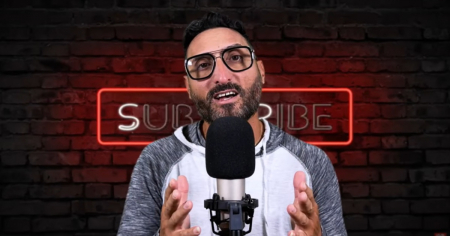
The Cuban YouTuber Frank Camallerys shared a video on his social media where he humorously and nostalgically reflects on some memories from his school days in Cuba, comparing them to his current life in Spain.
I don't know if I'm the only one who was traumatized, but I just passed by a school, a primary school around here where I live, and I thought, of course, these kids will have to give their teacher a little piece of bread just like I used to greet her," begins the content creator, who has amassed hundreds of thousands of followers on social media.
In the video, recorded from his car, Camallerys recalls that, when he was a child, the students at his school in Cuba “would take a piece of bread and place it on the corner of the teacher's desk” along with a little soda or yogurt. “I had an aluminum cup, I will never forget it, that each of us would bring a little soda, it didn’t matter if it was carbonated, guava juice, or yogurt, that woman would drink it,” he recounted.
The YouTuber also mentioned other common experiences in Cuban schools, such as the collection of money among students to buy fans that “disappeared every year,” and the traditional school camping trips. “Will they explore camping, learn the signals, tie knots, climb a rope, have they camped in Ciudad Libertad?” he asked ironically.
The video, published on its social media under the title "Traumas Left by Communism Now That I Live in Spain", quickly surpassed thousands of views and generated a wave of comments among Cubans both on and off the island.
Among the reactions, many users shared similar experiences from their school years in Cuba: “In my primary school, we had to contribute money to buy wall fans for every class,” one recalled. “I don’t remember the bit of bread being voluntary,” another added. Several compared Cuban education to the Spanish system: “Here they go on field trips, but the parents pay for them. There are no slogans or camping and exploration activities. The education here is more advanced than in Cuba.”
On Instagram, where Camallerys shared the same video, the comments followed a similar theme. “It's amazing how as children we have the ability to absorb things and normalize them; it's sad to have experienced those things, but it makes you appreciate many others,” wrote one person. Another added: “The glass thing traumatized me in childhood. How can I forget the Spanish teacher mixing water, soda, coffee, and anything that came her way and then drinking it.” Other users took it humorously: “We lived in a parallel reality,” or “At least I got cake, cookies, and soda for snacks, but I still can't see rice, peas, and egg in the same week.”
The content was interpreted as a way to sarcastically remember the shortcomings of Cuban childhood under the communist system, while also maintaining empathy for the teachers and peers of those years.
The video arrives weeks after Frank Camallerys shared on his social media the progress on the renovation of his new house in Madrid, a project that, as he told his followers, has been “one of the most exciting and expensive” of his life. In that video, published on December 2nd and featured by CiberCuba, the creator highlighted that he will soon be able to permanently move into his new home, which has “excellent natural lighting and a terrace.”
Recurring traumas among emigrated Cubans
The phenomenon of "traumas" or cultural shocks upon leaving Cuba has become a common topic among Cuban creators on social media.
In January 2024, the TikToker Anita Mateu shared a recurring nightmare on TikTok titled "Trauma of the Cuban immigrant": dreaming of returning to Cuba and being unable to leave again. Dozens of users admitted to having similar dreams.
Months later, the creator life_byanita published another viral video titled "I am Cuban and…”, where she shared habits she maintains despite living outside the island, such as saving containers or squeezing kitchen sponges to the maximum. “I always save things just in case someone is going to Cuba,” she said jokingly.
In June 2025, the YouTuber Michel Crónicas starred in another viral video from Mexico where he asked in a supermarket, “How much can I take?” upon discovering that he could shop without limits. His content, which blended surprise, humor, and critique, was widely shared as it captured the emotional impact of abundance after experiencing scarcity.
In November 2024, the TikToker Kelu, a Cuban in Mexico, expressed that she feels “happy to never have to do morning shifts again in my life,” reflecting on the school routines and “voluntary” work in Cuba.
These stories, with different tones and settings, share a common thread: the contrast between daily experiences on the island and life outside it, which many Cubans describe as a process of adaptation marked by memory, nostalgia, and sometimes humor.
Filed under: