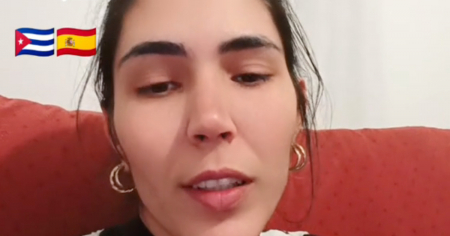
A Cuban living in Spain has sparked a wave of comments on TikTok after posting a video in which she mentions several customs of the country that, she says, “leave Cubans absolutely baffled.” In the recording titled “Things in Spain that leave Cubans amazed,” content creator @irene.morell.gonz humorously and with astonishment reviews Spanish habits that she finds curious, ranging from iced coffee to dinners that start around midnight.
"Things about the Spanish that leave us Cubans completely crazy, totally in shock. If you're a Cuban living here in Spain, stay because you're going to die laughing," she says at the beginning of the video. The young woman remarks that one of the customs that surprised her the most was discovering that, even in summer, Spaniards don't stop drinking coffee but instead add ice. "Here in summer, they don't stop drinking coffee because they put ice in it. For us Cubans, that's pretty crazy, because in Cuba, whether it's summer, winter, or anything, it's always hot coffee," she explains with laughter, adding that she understands that "the temperatures here will never compare to those in Cuba" because "it's just way too hot here."
Another difference she mentions is the sale of eggs by size in supermarkets. "How do I explain to my Cuban brothers that here you choose eggs by size? Yes, sir, by S, M, L, and even XL, while in Cuba there's not even an egg," she notes with astonishment, recalling that on the island "when you buy a carton, it doesn't matter if you get small or large eggs, the price is the same."
He is also struck by the habit of buying bottled water instead of drinking from the tap. "Here, they bring liters of bottled water home to drink when there’s tap water available, and there’s no danger in it. In Cuba, we drank water straight from the tap, which wasn't cleaned in the pipes, and we built up immunity and we're alive," he remarks, clarifying that, although he understands that the tap water in Spain is safe, he finds it "an unnecessary expense."
Amidst laughter, she also questions the habit of buying bags of ice at the supermarket despite having molds to make it at home. “So why do people buy bags of ice at the supermarket? It seems like an unnecessary expense,” she says, adding, “I understand that having ice for an emergency is fine, but taking it home, I don’t know. Someone explain to me what the bags of ice are for.”
Meal times are another cultural shock she mentions. “Another thing I can’t get over is the late dinners. Explain to me why you have to eat dinner so late. I have the company Christmas dinner on December 19th, and now ask me what time it is: at 11 PM. At that time, Cubans are already sleeping,” she says with a laugh. The young woman closes her video by insisting that her observations are not meant to offend: “I hope you enjoyed it. You know I say everything with affection, and these are the things that surprise me, and there are many more, but go ahead and comment on what surprises you the most here in Spain.”
The video gathered hundreds of comments, both from Spaniards explaining local customs and from Cubans who resonated with the experience. Some users provided informative and contextual responses. One person commented that "in Spain there are areas where the water has a lot of lime, which can lead to kidney stones, so it's not at all foolish to buy bottled water." Another explained that "the ice from bags lasts longer without melting, allowing us to keep our drinks cold for a longer time," while others pointed out that "here, bagged ice is sold for bars and hotels, as well as for young people's gatherings."
There were also those who interpreted the schedules through the lens of local customs. “Your company dinner is late because there are other reservations before, which means you arrived late,” someone commented, while another person recalled, “At six in the evening, we have a snack, and at eight, we have dinner like the chickens.” Some chose to respond with empathy, writing, “Darling, these are our customs; over time, you’ll see it as normal,” while others firmly defended the local way of life: “In Spain, we live as we please, and those who come should do the same.”
The debate also allowed room for humor. One user remarked, "Is it hotter in Spain than in Cuba?" accompanied by emojis, while another pointed out with laughter that "in summer, those seven ice cubes last less than an hour." There were also messages of appreciation for the way the Cuban addressed the topic. "I want to thank you for the tone you use to comment on things that catch your attention about Spain. Not all immigrants do this, and it’s refreshing to see that you do so with respect and a smile," someone wrote.
The testimony of @irene.morell.gonz adds to a trend of Cuban migrants who use social media to share their first impressions about Spain. In another instance, a young man stated that “he came prepared for many things, but these five left him speechless,” referring to the respect in the streets, the punctuality of public transportation, and the friendly treatment he receives in his daily life.
Another Cuban creator published a video in which she debunked ideas about life in Spain, asserting that “Spaniards do take baths, Spaniards do not smell bad” and that “it is possible to live on a minimum wage.”
Videos about parties and celebrations in the country have also gone viral, such as that of a young Cuban who claimed to have lost track of "how many holidays and how many parties are held here." These stories, which have gathered millions of views, reflect the cultural shock experienced by many Cuban emigrants upon arriving in a country where the routine, customs, and even meal times function very differently from life on the island.
Filed under: