
Related videos:
In Cuba, the dollar is no longer a symbol of the empire or an ideological enemy, but rather a lifeline. However, not for the people: for the regime.
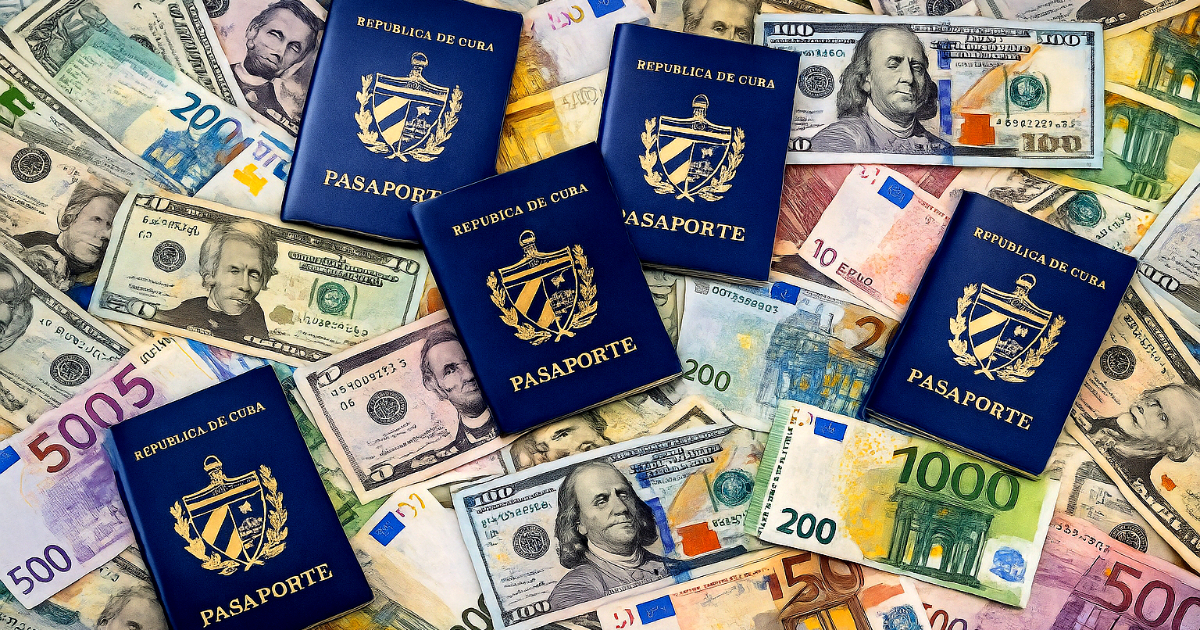
Behind the so-called “partial dollarization” approved in 2025 and the massive exodus of Cubans in recent years lies a morally devastating equation: the State drives its citizens to emigrate in order to then live off the money they send from abroad.
Since the legalization of the dollar in 1993, during the Special Period, the Cuban government learned a lesson that it has refined to cynicism: massive emigration is not a failure of the system, but a tool to sustain it.
Today, three decades later, the Cuban totalitarian regime survives thanks to the dollars from those who left fleeing and the resignation of those who could not leave the Island.
The new version of the same script
Since the arrival in 2018 of the "continuity" government of Miguel Díaz-Canel, the structural crisis began to worsen, and the Cuban peso continued to plunge irreparably.
After the pandemic and the massive protests on July 11, 2021 (11J), the Cuban regime abandoned its whims regarding regulations and reorganizations, reverting to the old script from the 1990s.
First came the deepening of the economic collapse with the sinking of the tourism sector; then the post-pandemic social explosion, followed by the onset of massive migration —this time through Nicaragua— and finally, the state-controlled dollarization.
The “exodus of the volcanoes,” in alliance with the regime of Daniel Ortega, allowed more than 700,000 Cubans to leave the country between 2021 and 2025. Each of them today represents a double victory for the Cuban power: one less critical voice within the island and a potential source of remittances from abroad.
In recent weeks, the government decided to deepen the partial dollarization through Decree-Law 113, which consolidates the use of the dollar and the euro in state operations, but keeps salaries in Cuban pesos. It is a profoundly unequal model: the State collects in foreign currency but pays in a currency without real value.
In this system, stores in Freely Convertible Currency (MLC) act as vacuum cleaners for remittances. Families receive money from Miami or Madrid, deposit it into electronic accounts, and the regime absorbs every dollar without it circulating as cash. Thus, money from the diaspora becomes political oxygen for the apparatus that caused the exile.
An economy of expulsion
Cuba today experiences an “expulsion economy”. The model does not aim to retain its people, but rather to strategically expel them so they can finance, from abroad, the same system that drove them away.
The result is a society divided in two: Those with family members abroad (FE) can access food, medicine, or basic products in MLC. Those who rely on state salaries survive on the margins, trapped in an economy with devalued pesos. Dollars not only divide classes; they also separate destinies.
The state has succeeded in turning remittances into a substitute for wages, and emigration into a functional economic policy. It is a perverse balance: the people leave, but the regime keeps the money.
There is no production, no reform, no productivity. Only control. And a state machinery that feeds on the remittances sent by a diaspora that works in freedom to inadvertently sustain the lack of freedom in their country.
Dollarization without monetary policy: A building without foundations
The monetary collapse is total. The Central Bank of Cuba maintains an official rate of 1 dollar for 120 pesos, while in the informal market the exchange rate exceeds 400. No one believes in the Cuban peso; no one saves in it.
The government has no foreign currency reserves or the capacity to establish a real exchange rate. Therefore, dollarization does not emerge as a technical reform, but rather as a tacit acknowledgment of the failure of the socialist monetary model.
Without a coherent economic policy, the regime is limited to managing scarcity. It collects foreign currency through tourism, remittances, and the export of medical services; restricts its circulation; and pays in pesos that are not even enough to survive.
It is a system that does not generate wealth; it extracts it. It takes from the work of those who emigrated, from the efforts of families who send money, and from the resignation of those who await an economic miracle that never arrives.
The morality of hunger
From an ethical perspective, dollarization and mass emigration are part of the same act of political cynicism: using necessity as a tool for control.
The Cuban government does not repress with tanks, but with prices. It controls the population not with prisons, but with foreign currency cards (MLC).
The citizen relies on the State to buy rice or chicken, but also depends on a relative abroad to have balance in their account. Thus, the regime has turned poverty into a tool of governance.
Economic policy no longer seeks well-being, but rather docility. Public morality has degraded to the point of accepting that hunger and emigration are a natural part of the landscape.
Meanwhile, official media repeat that dollarization is "a necessary measure to regulate the exchange market." But in reality, it does not regulate anything: it merely legitimizes a chaotic statu quo that benefits the extractive elites of the regime.
Cubans live between the dollar that does not circulate and the peso that has no value, between the emigration that empties the streets and the remittances that fill the banks.
A regime sustained by its diaspora
The paradox is striking: the system that has expelled the most citizens in Latin America survives thanks to those same citizens. Every dollar sent from exile sustains the prevailing order of things within the island.
The Cuban regime does not need deep reforms as long as it has a diaspora that funds it involuntarily. There is no monetary policy or productive reform, but there is a constant flow of foreign currency channeled by the state.
The result is an immoral model, economically unviable, and politically cynical: a dictatorship financed by those who fled from it.
The Last Surrender
The partial dollarization of 2025 does not represent an opening, but rather a surrender. The regime acknowledges that it cannot maintain the value of its currency nor offer decent wages.
But instead of reforming its structure, it prefers to dollarize prices while keeping the people paid in pesos. The totalitarian state has renounced the economy, but not power. That is why it survives: because it controls desperation with the same skill with which it manages the dollars from exile.
In essence, the Cuban economy is no longer national or rational, but emotional. It thrives on the connection between those who left and those who remained. And that connection, manipulated by the regime, is now its primary source of survival.
Cuba did not dollarize for the sake of modernity. It dollarized out of surrender. And Cubans did not emigrate for freedom: they emigrated because the State expelled them in order to continue collecting in their name.
Filed under:
Opinion article: Las declaraciones y opiniones expresadas en este artículo son de exclusiva responsabilidad de su autor y no representan necesariamente el punto de vista de CiberCuba.