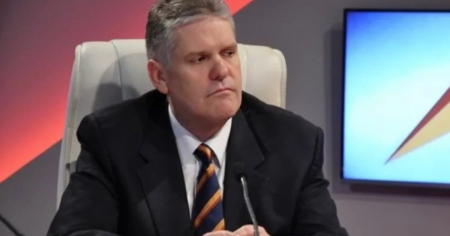
The Minister of Economy and Planning of Cuba, Joaquín Alonso Vázquez defended on state television a new management, control, and allocation scheme for foreign currency, illustrating it with an example.
In the official space of the Mesa Redonda, it was explained that if a foreigner wants to buy a beer in a private restaurant and doesn't have pesos, they can pay in dollars, but that money —as explained— must ultimately be deposited in the bank to be converted into pesos and support the State's budget, with the argument that this way “those riches can also be redirected… to the rest of the population”.
"A foreigner arrives and wants to have a beer but doesn’t have any pesos. The foreigner has two options: either he goes to the market to exchange his dollars for pesos and pays, or we can make it quicker by telling that economic actor to accept the dollar at the exchange rate set by the Central Bank of Cuba and receive that dollar in his cash register," he said.
And he continued: "But that actor is not included in the partial dollarization of the economy; therefore, he does not have an account in foreign currency, so that dollar he takes to the bank and it is credited in pesos at the exchange rate of the segment where that economic actor operates."
The minister acknowledged that, under current conditions, the actor might prefer the rate of the informal market, but stated that this market is “fictitious,” encouraging illegal activity and driving up prices, and that the new regulations aim to “return to normalcy,” “stabilize us,” and adjust the exchange market.
In his speech, Alonso Vázquez stated that the goal of the system is not to "dollarize the economy", but to organize who can operate with foreign currencies, regulate the legitimate ways to access foreign currency, and increase state control over those flows.
The mechanism was approved through Decree-Law 113 of the Council of State and regulated by resolutions from the Ministry itself and the Central Bank of Cuba (BCC).
"Trading in foreign currency" is not for everyone
Alonso Vázquez stated that the regulations define which actors can receive and make payments in foreign currency within the economy, and that those who are not authorized cannot operate in foreign currency.
In those cases, if an actor needs foreign currency to travel, they must go to the market to exchange and buy, he explained.
The minister maintained that the system aims for a "possible and viable revitalization" of the economy —production and services—, but insisted that to access the foreign currency "required by the economy," it is necessary to export, "link together," sell in the Special Development Zone of Mariel, and create a "financial structure" that allows for the mobilization of existing reserves.
It also listed as authorized sources of foreign currency, among others: exports, e-commerce with payments from abroad, credits and financing, pre-financing, donations, financing from international organizations, operations in the ZED Mariel, electronic payments among actors, sales to foreign currency trading companies, centralized allocations, and "others" as defined by the competent authority, serving as an "open window" for future sources.
He indicated that the system “does not discriminate based on the type of property” and includes state entities, small and medium-sized enterprises, cooperatives, and individuals engaged in economic activities (self-employed workers, farmers, artists), as well as foreign or mixed legal entities and local or cooperative projects, all within the established regulatory framework.
Lastly, he insisted that the regulation is presented as a "sovereign" decision aimed at addressing economic issues, regulating access to foreign currency, and "disciplining" the actors, while emphasizing that the essential services for the population "continue to be in Cuban pesos" and that the future goal would be to "completely de-dollarize" the economy.
Filed under: