
Related videos:
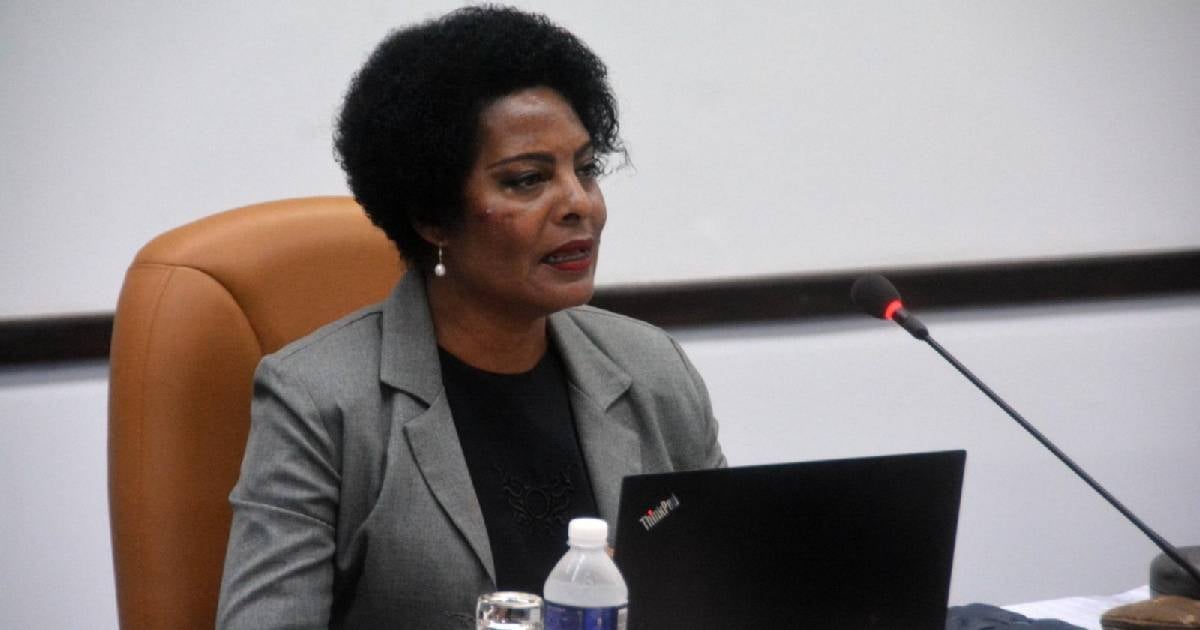
The Cuban regime announced that Juana Lilia Delgado Portal, president of the Banco Central de Cuba (BCC), will make a special appearance tonight at the conclusion of the Star Broadcast of the National News of Cuban Television, in what analysts anticipate will be an attempt to justify the controversial partial dollarization of the economic system that came into effect this Wednesday.
The hearing will be broadcast on the channels Cubavisión, Cubavisión Internacional, and Caribe, as well as on Radio Rebelde and Radio Habana Cuba, reported the official platform .
It occurs just six days after the publication of the Decree-Law 113/2025, through which the government of Miguel Díaz-Canel legalizes, for the first time in more than two decades, the internal use of the dollar and other foreign currencies within the national territory.
The new system, presented as a "foreign currency management and control mechanism", breaks away from the model of the Monetary Ordering of 2021, which had established the Cuban peso (CUP) as the sole valid currency for all internal operations.
The Central Bank and the Ministry of Economy and Planning (MEP) will now have the authority to authorize transactions, payments, and bank accounts in dollars and euros, for both state enterprises and non-state actors: micro, small and medium enterprises, cooperatives, self-employed workers, artists, producers, and individuals with accounts abroad, the regime announced.
Although the government maintains that the measure is "temporary," economists warn that it represents a "structural reconfiguration" of the monetary system, with the creation of a dual scheme and centralized control of currency through the new mechanism "ACAD (Currency Access Capacity Allocation)."
"This decree-law facilitates currency transactions in our country," declared Minister Joaquín Alonso Vázquez.
“We are not building capitalism with partial dollarization, but rather a socialism with the characteristics of our country,” he noted.
The ACAD will allow authorized companies and individuals to purchase foreign currency directly from the State using Cuban pesos, as long as funds are available.
This system replaces the old liquidity accounts (CL) and converts access to the dollar into an administrative decision under ministerial control.
Additionally, private entities will be allowed to retain only up to 80% of their income in foreign currency; the remainder must be mandatorily submitted to the State, which will convert it to pesos at the official exchange rate of 1 USD = 120 CUP.
In practice, the government secures a share of all foreign currency circulating in the economy, reinforcing its control over the flow of hard currency even within the private sector.
The Decree-Law also "authorizes payments in foreign currency within the country," especially in the Special Development Zone of Mariel (ZEDM) and in retail and wholesale operations in MLC (Freely Convertible Currency).
The measure institutionalizes what had previously been a tolerated practice, consolidating a "legalized dual economy."
The appearance tonight generates anticipation among economists and citizens, who are seeking explanations regarding the real impact of the measure on prices, wages, and the value of the Cuban peso.
On social media, Cubans have expressed concern over a "growing social inequality" between those who have access to foreign currency and those who rely exclusively on CUP, which continues to devalue in the informal market.
Filed under: