
Related videos:
This Wednesday, the Central Bank of Cuba (BCC) announced with great fanfare that the country "was starting the transformation of the currency market".
They introduced it as if it were the beginning of a new era: stability, transparency, monetary balance… But when one sits down to read the fine print, the story is different: the regime has created three different exchange rates that fix nothing and, as always, end up benefiting those in power rather than the people.
In other words: they've made a mess with the money, but with pretty words.
What is this exchange rate and why does it matter?
The exchange rate is simply the price of the dollar (or the euro) measured in Cuban pesos.
If they tell you that one dollar is worth 440 pesos, it means you need 440 CUP to buy one. And if the government says it's worth 24... well, I wish that were true.
The problem is that in Cuba there are multiple prices for the same dollar, and that breaks any economic logic. While you go out to the street or to Telegram to exchange at 440, the State enjoys the privilege of buying dollars at 24 pesos and claims that everything is “under control.”
The new invention: Three cups, three worlds
With the announcement from the Central Bank, Cuba now has three official exchange rates:
- The rate of 1x24, which is maintained for government operations: electricity, oil, basic goods, transportation… everything that the State considers “strategic”. It is the dollar used by ministries, state-owned enterprises, and, above all, by GAESA, the military group that controls tourism, the MLC stores, airports, and even banks.
- The rate of 1x120, for state or mixed enterprises that generate foreign currency, such as exporters or those in tourism. It is supposedly aimed at "stimulating competitiveness." In practice, it is a way to give them a little more breathing room without loosening control.
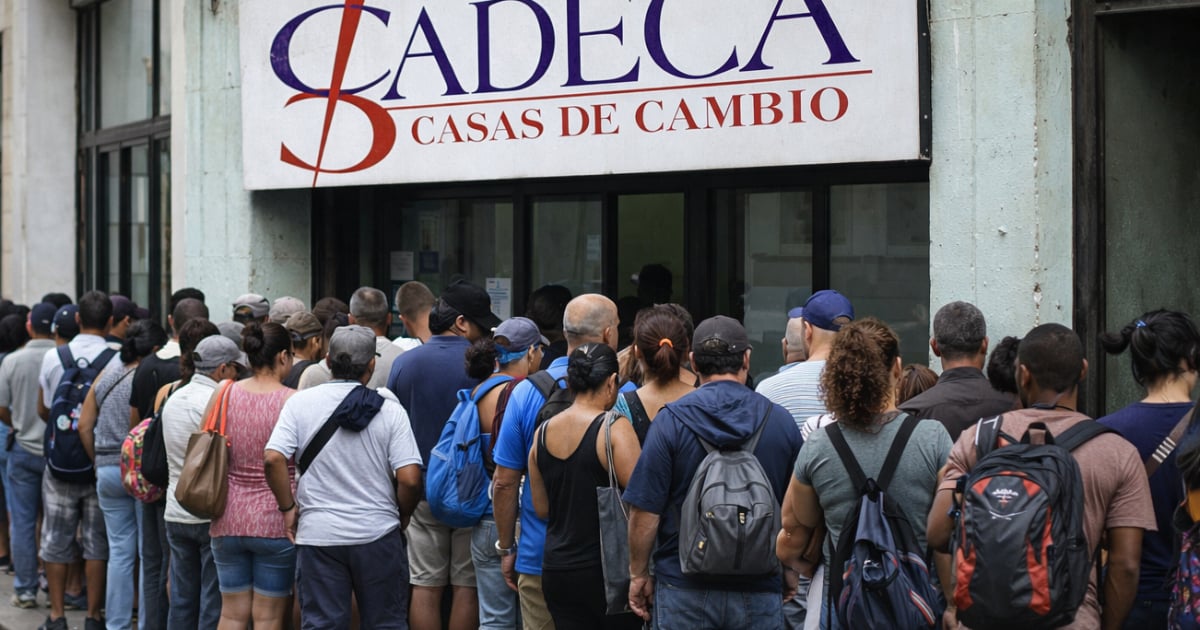
- The new "floating" rate, which will be updated daily, according to the Central Bank, "based on supply and demand." This will apply to individuals, the private sector, and any Cuban who wishes to buy or sell currency at CADECA or at the bank.
It sounds like a free market, but it’s a different story.
The trick: A "floating" market that doesn't float
The Central Bank wants to make you believe that this new exchange rate will move freely, like in other countries, depending on how many dollars come in or out of the market. But the problem is that in Cuba there is no free market, because everything passes through the hands of the State. The government decides:
- How many dollars does it sell for?
- To whom does he/she sell them?
- At what price?
- And when will they be put into circulation?
That's not a floating rate; that is a fixed rate. Or as any Cuban would say: a rope that they loosen or tighten according to their convenience.
The economist Mauricio de Miranda Parrondo explained it bluntly: “The Minister of the Central Bank intends to tell the market at what rate it should operate. That's not how the economy works.”
And he is right. In a real market —like in Mexico, Colombia, or the Dominican Republic— banks buy and sell currencies freely, and the Central Bank only publishes an average rate at the end of the day.
In Cuba, it is the opposite: first the Central Bank states the figure, and then forces the market to adapt.
GAESA wins, the people lose
Behind all this intrigue, there is a clear winner: GAESA, the military consortium that handles the big money in the country.
With the rate of 1x24, companies in the group can buy dollars at a bargain price, import cheap products, and then sell them in MLC as if the dollar were worth 440 pesos. It's a win-win business.
De Miranda himself called them out by name: “They want to give special conditions to certain segments (GAESA among them) to operate at a rate of 1x24, which is unsustainable for the country.”
Think of it this way: You work in a private business and need dollars to import flour, parts, or oil. You go to the bank and they tell you that the dollar costs whatever the government decides that day, or that there is no availability.
Meanwhile, GAESA buys them for 24 pesos and sells the same products for hard currency. This is not an economic policy: it is a system of privileges.
Three rates, three realities
Let's put it in concrete examples:
- The State: buys dollars at 24 pesos. With 24 CUP, you can get one dollar. In reality, the dollar is worth 440. It's like going to the market with 10 pesos and being sold a hundredweight of rice. Pure fantasy.
- Intermediate state-owned enterprises: they are changing to 120. They are breathing a little easier, but they still depend on permits, ministries, and paperwork.
- The common citizen: if they are lucky, they might be able to exchange about 100 dollars at the "floating" rate. But that value is determined by the Central Bank, and there are almost never foreign currencies available. In short: people will continue buying and selling dollars on the street, where they hold much more value.
Three rates, three worlds, and one single outcome: inequality.
The economic lie
The regime claims that these measures will prevent sharp devaluations and protect the people.
The reality is that the population does not have access to any of those advantages. The entire system is designed to sustain the state and military apparatus, not to stabilize the currency.
De Miranda summarized it better than anyone: “It is an unacceptable self-deception to believe that just because the government decides the dollar is worth 24 pesos, the market will accept it.”
And that has been the essence of Cuba's economic policy for decades: the State invents a number and expects reality to adapt.
What will happen now?
Nothing we don't already know:
- The Cuban peso will continue to lose value.
- The informal market will continue to set the pace.
- Prices will continue to rise.
- And the government will continue to talk about "monetary restructuring" while the country sinks into chaos.
The new currency scheme is not a solution; it is a patch with an olive green uniform. Not a step towards stability, but another tightening to control every dollar that enters the country.
In summary
The "currency transformation" changes nothing. It only divides the country further
- Between those who have access to dollars and those who do not.
- Between those who govern and those who survive.
- Between official rhetoric and the reality in people's pockets.
Three rates, three lies, one single truth: in Cuba, money is still worth less than obedience.
Filed under: