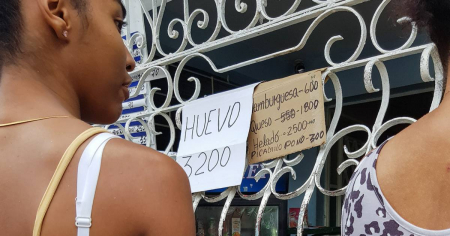
The latest speech by Miguel Díaz-Canel during the XI Plenary of the Central Committee of the Communist Party of Cuba once again showcased the disconnection of the government from the reality experienced by the majority of Cubans.
In an attempt to disguise the economic and social deterioration, the ruler replaced the word "poverty" with the euphemism "material deprivation," once again blaming the "blockade" and the "enemy's hatred" for the misery the country is experiencing.
"Yes, there is a tremendous material shortage in Cuba," said Díaz-Canel, attributing the crisis to a supposed "genocidal policy" of the United States and to the media "created by the enemy" that, according to him, "celebrate that poverty."
At the same time, he affirmed that on the island “there is another reality” of “a creative and hardworking people who do not give up.”
The speech, steeped in heroic rhetoric, avoided any mention of the internal causes of the crisis as well as the regime's responsibility for the productive collapse, the decline in wages, and the loss of purchasing power.
Monreal: "Poverty has been depoliticized in Cuba."
In a recent analysis published in his Substack newsletter, the Cuban economist Pedro Monreal strongly criticized the official narrative.
According to Monreal, the government's stance of denying the existence of poverty in Cuba and replacing it with "material deprivation" is "reductionist and lacking in reasoned self-criticism."
"Material deprivation is a dimension of poverty, but it does not replace the concept itself. By focusing on deprivation rather than exclusion, the official discourse depoliticizes social issues," argued Monreal.
The specialist reminded that poverty is not limited to consumption or the scarcity of goods, but is "the result of social relations that produce exclusion." Therefore, treating it as an external phenomenon, a product of the "enemy," amounts to erasing the political responsibility of the State in its creation and perpetuation.
The "ordering" and the expansion of poverty
Monreal stated that the policy of economic "ordering," implemented in 2021, "massified poverty in Cuba."
The reform, which aimed to unify the currency and improve revenue, ended up causing a significant contraction in real wages and an increase in the cost of living.
According to official data, the average state salary in 2025—6,744 pesos per month—is completely disconnected from the actual cost of the basic basket of goods and services, estimated by experts to be in the "tens of thousands of pesos."
This is further compounded by the fact that, while income from labor is declining, business sectors—particularly those controlled by the military conglomerate GAESA—are increasing their share of GDP.
The primary income distribution adopted an anti-labor and pro-business scheme, Monreal explained.
Less social spending, more administration and security
One of the most alarming elements pointed out by the economist is the drastic reduction in social spending.
Between 2008 and 2024, spending on education decreased by 62%, in health and social assistance by 50%, and in social security by 45%. In contrast, spending on "public administration and national security" increased by 17%.
This change reveals a clear priority of the regime: to sustain the bureaucratic and military machinery at the expense of the basic needs of the population.
"The state's wage policy and the reduction of fiscal space for social spending have caused and continue to perpetuate poverty in Cuba," Monreal warned.
Impoverishment as a tool of control
The analysis also suggested that widespread impoverishment has served the government as a covert means of macroeconomic stabilization.
By keeping income and consumption low, inflationary pressure is reduced, albeit at the expense of the population's well-being. "It may not have been intentional, but it has been twistedly effective," remarked the economist.
Denying poverty, denying politics
For Monreal, the denial of the concept of poverty has a political background: “Every social exclusion is inevitably associated with political exclusion.”
Therefore, addressing poverty in Cuba cannot be done without acknowledging the need for a structural transformation of the political and economic system.
Instead of blaming the external "enemy," the economist suggested looking inward: "Is there today in Cuba a political system obstructing a better income distribution? What type of inclusive political action is necessary?"
Meanwhile, the official rhetoric insists on seeing "enemies" where there is hunger, and on speaking of "shortages" where there is structural poverty.
The result is a country where heroic speeches replace effective policies and where, increasingly, the dignity of the people is conflated with their resignation.
Filed under: