
Related videos:
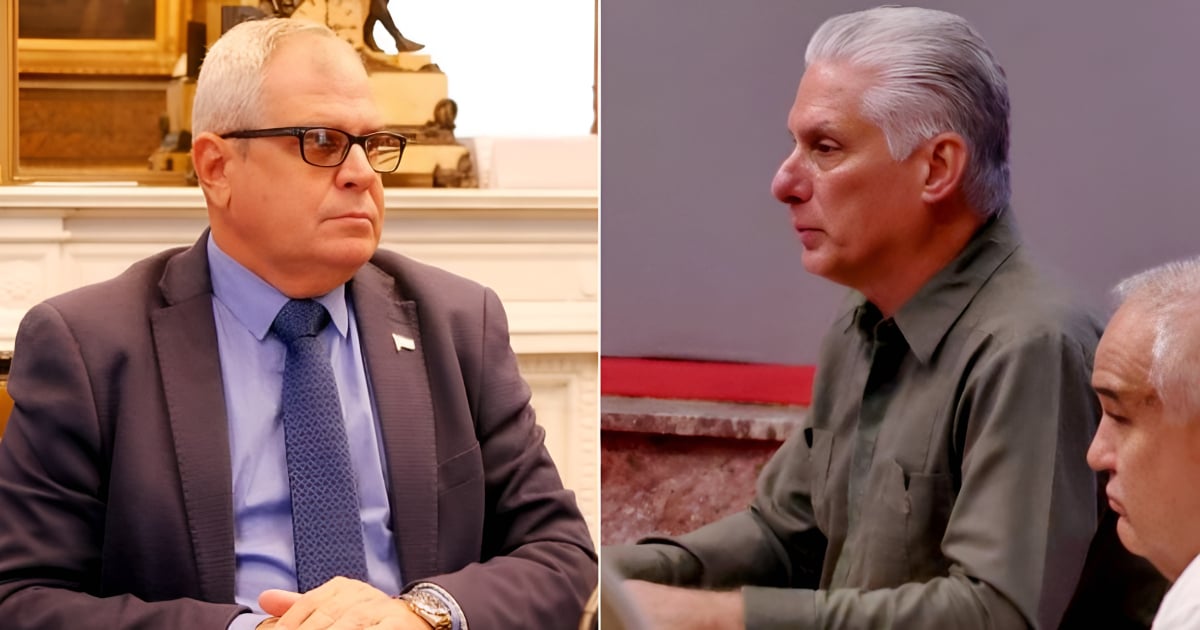
The hermetic world of Cuban power has revealed an unusual crack this week: Miguel Díaz-Canel did not accept the resignation of Homero Acosta Álvarez, one of the most influential —and at the same time most discreet— figures of the regime.
The striking announcement, made during the State Council session alongside other accepted resignations, went almost unnoticed in the official media. Cubadebate simply reported that “the resignations of Ulises Guilarte de Nacimiento and Ricardo Rodríguez González were accepted” and glossed over Acosta Álvarez's resignation request.
The omission of Homero Acosta's name from the list of released officials has sparked a variety of interpretations among observers and analysts: are we witnessing a mere administrative maneuver, an internal struggle, or the moral decline of one of the legal architects of Castroism?
According to the information provided by the president of the National Assembly of People's Power (ANPP), Esteban Lazo Hernández, Acosta Álvarez submitted his resignation from his seat as a deputy, but not from his positions within the State. However, his resignation of the seat appears to have been explicitly rejected for the time being.
In this way, the Secretary of the Council of State and of the ANPP remains in both roles, as well as in his position as a deputy, following the decision of the leader to not accept his legislative resignation.
A low-profile official with high power
Homero Acosta, 61 years old, is one of the most veteran and trusted figures within the Castro regime, but he is also one of the least visible.
A trained lawyer, university professor, and former officer in the Armed Forces, he has held strategic positions for over two decades at the intersection of the Communist Party, the Army, and Parliament.
For years, he served as the legal advisor to the Ministry of the FAR and later to the Office of the Second Secretary of the Communist Party, when that position was held by none other than Raúl Castro.
Since then, Acosta Álvarez has established himself as a sort of notary of power, the one responsible for translating the most significant political decisions of the leadership into legal language.
His rise culminated in his appointment, in 2009, as Secretary of the Council of State, and later, in 2019, as Secretary of the National Assembly of People's Power, roles that made him the main coordinator of the Cuban parliamentary apparatus.
In fact, no law or constitutional reform has overlooked its technical review or approval.
For this reason, his resignation —and especially the fact that it has not been accepted by Díaz-Canel— has raised alarms.
The man behind the Constitution of 2019
If there is a name associated with the legal framework that supports the regime, it is Homero Acosta.
He was one of the main drafters of the 2019 Constitution, a charter that, under the guise of institutional modernization, cemented the absolute power of the Communist Party, preserved the irrevocable socialist nature of the State, and legally protected political repression.
During the constitutional process, Acosta Álvarez emerged as the technical and rational face of the project. In interviews with state television and at international forums, he calmly defended the "superiority of Cuban socialism" and the "necessity of a strong constitutional order."
However, in recent years, its role has increasingly been linked to the management of the structural crisis of the system: the de facto dollarization, the simulation of debates in the ANPP regarding laws and government programs, the loss of legitimacy of the legislative power, and the growing inequality between those who have access to foreign currency and those who live with Cuban pesos.
The resignation not accepted
The fact that Díaz-Canel accepted the resignations of Guilarte de Nacimiento and Rodríguez González, but not that of Acosta Álvarez, has been interpreted by some as an attempt to preserve the technical stability of the regime.
The importance of Acosta within the system is undeniable. His figure acts as the legal and administrative glue of the Cuban State, and his thorough knowledge of the legislative machinery makes him a true gray eminence within the regime.
In practice, without its technical control and parliamentary coordination network, the institutional framework of Castroism would lose cohesion, which explains why its departure is unacceptable to those in power.
Wear and dilemmas
For months, rumors have been circulating about tensions within the Communist Party, divided between a “pragmatic” faction that advocates for the partial dollarization of the economy —essential for sustaining the regime's revenue— and an old guard of orthodox members who oppose the inequalities that this policy has exacerbated.
Homero Acosta, educated in the idealism of the eighties and connected to the old legal structure of classical socialism, may be facing that moral dilemma: witnessing how the system he swore to defend is transforming into a dual economy where the military and leaders live in dollars, while the people survive on pesos.
The political and legal project that Acosta Álvarez helped to codify shows signs of exhaustion. His figure is not that of a charismatic ideologue, but rather a power technician, an institutional operator who has upheld the legal framework of the system for years.
But even an official of that profile can reach a breaking point, especially when the socialist rhetoric they defended has turned into a facade that conceals corruption, inequality, and privilege.
Other observers maintain that Díaz-Canel cannot afford Acosta Álvarez's resignation at this moment.
The regime is going through a transition of key personnel, with the departure or reassignment of historical figures within the political apparatus. Losing Homero Acosta —with his understanding of the constitutional framework and his connections in the Party and the FAR— would be a serious blow to bureaucratic stability.
Therefore, the subtle gesture of "non-acceptance" could be interpreted as a maneuver of restraint, a way to buy time while negotiating their permanence or an "orderly" exit that does not leave power vacuums.
A man in a crisis system
Homero Acosta has always embodied the profile of a disciplined and loyal bureaucrat, without grandiloquent speeches or frequent appearances in the press.
But his influence is undeniable: he was the one who articulated the legal transition between Raúl Castro and Díaz-Canel, who oversaw the design of the new Council of State, and who maintains technical control over parliamentary decisions.
If your resignation is due to personal exhaustion, it would be a sign that even the most solid pillars of Castroism are beginning to show internal fractures.
If, on the other hand, this is a controlled political maneuver, it could signal the beginning of a reconfiguration of power where Díaz-Canel —or, more accurately, Raúl Castro and his military environment— seek to replace the old operators with more compliant figures.
The crack beneath the surface
Whatever the reason, Homero Acosta's "non-resignation" highlights the vulnerability of the regime within its own institutional framework.
What until a few years ago seemed like a monolithic apparatus now shows signs of wear, internal tensions, and moral contradictions.
The jurist who drafted the Constitution that legitimized power may be facing the same dilemma that today's communist elite encounters: to continue upholding a structure that is collapsing or to attempt, even silently, to distance themselves from it.
In Cuba, where silences weigh more than words, a man like Homero Acosta wanting to leave —and the government not allowing him— speaks volumes beyond what official statements will ever convey.
Filed under: