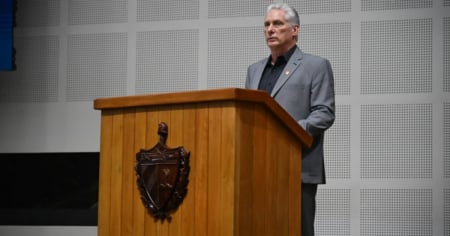
The National Assembly of People's Power of Cuba approved a constitutional reform that removes the age limit of 60 years to access the presidency, without subjecting the change to popular consultation; the authorities assert that the procedure was "completely legal" and "supported" by the current Constitution.
During the last session of the fifth ordinary period of the National Assembly, regime officials decided to remove the paragraph from Article 127 that established the requirement of not exceeding 60 years of age to be elected president for a first term.
This limit had been introduced in the 2019 Constitution at the urging of General Raúl Castro, as an institutional safeguard inspired by his personal experience.
The Secretary of the Parliament, Homero Acosta, and the President of the Constitutional and Legal Affairs Commission, José Luis Toledo Santander, defended the reform, arguing that the Constitution provides means for modification without the need for a referendum, as long as it does not affect the president's powers, the length of his term, or the "immutable" clauses such as the irrevocability of socialism.
"Article 103 establishes that the National Assembly is the only body with constituent power," Acosta stated, emphasizing that the process "fulfilled" all the requirements: it was promoted by the Council of State, approved by the necessary quorum, and through a nominal vote, an "exceptional modality."
Toledo argued that the country's context has "changed" since 2018, and that the aging population requires "flexibility": “The previous regulation became an obstacle for individuals over 60 years old, who possess experience, commitment, and full physical and mental capabilities, to take on that responsibility.”
With the reform, any Cuban citizen over the age of 35 can now run for the position, with no upper age limit. However, the requirements regarding experience, loyalty to the revolution, and competence remain in place, according to officials.
Although no criticisms were raised during the parliamentary debate broadcasted by state media, the absence of a public consultation —like the one that accompanied the approval of the Constitution in 2019— represents a significant difference in terms of citizen participation.
The law that was approved was submitted directly by the State Council, without any plebiscitary mechanisms or prior public discussion forums.
"Today, the principles established by the Constitution have been fulfilled. It does not require any further procedures because what was reformed is a requirement, not a power of the president," Acosta emphasized to justify the decision.
Background and Political Context
The reform takes place at a time when the ruler Miguel Díaz-Canel, who has already turned 60, is completing his first term.
Although the authorities insist that the changes were not designed with a specific name in mind nor for a specific situation, the legal modification paves the way for their eventual re-election.
According to the second "whereas" of the approved legal text, the adjustment responds to "the need to guarantee the institutional integrity of the nation and secure the future of the Revolution."
Raúl Castro, who in 2019 pushed for the 60-year limit to access the presidency for the first time, is the one who has now proposed its removal.
The very Castro, at 94 years old, requested the change to the Political Bureau of the Communist Party, as revealed by the president of the ANPP, Esteban Lazo, according to the official portal Cubadebate.
Frequently Asked Questions about the Constitutional Reform in Cuba without Popular Consultation
What does the recent constitutional reform in Cuba consist of?
The constitutional reform in Cuba removes the 60-year age limit for assuming the presidency in a first term, allowing any Cuban citizen over 35 years old to run without age restrictions. This change was made without public consultation.
Why wasn’t a public consultation held for this reform in Cuba?
According to Cuban officials, the Constitution allows for reforms without a referendum as long as they do not affect the president's powers, the term of office, or the "immutable" clauses such as the irrevocability of socialism, thus justifying the lack of public consultation.
What justification was given for eliminating the age limit for the presidency in Cuba?
It is argued that the aging population in Cuba requires relaxing the requirements to access the presidency, allowing individuals over 60 years old with experience and commitment to assume the role.
Who initiated the change in the age limit for the presidency in Cuba?
Raúl Castro was the one who proposed eliminating the age limit for the presidency in Cuba, and the National Assembly of People's Power approved the reform without any visible debate or dissent.
Filed under: