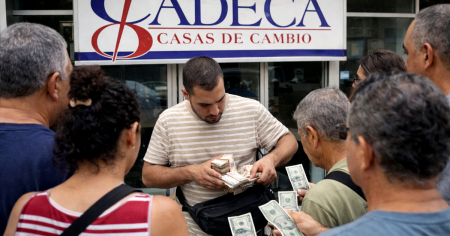
The informal foreign exchange market in Cuba begins this December 20 with a new development: the price of the freely convertible currency (MLC) drops.
Early this Saturday, the digital currency used by the Cuban regime dropped from 315 to 310 CUP, which indicates a decrease of five units compared to its value from the previous day.
Such a collapse takes place following a increase registered the day before for the MLC, driven by expectations generated after the implementation of the official "floating" exchange rate, which promised stability for the Convertible Currency and attempted to erase predictions of its potential disappearance.
In the case of the dollar and the euro, there are no changes today: the US currency remains valued at 440 CUP and the European currency at 480 CUP, according to the daily report from the independent media elTOQUE, which documents the fluctuations in foreign exchange rates in Cuba.
Exchange Rate Evolution
For the third consecutive day, the dollar and the euro remain steady in the Cuban informal market.
At the moment, the so-called "floating rate" set by the Cuban government has not managed to influence the parallel market for the two most important currencies operating on the island.
According to the independent outlet elTOQUE, the dollar and the euro have maintained similar values for several days, reflecting stability despite the government announcement.
Exchange rate today 12/20/2025 - 7:08 a.m. in Cuba:
Exchange rate of the dollar USD to CUP according to elTOQUE: 440 CUP.
Exchange rate of the euro EUR to CUP according to elTOQUE: 480 CUP.
Exchange rate of MLC to CUP according to elTOQUE: 310 CUP.
Equivalence of United States Dollar (USD) to Cuban Peso (CUP), according to the exchange rates on this December 20:
1 USD = 440 CUP.
5 USD = 2,200 CUP.
10 USD = 4,400 CUP.
20 USD = 8,800 CUP.
50 USD = 22,000 CUP.
100 USD = 44,000 CUP.
Equivalence of Euro banknotes (EUR) to Cuban Peso (CUP):
1 EUR = 480 CUP.
5 EUR = 2,400 CUP.
10 EUR = 4,800 CUP.
20 EUR = 9,600 CUP.
50 EUR = 24,000 CUP.
100 EUR = 48,000 CUP.
200 EUR = 96,000 CUP.
500 EUR = 240,000 CUP.
Floating rate in effect
Since last Thursday, Cuba has introduced a new exchange rate system. The Central Bank has activated a floating rate for citizens and private individuals as part of a gradual reform aimed at reducing informality and reorganizing the flow of foreign currencies.
The new system is structured into three segments:
Segment I (1x24 CUP): essential state operations.
Segment II (1x120 CUP): companies with external income.
Segment III (floating rate): for individuals and small and medium-sized enterprises, published daily by the BCC.
The stated goal: to advance towards a future unification without provoking a monetary collapse.
As of the closing of this note, the value of the foreign currencies at the official floating rate for this Saturday has not yet been disclosed.
Until yesterday, they remained with little variation: The official dollar was at 410 CUP: the euro at 480.77 CUP, and the MLC was around 300 CUP.
What changes for citizens and businesses?
People will be able to sell foreign currency at the new official rate and purchase up to 100 USD through digital appointments. The supply remains limited: only what is obtained through legal means (remittances, exports, etc.) will be sold.
Self-employed workers and micro, small, and medium enterprises (mipymes) will be able to acquire foreign currency from fiscal accounts, up to 50% of their quarterly gross income, without needing to resort to the informal market.
Reform or resignation?
The introduction of the floating rate effectively represents a validation of the informal market, which for years determined the true value of the Cuban peso.
The redesign may organize certain flows, but it does not replace the lack of trust in the state financial system. Without transparency, liquidity, and structural reforms, this measure risks being yet another patch in a model that has lost credibility.
On official platforms such as Cubadebate, hundreds of internet users reacted with irony to the new rates, labeling them a “state re-edit” of the black market.
“So much criticism of elTOQUE only to end up the same way”, wrote a commentator.
The regime's Macroeconomic Stabilization Program aims to move towards a future currency unification, but it faces skepticism due to a lack of transparency and a cash shortage.
With an average salary equivalent to 16 dollars a month at the official rate, Cubans continue to rely on the informal market to access foreign currency and basic products.
The implementation of the floating rate seems less an attempt at control and more an implicit validation of the informal market, which has reflected the true value of the Cuban peso for years.
Without structural reforms or liquidity guarantees, the measure could become another band-aid within an exhausted economic model that is disconnected from the country's everyday reality.
Filed under: