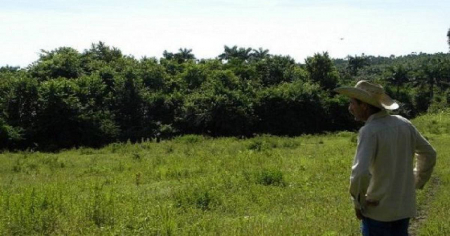
In an unusual acknowledgment on official television, the program Cuadrando la Caja stated that Cuba "is not in a position to provide a nationwide solution" to the agricultural crisis due to a lack of economic resources, and advocated for partial local solutions.
"Today the country is not in a position to provide a national solution because there is no economy to do so." This was stated by Dr. Roberto Caballero, a member of the National Executive Committee of the Cuban Association of Agricultural and Forestry Technicians, during the most recent broadcast of the official program focused on food production in Cuba, in which no farmers participated.
"But what I do believe is that improvement must come from the bottom up, that we need to start mobilizing resources, local potential, and capabilities, and beginning with the municipalities and provinces, we should start to uplift them by granting greater real autonomy to the territories," the official added.
The statement set the tone for a debate focused more on managing scarcity than on a structural recovery of the sector.
Similarly, the other panelist, engineer José Carlos Cordobés, general director of Industrial Policy at the Ministry of Food Industry, agreed that food production does not meet national demand and that the industry relies on an agriculture weakened by a lack of supplies, energy, and financing.
The program emphasized that, given the impossibility of a "national solution," alternatives must arise "from the ground up," prioritizing municipal autonomy, the utilization of local capacities, and productive linkages among farmers, industries, and new economic actors.
Caballero emphasized that territorial autonomy remains "relative" and limited by centralized decisions, which reduces the actual capacity of local governments to produce food.
The debate also addressed the promotion of models such as micro, small, and medium enterprises (mipymes) and mini-industries, as well as the need to strengthen cooperatives and sustainable production systems.
However, it was acknowledged that the existing legal framework is extensive, but the central issue remains the "how" to implement it in a context of chronic scarcity.
Although specific experiences in some provinces were mentioned as positive examples, the program itself admitted that these solutions are not generalizable and depend on local initiatives, specific incentives, and exceptional arrangements within the system.
The space closed without providing a clear path for transformation, yet it documented a diagnosis that acknowledges severe economic limitations and shifts the responsibility for overcoming the crisis to the regions, in a scenario where national planning once again appears incapable of sustaining its own objectives.
Caballero also sparked controversy by criticizing the high consumption of rice in Cuba and suggested that one of the main obstacles to achieving so-called food sovereignty is the eating habits of the population.
"We are not Asians. Eating rice is not a Cuban habit. It's part of our traditions, but that changes, and now it’s easier than ever to introduce that change because, with the shortages we have, anything you put in front of people in the little square works," he said with a smile.
Amidst the weariness, the delegitimization, and the rejection of the model
The audience's comments were largely critical and went beyond the technical framework of the program to fundamentally question the political and economic model.
Many users interpreted the admission that "there is no economy" as a confession of structural failure after more than six decades of state management.
Reports of the lack of freedoms, excessive centralization, the absence of genuine private ownership of land, and the role of Acopio as a hindrance to production were reiterated.
Other comments ridiculed the panelists, questioned their technical legitimacy, and accused the forum of being propaganda intended to justify the unjustifiable.
Several interventions contrasted the current situation with Cuba before 1959, pointing to communism as an imported and failed system, while some voices openly raised the need for a political change as the only viable solution to the agricultural and national crisis.
A few days ago, the Cuban economist Pedro Monreal expressed regret that the Government deliberately misinforms the public about the seriousness of the agricultural crisis through systematic delays in the publication of statistics and the replacement of verifiable data with propaganda.
In a post on his Facebook account, Monreal insisted that the current agricultural crisis is “deeper and more prolonged” than that of the Special Period, but that the State is concealing it by combining a simplified narrative with a reinforced statistical blackout.
Filed under: