The Cuban regime boasted about the alleged stability of the National Electric System (SEN), stating that by the time the new year arrived, "everyone had electricity."
The statement was made by the official journalist Esther Lilian González in a report from the Ministry of Energy and Mines of Cuba, where she asserted that December 31st "was a good day for the Electric Union (UNE)" because the system "closed its loads at 8:30 PM. This means that at 12:00 AM, when January 1st arrived, everyone in Cuba had power."
However, that supposed happiness was short-lived. Just a few hours later, the country faced long blackouts once again.
Sustained collapse of the system
The technical report of the Electric Union confirms that the situation of the SEN remains critical. At 6:00 a.m. this Thursday, the availability was just 1,500 MW against a demand of 1,360 MW, without any outages at that moment, although with a forecast of new interruptions of up to 150 MW throughout the day.
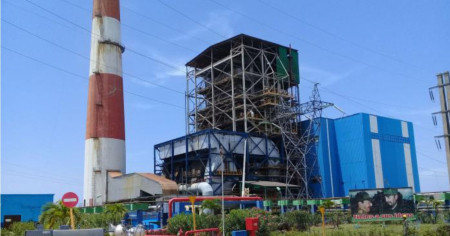
The document details that the 5th unit of the Mariel CTE, 2nd unit of the Felton CTE, and 3rd unit of the Céspedes CTE remain out of service; while other units, such as the 2nd unit of the Santa Cruz CTE and the 4th unit of the Carlos Manuel de Céspedes CTE (Cienfuegos), are undergoing scheduled maintenance. In total, 687 MW are out of service due to technical limitations in thermal generation.
These problems are compounded by the limitations due to fuel shortages. There are 66 distributed generation plants that are not operating, representing a loss of 700 MW. Additionally, 35 MW from the Patana de Melones, 40 MW from the Patana de Regla, and 142 MW due to a lack of lubricant contribute to a total deficit of 917 MW from fuel shortages.
The forecasts for the peak hours on January 1 are not promising. Despite the potential entry of unit 3 of CTE Céspedes with 120 MW, a total availability of 1,620 MW is estimated against a maximum demand of 2,950 MW. If current conditions persist, an impact of up to 1,360 MW is anticipated during the nighttime hours.
While the regime tries to sell optimism with triumphant phrases, the country's energy reality remains entrenched in a structural crisis, characterized by technological deterioration, poor state management, and a lack of sustained investment. For millions of Cubans, the new year began once again amid blackouts, heat, and uncertainty.
Filed under: