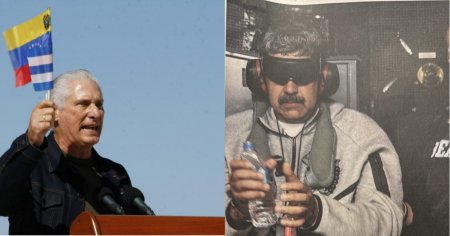
Burned cars, collapsed structures, shrapnel scattered across runways and buildings with visible impacts. The images and videos circulating on social media reveal the extent of the damage in military and airport areas of Venezuela, amidst a day that concluded with the capture of the dictator Nicolás Maduro by the United States.
The information has been pieced together from various sources. According to Europa Press, the Venezuelan government reported attacks in Caracas and the states of Miranda, Aragua, and La Guaira during the early morning, while residents of the capital reported explosions, aircraft flying overhead, and an atmosphere of alarm.
In local networks and media, there were reports of gunfire in areas such as El Valle, Los Próceres, La Pastora, 23 de Enero, and regions near La Carlota, a key military enclave in the city.
One of the first regional leaders to give specific names was Colombian President Gustavo Petro, who stated that Caracas had started being bombed with missiles and called for the UN and OAS to meet "immediately."
The list that was disclosed includes particularly sensitive locations: Fuerte Tiuna, the Federal Legislative Palace, the Cuartel de la Montaña, Hatillo Airport, an N3 F16 base in Barquisimeto, a private airport in Charallave, and the helicopter military base in Higuerote, as well as reports from the central area of Caracas.
Petro also spoke about areas without supply in sectors of southern Bogotá and places like Santa Mónica, Los Teques, and 23 de Enero.
In parallel, the agency EFE reported fire and damage to the fencing of the Generalissimo Francisco de Miranda Air Base (La Carlota), as well as destruction on the adjacent highway and the presence of uniformed personnel and vehicles surrounding the area, a scene consistent with images showing debris and impacts on nearby infrastructure.
The videos attributed in some cases to recordings in Higuerote (Miranda) display destroyed military equipment, burned vehicles, and what is described as a damaged Buk-M2E air defense system, in addition to signs of damage to airport infrastructure.
Other shots show aircraft reduced to scrap and buildings with severe damage, reinforcing the idea that the impacts would have hit strategic facilities.
In the United States, the official account was presented in terms of a meticulously planned mission. At a conference in Mar-a-Lago alongside Trump, the Chairman of the Joint Chiefs of Staff, General Dan Caine, stated that the operation, dubbed "Absolute Resolution," was the result of "months of planning and rehearsal" and received real-time aerial and ground intelligence support.
In this context, the level of scrutiny over Maduro was mentioned, describing it as a meticulous monitoring of routines and movements.
Caine assured that an aircraft was hit during the mission but remained operational, and he spoke of "self-defense" clashes during the withdrawal.
Trump, for his part, stated that he followed the operation "in real time," describing it as extremely complex, involving dozens of planes, helicopters, and jets. He maintained that Maduro was captured swiftly, with no fatalities among the participating forces, although there were some injuries.
Filed under: