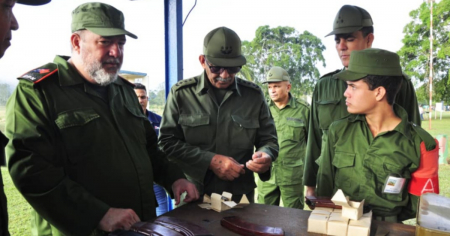
The Prime Minister Manuel Marrero assured this Friday that Cuba is in a "war economy" and that the individual and collective efforts will determine what the country can sustain and develop by 2026.
During an extraordinary session of the Provincial Council of Havana, Marrero advocated for the implementation of the Government Program to correct distortions and revive the economy, describing it as the "compass" for territorial management in a context he characterized as of utmost economic complexity.
According to the head of government, the results must translate into concrete solutions visible in the daily lives of the population, revealed a report from official television.
Marrero emphasized that, under conditions of a "war economy," the country cannot rely on external factors and must accept that the effort of each individual, each collective, and each institution will determine what can be produced, distributed, and sustained.
He insisted that this reasoning is the only way to ensure minimum stability and aspire to development.
The prime minister emphasized the need to strengthen the ongoing connection with the population, government structures, and mechanisms of participation and popular oversight.
In that regard, he spoke of a "government on the street," guiding and explaining decisions, with the stated goal of instilling confidence and encouragement amid the crisis.
In the meeting, the governor of Havana, Janette Hernández Pérez, outlined as priorities the utilization of the territory's potential and internal reserves, the increase of physical production, the recovery of installed capacities, and the diversification of exports.
Marrero supported this approach and reiterated the municipality's role in seeking its own solutions, particularly in food production and revenue generation in foreign currency.
The head of government defended the application of science as a mandatory, not optional, axis for addressing the economic crisis, and called for the widespread adoption of best practices, reducing bureaucracy, and correcting internal shortcomings.
He reaffirmed that the "economic battle" remains the fundamental task of the country and that the declared final objective is to achieve the well-being of the population through endogenous resources and the call for "collective intelligence."
Here is only what will be added at the end of the note, following your guideline and without repeating the main structure:
For several years, Marrero has referred to the economic crisis as a "war economy," a concept he uses to justify the intensification of austerity measures, control, and centralized planning amid the worsening of the island's structural crisis.
In previous speeches before the National Assembly and during meetings of the Central Committee of the Party, he has reiterated that planning and collective effort are essential to tackle the "adverse conditions" which he primarily attributes to the U.S. embargo and the lack of foreign currency, while also admitting that progress has been insufficient to reverse deep-seated distortions in production and financing.
The capture of Nicolás Maduro on January 3 during a U.S. military operation and the subsequent tensions have jeopardized one of the energy pillars of Cuba: the oil shipments from Venezuela, which have traditionally provided a significant portion of the fuel that keeps the struggling electrical grid and production running.
With Venezuelan crude oil exports now under U.S. control and the possibility of shipments to the island being suspended, Cuba faces the prospect of an energy collapse that will exacerbate blackouts, further limit production, and deepen the overall economic downturn.
Filed under: