
Related videos:
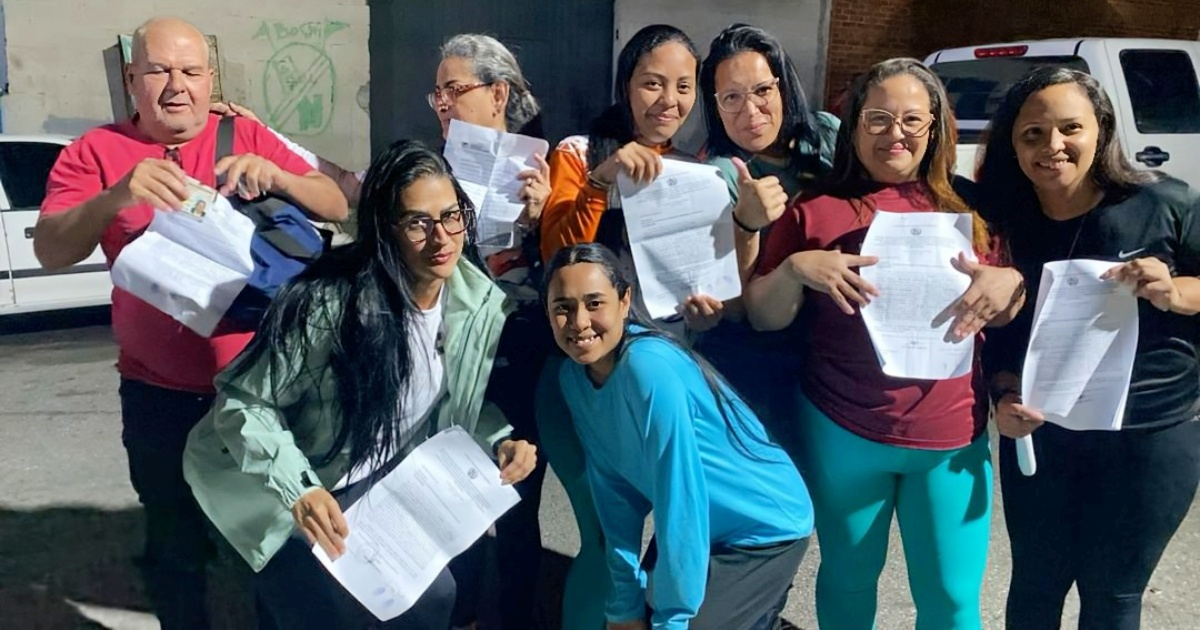
The Government of Venezuela announced this Monday the release of 116 political prisoners, according to an official statement from the Ministry of Popular Power for Penitentiary Services.
However, this is a figure that, as of now, has not been fully confirmed by human rights organizations, which describe a process that is slow, fragmented, and characterized by opacity.
According to the official document, “in recent hours, 116 new releases have been finalized, adding to the 187 granted during the month of December 2025.”
The text argues that the measures "have benefited individuals deprived of their liberty for actions associated with disrupting the constitutional order and threatening the stability of the Nation," a euphemistic formulation in the pronouncements of the Venezuelan Executive to refer to political prisoners.
However, NGOs specialized in monitoring repression in Venezuela significantly lower the figures.
The Penal Forum, one of the main organizations documenting arbitrary detentions in the country, has confirmed the release of 24 detainees during the early hours of this Monday.
The figure brings the total number of released individuals to 41 since the government announced a "gesture" of mass release last week.
In its statement, the Ministry of Popular Power for Penitentiary Services asserts that the releases are part of a "comprehensive review of cases" initiated "voluntarily" by Nicolás Maduro and continued under the direction of Delcy Rodríguez Gómez, as the acting president.
"The Venezuelan state thus reaffirms its institutional strength and commitment to delivering justice in the exercise of its sovereignty," the text states, dated in Caracas this Monday.
Meanwhile, NGOs insist that the only valid verification is the effective release of the detainees, without conditions or enforced silence, and warn that the situation of political prisoners in Venezuela remains critical.
Partial releases and ongoing verifications
The confirmed releases took place in the El Rodeo I and La Crisálida (Las Crisálidas) penitentiary centers, both located in Caracas.
Among those released are two Italian citizens - the aid worker Alberto Trentini and the businessman Mario Burlò - as well as the Hispanic-Venezuelan citizen Alejandro González, ex-husband of the lawyer and human rights defender Rocío San Miguel.
Foro Penal stated that it is still verifying other possible cases.
"We are checking other releases of Venezuelans and foreigners that may have also taken place this morning," the organization reported on its X account, where it published the list of the 24 individuals whose release it was able to confirm.
The case of Alejandro González and Rocío San Miguel
The release of Alejandro González has attracted special attention. González, a retired member of the Venezuelan Army, was detained on February 9, 2024, the same day as Rocío San Miguel.
At that time, he was working as a manager for the oil company Chevron in Venezuela, where he was responsible for coordinating flights for employees and executives.
The authorities accused him of disclosing political and military secrets concerning national security, obstructing justice, and conspiracy to commit a crime, charges that human rights organizations described as unfounded.
Rocío San Miguel, a prominent analyst of the Venezuelan military establishment and a critic of the government, was released on January 10, along with four Spanish citizens, after spending two years in detention at the headquarters of the Bolivarian National Intelligence Service (SEBIN), El Helicoide. She was accused of being part of an alleged conspiracy against then-president Nicolás Maduro.
Italian citizens return to their country
The two released Italian citizens, Alberto Trentini and Mario Burlò, are already on their way back to Italy on a plane from the Italian State, according to the Ministry of Foreign Affairs of that country. They are expected to arrive between Monday night and Tuesday morning.
Upon arriving at the Italian embassy, both stated to local media: "They have treated us well, they have not tortured us," according to reports from Rome.
It was there that they learned about the political events surrounding their release from prison.
Political context and official announcement
The announcement from the Venezuelan government comes after the capture and extraction of Nicolás Maduro during a military incursion by the United States, an event that triggered a significant political crisis.
In that context, the Executive announced the release of a “significant number” of political prisoners as a gesture towards peace and “national unity.”
The president of the National Assembly, Jorge Rodríguez, stated that the measure aimed to "contribute to the effort" of national reconciliation.
However, the releases have occurred gradually and under strong restrictions, according to reports from family members and human rights defenders.
A drip of figures and conditional freedoms
Four days after the initial announcement, the Ministry of Penitentiary Services released a statement increasing the number of releases to 116, but humanitarian organizations warn that many of these releases have not yet taken place.
Moreover, those who have already been released from prison face restrictive conditions, such as prohibitions on speaking publicly about their cases, regular appearances before the courts, or mobility limitations.
The lack of transparency is not new. At Christmas and New Year's, the government announced similar measures for 187 detainees, figures that were also not fully realized. For NGOs, the inconsistency in the numbers and the absence of verifiable information have become a constant every time the Chavismo resorts to releases during moments of high political tension.
More than 800 political prisoners and growing concern
According to Foro Penal, as of last week there were at least 800 political prisoners in Venezuela, although other organizations raise the figure to over a thousand. They report that arbitrary detentions have not stopped, even amidst announcements of releases.
This Sunday, dozens of family members slept outside several prisons across the country to demand the release of all political prisoners. The anguish has intensified following the death of Edison Torres, which occurred in the cells of the Bolivarian National Police, in the so-called Zone 7 of Boleíta.
The Public Prosecutor's Office reported that the death occurred due to a "sudden health deterioration," an explanation that has raised concern among family members and activists worried about the conditions of detention and the medical care of those incarcerated.
Filed under: