
Related videos:
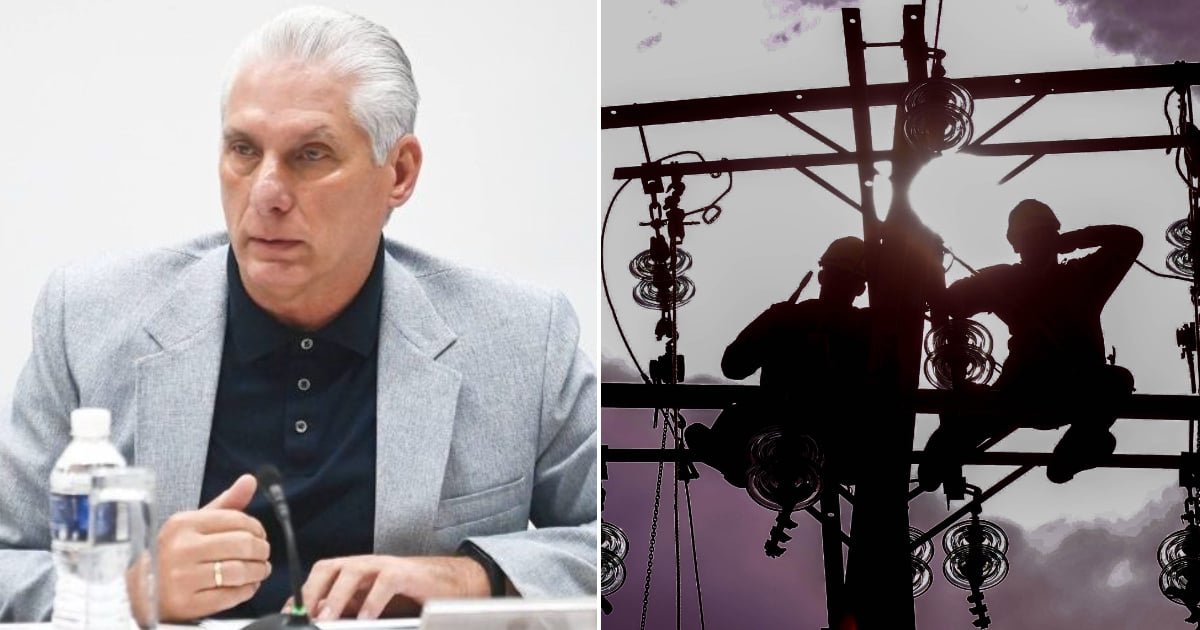
Miguel Díaz-Canel congratulated Cuba's electrical workers this Wednesday, but his message on social media prompted a wave of criticism and ridicule amid the prolonged blackouts affecting the country.
In his post, the leader wrote: “On Electric Workers' Day, may the embrace and congratulations of our entire people reach them. Their dedication and commitment are essential for keeping the light of the Homeland shining.” The post garnered over seven thousand reactions and more than a thousand comments, many of which were laced with irony due to the contrast between the presidential speech and the energy reality faced by the island.
"It's the safest job in the world, those lines are always under no tension," commented a user, referring to the collapse of the electrical system. Others sarcastically asked, "And when will we have electricity?" or stated that it was "electricians without electricity, what a parody." Overall, the tone was one of skepticism and mockery towards the official message. "What do they do if there's no electricity most of the time?" wrote another user, while several added phrases like "there's no electricity, nothing to celebrate" or "hugs, you hypocrite, give them good salaries and a decent quality of life."
In the network X (formerly Twitter), the reactions were more openly political. “This must be a parody… what a shame,” wrote one user, while another summarized: “and there is never any power.” A comment echoed hundreds of times noted: “The cynicism is complete. Cuban electrical workers do not suffer from any inhumane blockade; they suffer from 65 years of incompetence, corruption, and a failed socialism.” Messages rejecting the U.S. blockade as the cause of the crisis were also repeated: “There is no total blockade preventing Cuba from trading or developing. The main hindrance to the Cuban economy is not the U.S., but the centralized communist model.”
Others recalled that the country maintains trade relations with over 160 nations and pointed out that "the U.S. does not prohibit Cuba from buying electricity, fuel, spare parts, or technology. Cuba can buy it... if it pays." Some users mocked the message, saying, "there are electricity workers in a country where there's never electricity, what a damn joke," or sarcastically asking, "what do you need wiring for if you don’t have power?" Others were more direct: "It's normal in Cuba: congratulating negligence, people who don't even work because there's nothing to fix," or "they must have less work than gravediggers."
Among the most critical messages were expressions of outrage directed at the ruler: “You don’t have much time left,” one wrote; another pointed out, “You’re in deep trouble, Canel”; and several referred to the inequality between the political elite and the population: “Yes, but you don’t lack a good steak on your table every day. The blockade doesn’t even reach you or your hound dogs. Why is that?” Some also commented on the current political context: “They live on an island and don’t let people fish; the level of corruption they have, they’ve got two weeks left. Good luck.”
Although some comments expressed support or recognition for the workers in the sector, most agreed that the president's message seemed disconnected from reality. "The electric workers are not to blame for the blackouts or the technological disaster," wrote one user, "they do too much and suffer just like the people. The blame lies with your regime, but you continue to throw out ridiculous slogans and bravado."
The message from Díaz-Canel was published on the same day that the national electrical system experienced one of its most significant impacts in recent weeks. According to official data, Cuba awoke on Wednesday to widespread blackouts and a capacity of only 1,420 megawatts against a demand of 2,050, resulting in a deficit of over 600 MW. The thermoelectric plants of Mariel, Nuevitas, Felton, and Antonio Maceo were partially out of service due to breakdowns, while dozens of distributed generation plants were halted due to a lack of fuel and lubricants. The energy crisis affects both daily life and national production, with reports of power outages lasting more than 10 hours daily in provinces such as Holguín, Camagüey, Villa Clara, and Santiago de Cuba.
The contrast between the official message and the reality of the country was highlighted in dozens of responses, where users questioned the leader praising the "resilience" of workers while most of the country remains in the dark due to ongoing blackouts.
Filed under: