
Related videos:
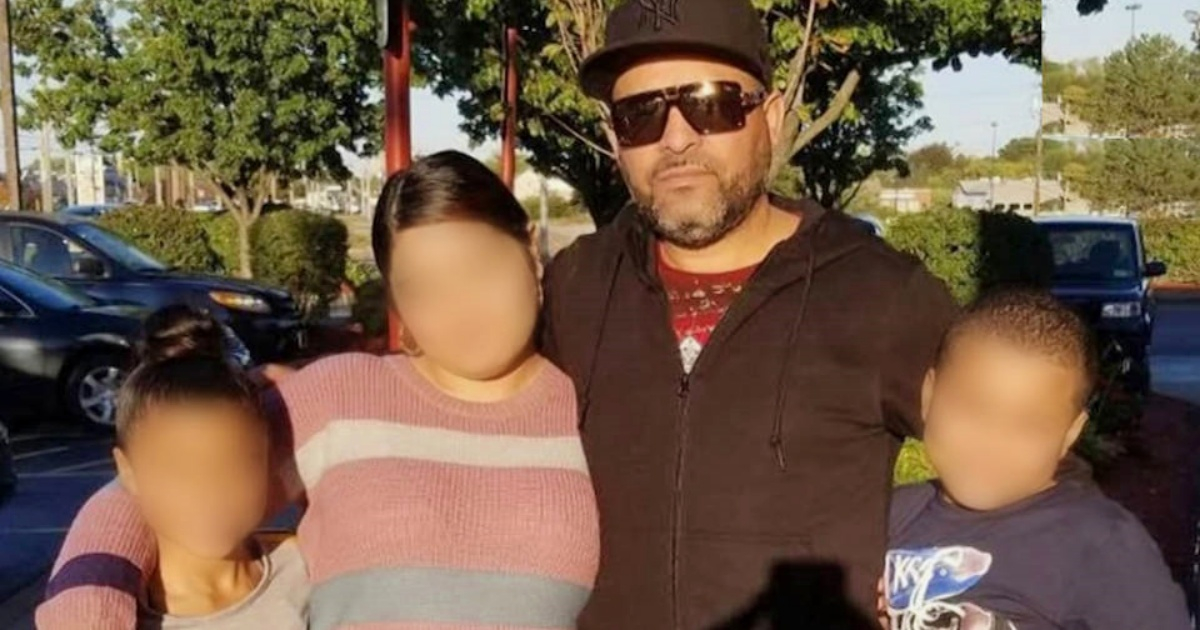
Geraldo Lunas Campos was 55 years old when he died alone, handcuffed and under the custody of the U.S. government, inside an immigration detention center lost in the Texas desert.
During days, his family believed the official version that spoke of a supposed suicide attempt. Today, that explanation collapses: a preliminary forensic report concludes that the Cuban died of asphyxiation and that his death was a homicide.
The case, which occurred on January 3, 2026, at the Camp Montana East detention center—an ad hoc federal facility built on land at the Fort Bliss military base—has taken a decisive turn following the release of preliminary findings from the El Paso County Medical Examiner's Office.
The information, revealed by The Associated Press (AP), directly contradicts the initial account provided by the Immigration and Customs Enforcement (ICE).
The forensic data is complemented by testimonies from witnesses and family members who describe Lunas Campos's final moments as a sequence of negligence, struggles, and lack of medical attention, in an environment characterized by secrecy and a lack of oversight.
Far from being an isolated incident, his death raises deep questions about what is really happening inside immigration detention centers in the United States and the human cost of a system that often operates beyond public scrutiny.
The contradictions of the official narrative
From the very beginning, ICE sought to downplay the incident in its public communication.
In a brief statement issued a week after the events, the agency simply noted that the detainee "exhibited disruptive behavior" while waiting for his medication and that, after refusing to return to his dormitory, he was moved to isolation.
Hours later, he was found in a state of distress, which prompted the intervention of medical personnel; however, he was ultimately declared dead by emergency services.
No physical altercation with security personnel was mentioned. The use of force was not mentioned.
A strangulation key was not mentioned, nor was it stated that the coroner would have classified her death as homicide.
However, following persistent questions from AP, the Department of Homeland Security (DHS)—which oversees ICE—modified its statement on January 11, claiming that the Cuban “attempted to commit suicide” while in isolation, and that he “violently resisted security personnel.”
According to spokesperson Tricia McLaughlin, it was during that struggle that Lunas Campos stopped breathing and lost consciousness.
"Campos violently resisted the security personnel and continued trying to take his own life," said McLaughlin.
"During the struggle that followed, Campos stopped breathing and lost consciousness," he added.
The testimony that changes everything
That version is contradicted by the account of a direct witness, Santos Jesús Flores, a 47-year-old Salvadoran detainee who was in a nearby cell within the isolation unit.
In an interview with AP, Flores stated that he witnessed the incident through the window of his cell
"The last thing he said was that he couldn't breathe," he recounted. "He didn't want to enter the cell where they were going to put him."
Flores stated that Lunas Campos was already handcuffed when he was brought down by at least five guards, and that one of them held him by the neck with his arm, which he described as a sort of chokehold.
In about five minutes, the body of the Cuban stopped moving. Only then, he said, did the agents remove the handcuffs.
This witness also stated that several detainees witnessed what happened and that the area was equipped with security cameras, which, in theory, would allow for the events to be corroborated. However, to date, no investigator has interviewed him, and DHS has not confirmed whether the recordings were reviewed.
Flores, who has already voluntarily accepted his deportation, stated that speaking out poses a risk, but that he felt the need to denounce what is happening in the center:
"In this place, the guards mistreat people a lot," he assured.
The forensic expert talks about homicide
According to AP, which obtained a recording of the call between the coroner and the family, the El Paso County Medical Examiner's Office informed them that the preliminary autopsy indicates the cause of death was asphyxia due to compression of the neck and chest, which would classify the case as homicide.
This type of qualification does not necessarily imply intent to kill, but it does establish that the actions of others caused the death.
Dr. Victor Weedn, a forensic pathologist consulted by AP, explained:
"This probably passes the 'but for' test. In other words, but for the actions of the agents, he would not have died. For us, that is generally considered homicide."
Weedn also acknowledged that in cases like this there can be pressures to soften the forensic report, but he believed that the office in El Paso "will stand firm."
A criminal record and a country that expelled him
Lunas Campos legally arrived in the United States in 1996, as part of a wave of Cuban migrants attempting to reach Florida by boat.
Based in Rochester, New York, he was arrested in 2003 for sexual contact with an 11-year-old minor, and in 2009 for attempted drug trafficking.
He was also charged with possession of weapons, theft, and driving under the influence of alcohol.
These circumstances led to the issuance of a final deportation order in 2005, although it could not be executed due to difficulties in obtaining travel documentation from the Cuban government.
However, his family has defended his memory. Kary Lunas, his eldest daughter, 25 years old, stated that the sexual abuse accusation was a result of a custody dispute:
“My father was not a pedophile”, he stated. “He was a good father. He was a human being.”
His ex-partner and mother of two of his minor children, Jeanette Pagán-López, confirmed that despite his past, Lunas Campos always stayed in contact with his children and was working at a furniture store for minimum wage, the only job he could find because of his history.
In his last family call, shortly after Christmas, he told them that he was expecting his imminent deportation to Cuba and asked his children to visit him on the island so as not to lose their connection.
"He wasn't a bad guy. I just want justice and for them to bring his body here. That's all I want," said Pagán-López.
Institutional silence, bureaucratic obstacles
After being informed of the death by the county morgue, Pagán-López contacted ICE to request explanations.
An official indicated to her that the only way to repatriate the body at no cost was if she agreed to its cremation, something she refused.
Days later, she received a call from a detainee that put her in touch with Santos Flores. Since then, she has been unable to communicate with ICE again and claims that the FBI has not returned her calls, despite having taken her information on two occasions.
He is currently trying to raise funds to transport the body to Rochester and organize a funeral.
What kind of center is Camp Montana East?
The facility where Lunas Campos died, Camp Montana East, is part of a rapidly expanding network of temporary detention centers established by the U.S. government.
It was built on military grounds as a quick solution to the increase in immigration detentions, and it is expected to become the largest immigration detention center in the country, with an estimated cost of 1.2 billion dollars.
What is worrying is that the management of the complex was delegated to Acquisition Logistics LLC, a private company based in a residential home in Virginia, with no prior experience in the administration of correctional facilities.
As of today, it has not been confirmed whether the guards involved were government employees or private contractors, which adds more uncertainty and potential legal gaps in the chain of accountability.
A systematic pattern of deaths from immobilization
The case of Lunas Campos is not an isolated incident.
An AP investigation published in 2024 documented hundreds of deaths that occurred during physical restraints by law enforcement, in which the victims were held face down with pressure on their chest or neck.
In most of these cases, authorities attribute the deaths to preexisting medical conditions or drug use, which complicates efforts to establish criminal or civil liability.
"Many people said 'I can't breathe' before choking to death," notes the cited news agency.
Moreover, the fact that the incident occurred within a military base may restrict the involvement of local civil authorities, further complicating accountability.
Who will answer?
While ICE and DHS insist that the investigation remains open and that they are committed to ensuring "safe and humane" conditions, the fundamental questions remain unanswered:
Was Lunas Campos handcuffed when he supposedly attempted suicide? Where are the security recordings? Which agency is actually investigating the case? Who are the agents or contractors involved?
At this point, the only thing that is clear is that a man died in federal custody, that there is a heartbreaking testimony that contradicts the official version, that the coroner has indicated a possible homicide, and that the institutions are not providing clear answers or access to the truth.
"I just want justice," Jeanette Pagán-López repeats.
Filed under: