
Related videos:
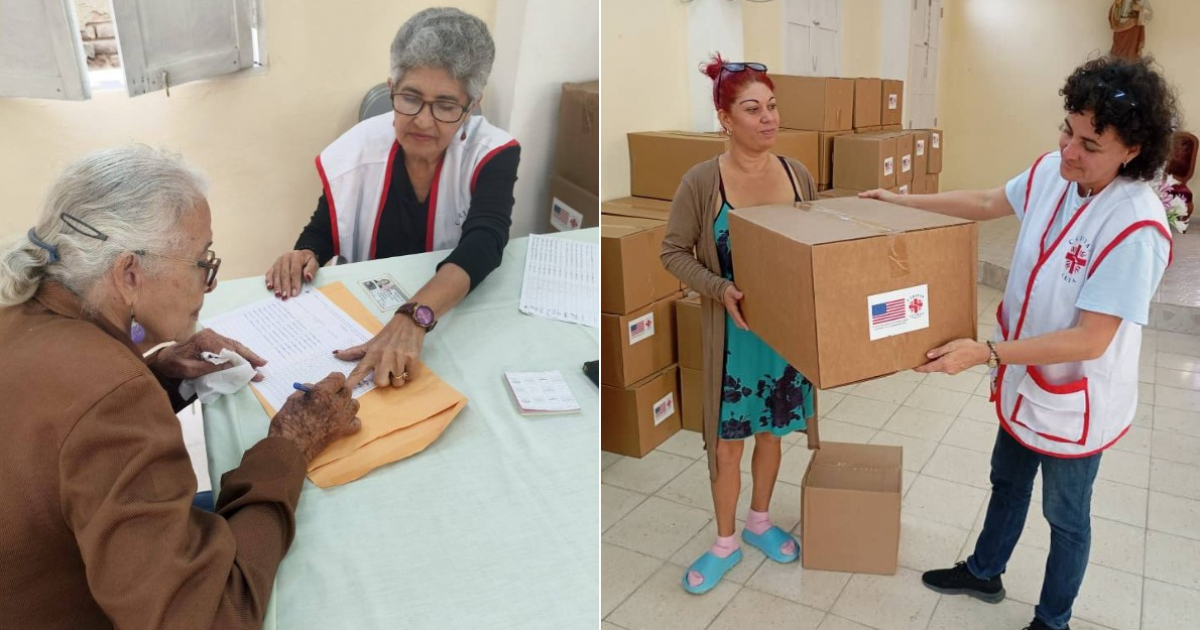
Cáritas Cuba began delivering food and hygiene kits to families in the Diocese of Holguín affected by Hurricane Melissa at the San Pedro Apóstol Parish in the municipality of Cacocum.
The distribution is carried out with the support of volunteers and community members, as reported by the organization on .
The modules are aimed at individuals who lost their homes, belongings, and regular access to essential resources following the passage of the cyclone.
The delivery is part of a broader humanitarian effort that includes several shipments from the United States, intended for about 6,000 families belonging to the dioceses of Bayamo-Manzanillo, Holguín-Las Tunas, Santiago de Cuba, and Guantánamo-Baracoa.
On Friday, the second plane with humanitarian aid arrived at Antonio Maceo International Airport in Santiago de Cuba, carrying 528 kits of non-perishable food and 660 hygiene kits.
It deals with basic products for daily subsistence in a context where many people still face serious challenges in meeting essential needs such as food and hygiene.
Cáritas emphasized that the shipment represents a gesture of charity and solidarity from the people of the United States towards those who have become more vulnerable after the hurricane.
The coordination of the delivery is managed by the Catholic Church and Cáritas Cuba, which ensure they act with an emphasis on dignified treatment, transparency, and the protection of beneficiaries.
The organization also highlighted the role of local volunteers, which allows assistance to reach families directly without intermediaries.
This second shipment adds to a first delivery that arrived earlier at Holguín International Airport, with the same quantity of food and hygiene kits.
The government of the United States announced a total of three shipments of aid for those affected by Hurricane Melissa in Cuba: two by air and one by sea.
According to a statement from the State Department, they are part of a package of 3 million dollars committed by the Trump Administration for disaster assistance.
Washington states that it is closely working with the Catholic Church in Cuba to ensure that aid reaches the Cuban people directly, transparently, and effectively.
The organization estimated that the assistance could benefit up to 24,000 people in the most affected provinces: Santiago de Cuba, Holguín, Granma, and Guantánamo.
In addition to basic food items such as rice, beans, oil, and sugar, the shipments include supplies for purifying and storing water, as well as essential household items, including pots, kitchen utensils, sheets, blankets, and solar lanterns to cope with power outages.
Meanwhile, the Cuban regime has criticized the shipment of this humanitarian aid from the United States.
Through a statement from the Ministry of Foreign Affairs, it accused Washington of using the tragedy for "political manipulation" and asserted that there was no official coordination between the two governments.
Cuban authorities noted that they became aware of the initiative through the Catholic Church and reiterated that all humanitarian contributions must go through the official channels of the State.
Despite this, the goods are being received and distributed in communities in the east of the Island that are still facing the aftermath of Hurricane Melissa.
The cyclone struck eastern Cuba as a Category 3 hurricane, leaving thousands of people homeless and causing damage to crops, telecommunications, electricity, and water infrastructure, in a context already characterized by shortages and blackouts.
Filed under: