
Related videos:
The Cuban historian and activist Alina Bárbara López Hernández questioned this Sunday whether the Government suspended constitutional guarantees, following the approval of plans for the "transition to a State of War," an official decision shrouded in legal ambiguity and informational silence.
The question was posed by López Hernández on his Facebook profile, directed “especially to legal experts,” following the session of the National Defense Council that approved “the plans and measures for the transition to a State of War” as part of Defense Day.
"When the state of war is declared, constitutional guarantees are suspended?" wrote the academic in a context marked by the systematic repression of peaceful protest.
The exchange generated dozens of comments. Silvia Jácome Alfonso warned that if war plans were to be implemented, guarantees would be effectively suspended, which would open the door to even greater abuses by the Police.
The journalist José Raúl Gallego introduced a key clarification: a State of War has not been formally declared, but plans and measures have been approved for a potential transition to that scenario.
Other users interpreted the announcement as a sign of repressive preparation in anticipation of a possible social outbreak.
Vladimir González stated that the regime is preparing to suppress protests with greater violence, while López Hernández emphasized that a formal suspension of guarantees would need to be acknowledged and communicated publicly, something that has not happened.
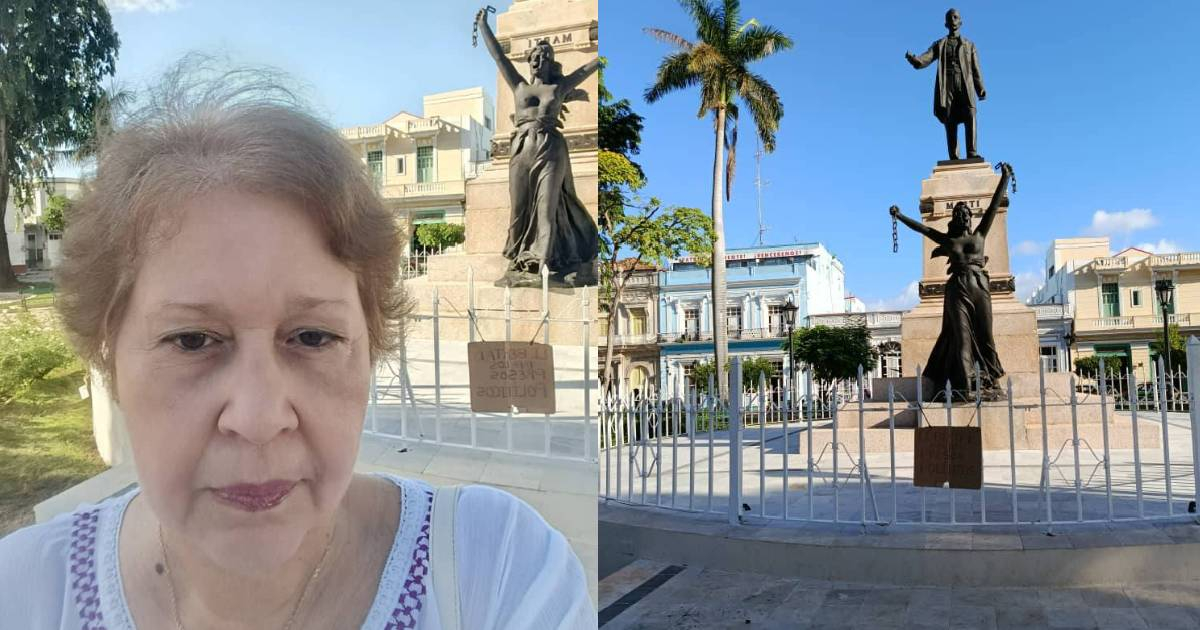
"Since they haven't done it, I assume they won't, so I go out without worries," she wrote, referring to the peaceful civic action that takes place every 18th in Matanzas.
The lawyer Fernando Almeyda provided a straightforward legal interpretation: should a State of War be declared, the National Defense Law would be enacted immediately, which in its article 10 empowers the National Defense Council to regulate fundamental rights differently, including the freedoms of expression, assembly, and the regime of detention of individuals.
López responded that, without an explicit public statement, one cannot technically speak of the suspension of guarantees.
The debate takes place against a backdrop of repeated harassment against López Hernández herself, who has been detained multiple times while attempting to peacefully protest in the Parque de la Libertad in Matanzas to demand the release of political prisoners.
Although the 2019 Constitution recognizes the right to peaceful assembly, the law that is supposed to regulate it has never been approved, in open violation of the Constitution itself.
The session of the National Defense Council was reported by official media such as Granma and Cubadebate, which highlighted the approval of plans for the "transition to a State of War" and the symbolic role of Raúl Castro, who "stayed informed" about the meeting.
The statement did not specify concrete measures or practical implications, nor did it clarify the legal status of constitutional rights.
Human rights organizations have repeatedly condemned the Cuban regime for criminalizing peaceful protest, ignoring its own constitutional guarantees, and using preventive repression as a tool for social control.
In that context, López Hernández's question is not rhetorical: it highlights the legal and communicational vacuum that those in power use to repress without facing explicit political costs.
In a country immersed in a profound crisis of food, electricity, and basic services, the announcement of the "transition to a State of War" has been interpreted by large segments of the population not as a defensive act, but as a veiled threat directed towards the population itself.
Filed under: