
Related videos:
Yunieski Lorences Domínguez, one of those imprisoned for peacefully protesting in Encrucijada, Villa Clara last November, has been released.
The news was revealed by the exiled Cuban activist Raimet Martínez, a member of the Cuban-Canadian Coalition.
Cuban civil society celebrated the release, but demanded the liberation of all the prisoners from Encrucijada, including the writer José Gabriel Barrenechea.
“I find this news very important, and I urge the government, as a citizen, to declare an amnesty for all Cuban political prisoners. I know it is difficult for them to do so, but it would be a significant, just step that would be very well received by a citizenry that has long demanded it,” said opposition intellectual Alina Bárbara López Hernández.
The trial, after the Prosecutor's Office requested nine years in prison for the protesters, was submitted for sentencing last Thursday, as reported by Martí Noticias.
Initially, the prosecutor's request for Lorences Domínguez was four years.
After the conclusion, a family member speaking on condition of anonymity told Martí Noticias that it was "a very long, very extensive trial."
“From the morning until about 8 at night. A very clear trial, very favorable for the boys. An exceptional defense, very good. It was evident how the defense discredited the police and the State Security, who were clearly lying in an attempt to harm them,” he added.
Fiscal requests
In early August, Cubalex reported on the provisional conclusions of the Public Prosecutor's Office, signed by prosecutor Ayrebi Miranda Pérez, which the NGO had access to, accusing the protesters of “taking advantage of the lack of electricity caused by the energy crisis to disrupt public tranquility” with pots and slogans.
The six individuals charged with the offense of "public disorder" participated on November 7, 2024, in a peaceful protest against the prolonged blackouts.
The prosecution is seeking nine years in prison for Yandri Torres Quintana and Rafael Javier Camacho Herrera.
They are requesting six years for José Gabriel Barrenechea Chávez, as well as five years for Rodel Bárbaro Rodríguez Espinosa, and five years of restricted freedom for Marcos Daniel Díaz Rodríguez.
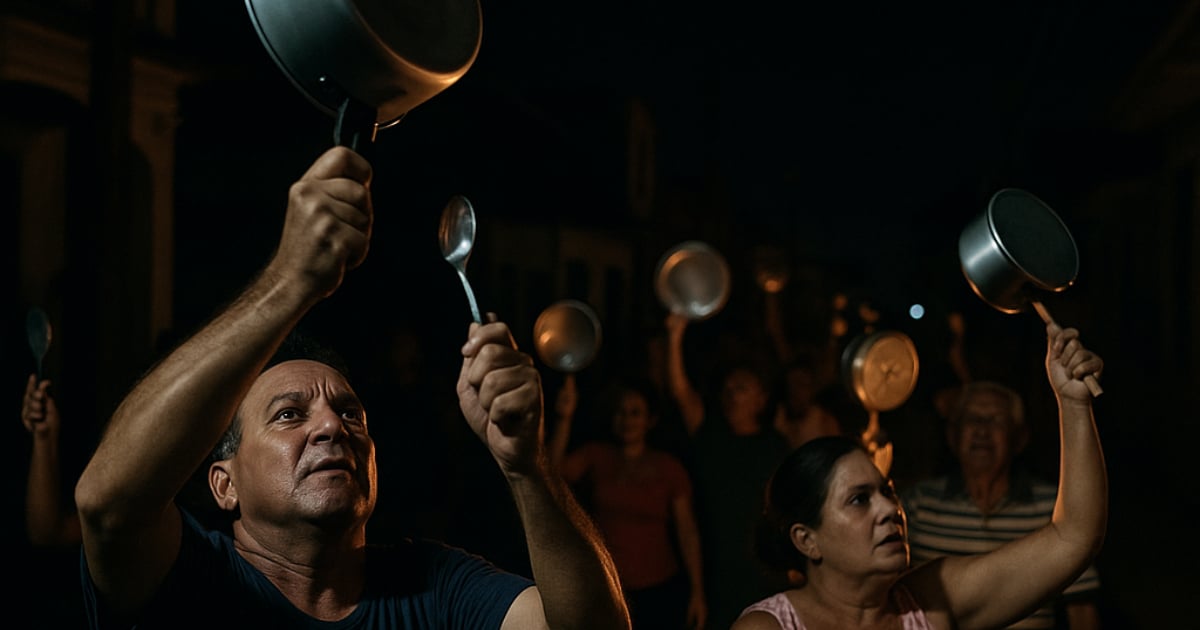
During the protests, the defendants performed pot banging and shouted phrases such as "Turn the power back on!" and "We want electricity!", demanding the restoration of electrical service.
Despite the absence of reported vandalism, physical violence, or property damage, authorities are presenting these actions as evidence of a massive attempt to disrupt public order.
In the case of the Cuban writer José Gabriel Barrenechea Chávez, the accusation is based on the claim that he "urged people not to leave the place" and on personal assessments such as his "relationship with people of questionable morality," "behavior on social media," and "outright disregard for the norms of coexistence."
Other notable cases include Andy Pérez Medero and Rasiel Cárdenas Pérez, who were arrested in the community of El Purio following similar protests.
Both remain incarcerated without any criminal charges against them.
Likewise, activist Alejandro Morales Pereira was arrested months after the events for demanding the release of the protesters.
According to Cubalex, his situation is critical and his life is at risk in prison.
"Where is the crime? Demanding a dignified life is not a crime," stated Cubalex in its public denouncement. The organization insists that the alleged evidence does not demonstrate violence, but rather the legitimate exercise of the right to protest.
The sentences requested by the Public Prosecutor's Office add to a long list of cases where civic protest is penalized as if it were a common crime, in a context of profound energy and social crisis on the island.
Frequently Asked Questions about the Release of Protesters in Cuba and the Context of the Protests
Why was Yunieski Lorences Domínguez released?
Yunieski Lorences Domínguez was released after being accused of participating in peaceful protests in Encrucijada, Villa Clara, in November of the previous year. Although a four-year sentence was initially requested for him, his release was announced by Cuban activist Raimet Martínez from the Cuban-Canadian Coalition.
What is the current situation of the writer José Gabriel Barrenechea?
José Gabriel Barrenechea Chávez remains imprisoned, accused of "public disorder" for his participation in peaceful protests in Encrucijada. The Prosecutor's Office has requested a six-year prison sentence for him, and his case has been highlighted by human rights organizations as an example of political repression in Cuba.
What charges did the Prosecutor's Office present against the protesters in Encrucijada?
The Cuban Prosecutor's Office accused the protesters of "taking advantage of the lack of electricity caused by the energy crisis to disturb public tranquility." They were charged with "public disorder" for banging pots and shouting slogans during the peaceful protests. No acts of vandalism or violence were reported, but the authorities regarded these actions as an attempt to disrupt public order.
What has been the response of Cuban civil society to these detentions?
The Cuban civil society has celebrated the release of some protesters, but continues to demand the release of all political prisoners, including those detained during the protests in Encrucijada. Activists and human rights organizations have condemned these detentions as violations of human rights and political repression by the Cuban regime.
Filed under: