
Related videos:
Energy crisis: Six hours without electricity in Havana and a deficit of 1,905 MW
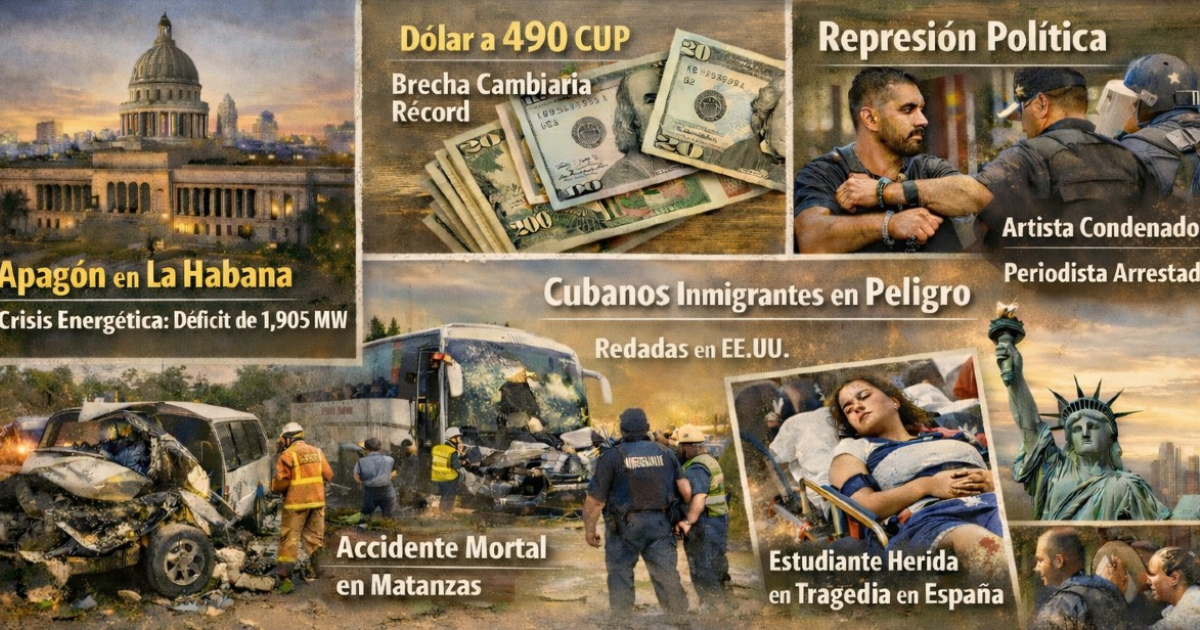
On Sunday, January 19, Cuba experienced one of the worst electrical collapses of the year, with prolonged blackouts that affected the entire country and left Havana virtually dark for more than six hours. The National Electric System (SEN) recorded a maximum impact of 1,905 megawatts (MW) during peak hours, according to the official report from the Electric Union (UNE). Read more
The Electric Company of Havana confirmed that the capital was without service since 6:39 p.m. on Sunday, with a maximum impact of 359 MW at 6:20 p.m., which paralyzed five of the six distribution blocks. Full service restoration was achieved after 12:06 a.m., following more than six hours of continuous outage. The company admitted that "it was not possible to meet the reported schedule" due to the low availability of base generation. Read more
Causes of the electrical collapse
Officials from the Ministry of Energy and Mines publicly acknowledged that the shortage of diesel fuel is the main cause of the blackouts. Lázaro Guerra Hernández, the general director of Electricity at the Ministry, admitted on national television: "The greatest factor is that we have distributed generation offline due to a lack of fuel practically. We do not have diesel fuel for distributed generation, and that affects the availability." Read more
This is compounded by multiple breakdowns in key thermoelectric plants: the Mariel, Felton, Antonio Maceo, and Carlos Manuel de Céspedes facilities are all out of service, along with over 100 distributed generation plants affected by fuel shortages. The initial energy deficit was 750 MW at the beginning of the day on Monday, but it progressively increased to reach 1,905 MW during peak hours. Read more
Foreign exchange market: The dollar rises to 490 pesos and the official gap reaches a historic record
On Monday, January 19, the US dollar was quoted at 490 Cuban pesos (CUP) in the informal market, representing an increase of two pesos compared to the previous day. The euro reached 525 CUP, solidifying its position as the most expensive currency in the parallel market, while the Freely Convertible Currency (MLC) remained stable at 400 CUP. Read more
The difference between the dollar price in the informal market (490 CUP) and the official rate of the Central Bank of Cuba (419 CUP) reached 71 pesos per dollar, marking the widest gap since the establishment of the "currency segmentation" system in December 2025. This phenomenon confirms that the monetary policy of the Cuban regime has completely lost control over the real value of the Cuban peso. Read more
Political repression: Conviction of independent artist and detention of journalist
On January 19, it was reported that the Cuban independent artist Fernando Almenares Rivera, known as Nando Obdc, was sentenced to five years in prison for the alleged crime of "propaganda against the constitutional order." The trial, held on November 26, 2025, was characterized as a "farce" by the Cuban Youth Dialogue Table, which denounced the use of the judicial system as a tool for punishing freedom of expression and critical art. Read more
The sentence is based on the fact that the artist "painted phrases with counter-revolutionary content" in August 2024 and placed them along a section of the Monumental Highway in Havana. The judicial document openly criminalizes dissent by stating that Almenares "meets with individuals opposed to the revolutionary process," despite explicitly acknowledging that he has no criminal record. Read more
Nando Obdc, 35 years old, was arrested on December 31, 2024, at his home in the municipality of La Lisa, without prior notice or a court order. At the end of July 2025, the artist declared a hunger strike while remaining incommunicado in a prison in Güines, Mayabeque. Read more
The Cuban writer and journalist Jorge Fernández Era was detained on Sunday, January 18, in Havana and remained in custody for over 15 hours, being released in the early hours of Monday. Fernández Era was arrested just hours after announcing on his social media that he would peacefully demonstrate in Parque Central to protest against the repression of thought and demand the release of political prisoners. Read more
His wife, Laideliz Herrera Laza, reported that the writer was not listed at any police station in the capital, describing the incident as a "kidnapping" by State Security. Fernández Era confirmed his release in a post on Facebook: "I was detained from 3:05 PM to 6:52 AM. I'm back home now." Read more
Events and accidents
In the early hours of Monday, January 19, a traffic accident on the National Highway, near the municipality of Jagüey Grande in Matanzas, resulted in the deaths of two people, including a 13-year-old girl. The collision between a car and a bus, supposedly from the National Bus Company, also left at least two people with serious injuries. Read more
The fatalities have been identified as Diamela Gómez Cepero, 13 years old, and Freddy Wong, the driver of the vehicle, both from Santa Clara, Villa Clara. The girl's parents, Dany Gómez and Yasmery Cepero, were urgently transferred to Faustino Pérez Hospital in Matanzas and are in critical condition. The accident occurred around 3 a.m. when the car was leaving Jagüey Grande heading to Havana. Read more
International and migratory context
The U.S. Immigration and Customs Enforcement (ICE) conducted a large-scale nationwide operation from January 16 to 18 targeting immigrants with serious criminal records. Among those detained is Ronal Garbey-Jorin, a 27-year-old Cuban arrested in Houston, Texas, with a previous conviction for assaulting a family member. Authorities reported that immigrants convicted of crimes such as murder, sexual abuse, and gang-related offenses were arrested. Read more
Daniela Arteaga, a Cuban student in Spain, was injured in the tragic train collision in Córdoba that left at least 40 dead. The young woman was found alive and admitted to the Reina Sofía Hospital in Córdoba. "Considering the severity, she is stable," assured the rector of the International University of Andalucía. The accident occurred when an Iryo train derailed and invaded the opposite track, causing a collision with an Alvia train. Read more
Daniela was traveling on the Alvia train that covered the Madrid-Huelva route, just hours after landing at Barajas Airport. She had been awarded a scholarship from the International University of Andalucía (UNIA) to pursue a master's degree in Communication and Audiovisual Education. According to a close friend, Daniela suffered fractures in several ribs and contusions on her head, although her life is not in danger. Read more
Also among those affected is the case of Geraldo Lunas Campos, a 55-year-old Cuban who died at the ICE detention center Camp East Montana in Texas. A preliminary forensic report concluded that he died from asphyxiation and that his death should be classified as homicide. An eyewitness claimed to have seen several guards struggling with the already handcuffed Cuban, with one of them applying a chokehold while Lunas Campos was repeatedly saying that he could not breathe. Read more
Conclusion
On January 19, 2026, a deeply multidimensional crisis engulfing Cuba was highlighted: unprecedented energy collapse with more than six hours of blackouts in Havana, record devaluation of the Cuban peso with a historic exchange gap of 71 pesos per dollar, systematic repression against artists and journalists, fatal accidents on deteriorated roads, and increasing international pressure on the regime in a context of isolation following the fall of its main ally, Venezuela. The day underscored the Cuban government's inability to guarantee basic services, economic stability, and respect for the fundamental rights of its population.
Filed under: