
Related videos:
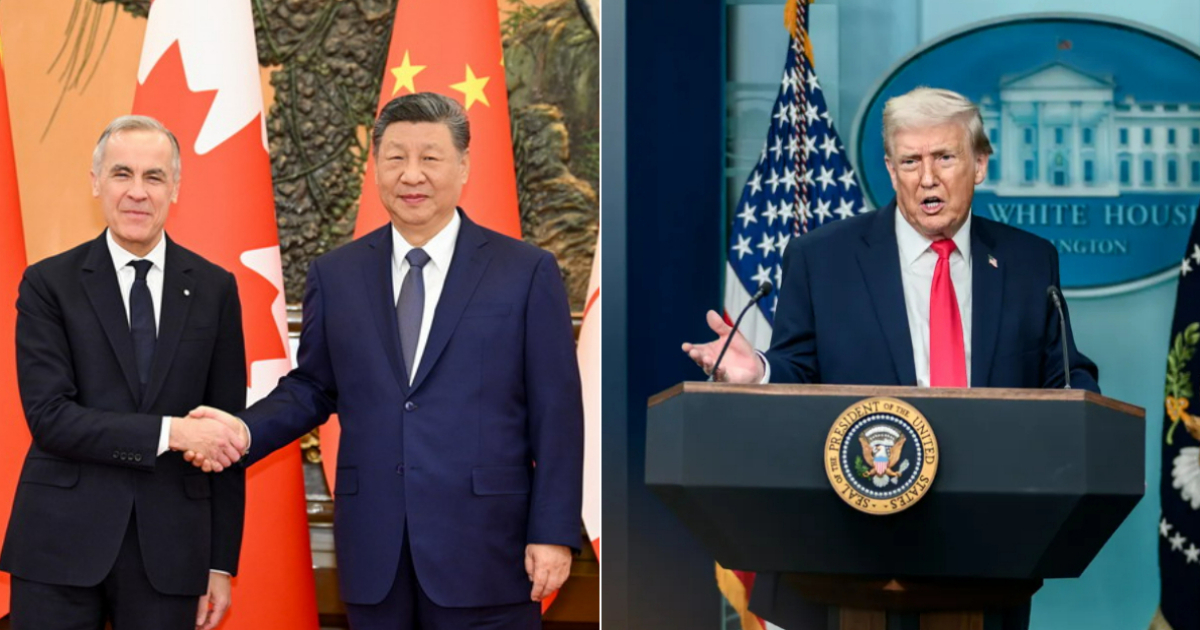
The President of the United States, Donald Trump, warned this Saturday that he will impose a 100% tariff on Canadian exports if the government of Mark Carney continues to get closer to China, following the recent visit of the Canadian Prime Minister to Beijing and his meeting with President Xi Jinping.
Trump's threat comes just days after Carney described relations with China as "more predictable" than those Canada has with the United States, a statement that caused unease in Washington.
The U.S. president deemed it "unacceptable" for a historic ally to seek to strengthen ties with a "strategic rival."
During their visit to the Great Hall of the People, Carney and Xi advocated for a "strategic relationship tailored to the current context," highlighted by Canada's intention to diversify its trade partners in light of the pressures from Trump's second term.
The meeting, the first of a Canadian leader in China since 2017, symbolizes Ottawa's attempt to restore fractured ties since the arrest of Huawei's executive, Meng Wanzhou, in 2018.
In Washington, sources from the White House indicated that the president views Carney's approach to Beijing as "a direct threat to North America's economic security."
In this regard, the Trump administration would be reviewing potential tariff measures that would affect Canadian steel, aluminum, and agricultural products, key sectors of the bilateral economy.
For his part, Carney defended Canada's right to maintain an "independent and pragmatic" foreign policy focused on trade and global stability.
The Prime Minister emphasized that "cooperation with China does not imply a distancing from the United States" and insisted that Ottawa will continue to support "an open and predictable economic order."
The diplomatic clash could further strain the already deteriorating relationship between the two countries, impacted by Trump's attempts to amend the USMCA and restrict the sale of Canadian raw materials to third markets.
Analysts fear a trade escalation that could impact supply chains in North America and accelerate Canada’s shift toward Asia.
Filed under: