
Related videos:
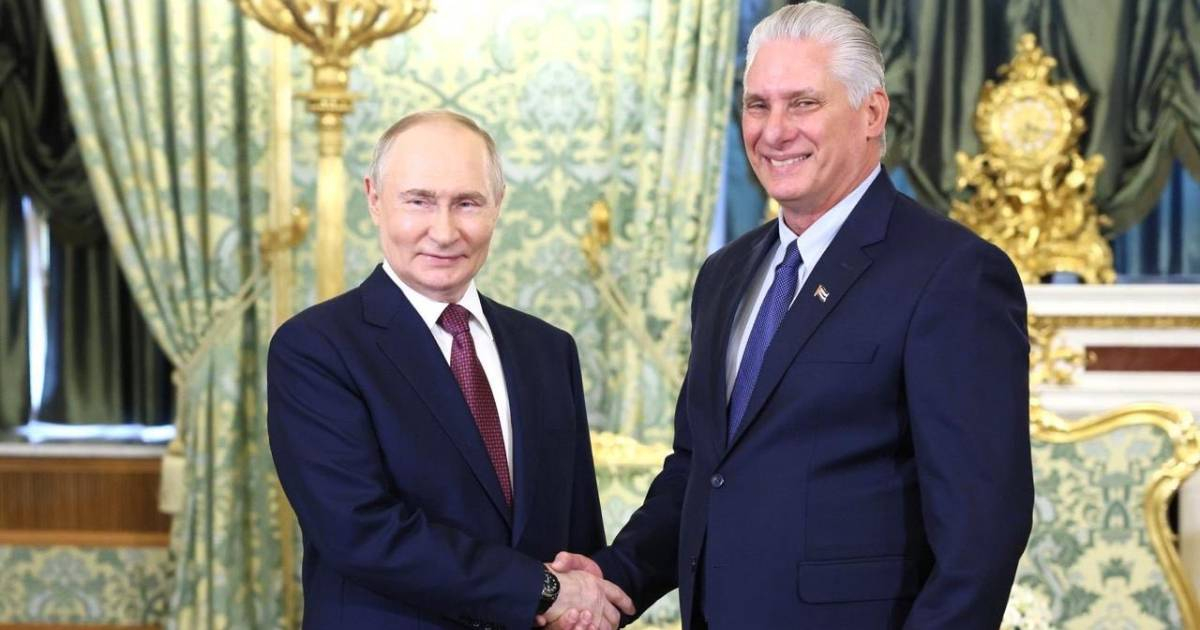
While the Cuban government insists on presenting its alliance with Moscow as a strategic support against the United States, an analysis reveals a less epic reality: for the Kremlin, Cuba today is more of a political symbol than a practical ally that can be protected.
An expert on Russian affairs warns that if Washington decides to increase pressure on the island, Moscow would have little room for action beyond rhetoric, constrained by the war in Ukraine and its own economic and military limitations.
The warning appears in an article published by Eurasia Daily Monitor, from the influential American foundation The Jamestown Foundation, authored by analyst Serguéi Sukhankin, a specialist in Russian foreign policy and an advisor on international security. The text claims that, following the large-scale invasion of Ukraine in 2022, Cuba has solidified its position as one of Moscow's most loyal partners politically, but also as one of the most vulnerable in material terms.
According to the analysis, the relationship between the two countries has primarily served to feed the Russian narrative of a "multipolar" world and demonstrate that the Kremlin still has allies in the Western Hemisphere, just a short distance from the United States. However, that value is more symbolic than real.
Economic cooperation, which encompasses sectors such as energy, infrastructure, agriculture, and tourism, has had a limited impact and functions more as a complement to the geopolitical discourse than as a concrete source of benefits.
In recent years, Moscow has used Cuba as a platform to test financial mechanisms alternative to the Western system, such as the use of the ruble in bilateral transactions or the introduction of Mir cards, while also positioning the island as a gateway for exporting Russian technology to the Latin American market. Nevertheless, the very deterioration of the Cuban economy and Russia's increasingly scarce resources have prevented this cooperation from translating into tangible relief for the island's population.
The article emphasizes that the Kremlin's concern is not economic, but reputational. Losing Cuba as a partner would have a significant ideological impact both within and outside Russia, especially among countries in the so-called Global South that see Moscow as a counterbalance to Washington. In this context, Russian analysts cited in the report warn that a potential collapse of Cuba would seriously undermine the multipolarity discourse promoted by the Kremlin.
The recent statements by the spokesperson for the Russian Ministry of Foreign Affairs, Maria Zakharova, reflect this concern. In mid-January, she described the language used by U.S. President Donald Trump towards Havana as “unacceptable blackmail,” after he urged the Cuban regime to reach an agreement “while there is still time,” following the capture of Nicolás Maduro in Venezuela.
The analysis indicates that the Kremlin's top priority remains the war in Ukraine, which has led Moscow to sideline or abandon other strategic allies in various regions of the world. In this context, if the United States decides to adopt a tougher stance toward Cuba, the Russian response would likely be limited to public statements and diplomatic gestures.
This is complemented by military cooperation between the two countries, reinforced in October 2025 with the ratification of a bilateral agreement that establishes the exchange of specialists, joint exercises, and coordination on security matters. Although some ultranationalist circles in Russia have speculated about a possible deployment of advanced weaponry on the island, the report itself considers such ideas to be more akin to propaganda than to a real possibility.
For Sukhankin, Moscow's dilemma is clear: Cuba remains a powerful symbol of historical resistance against the United States, but symbols, he warns, “fall if no one protects them.” And in the current context, all indications are that Russia is no longer in a position to do so.
Filed under: