
Related videos:
The recent approaches between the regime in Havana and representatives from Russia and China have raised alarms in Washington, which views these moves as a matter of national security.
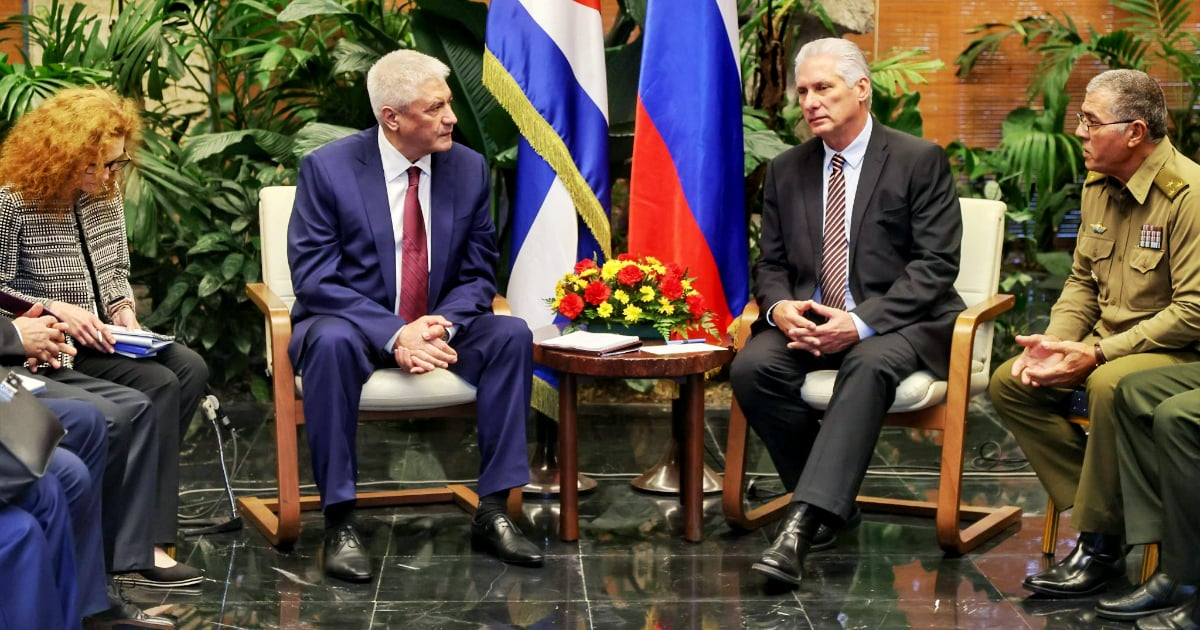
According to Martí Noticias, sources from the U.S. government expressed their concern over the ongoing contacts between the Cuban regime and the Russian Minister of Internal Affairs, Vladimir Kolokoltsev, as well as with the Chinese ambassador in Havana, Hua Xin.
The State Department emphasized that these movements are of interest to the National Security of the United States, highlighting the importance of Cuba being "competently led by a democratic government" and "refusing to harbor the military and intelligence services of our adversaries."
The State Department has reiterated that it will continue to monitor the Cuban regime's ties with rival powers. Recent contacts with Moscow and Beijing confirm that Havana is attempting to reconfigure its network of strategic support in light of the new regional reality imposed by the Trump Administration.
The Russian Visit and Its Regional Context
The Russian Interior Minister began an official visit to Cuba this week, the second in just over two years, with a schedule of bilateral meetings that included encounters with his counterpart Lázaro Alberto Álvarez Casas, General Raúl Castro, and the current leader Miguel Díaz-Canel.
His trip marks the first visit of a high-level Russian delegation since the U.S. military deployment in the Caribbean and the operation that culminated in the capture of Venezuelan dictator Nicolás Maduro, in which 32 Cuban soldiers were killed.
Díaz-Canel described the meeting with Kolokoltsev as "of great significance" while seeking to strengthen his alliance with Moscow amid heightened tensions with the United States.
International observers interpret this visit as an attempt by Havana to secure military and political support in the face of growing international isolation and internal discontent.
Chinese support and emergency aid
In parallel, Chinese ambassador Hua Xin was received by Díaz-Canel at the Palace of the Revolution in a meeting that, according to the official account, discussed bilateral cooperation and the "acceleration of the Community of Shared Future between both countries."
The meeting takes place a few days after President Xi Jinping approved a new round of aid to the Island, valued at 80 million dollars, along with a donation of 60,000 tons of rice.
The funds, as reported by the Presidency of Cuba, will be allocated for the purchase of electrical equipment and to cover "urgent needs," amid the collapse of the national energy system and a deep social crisis.
However, the aid arrives in a context of increasing pressure from the Donald Trump administration, which has warned the Cuban regime that “there will be no more oil or money” from Venezuela following Maduro's downfall.
Filed under: