
Related videos:
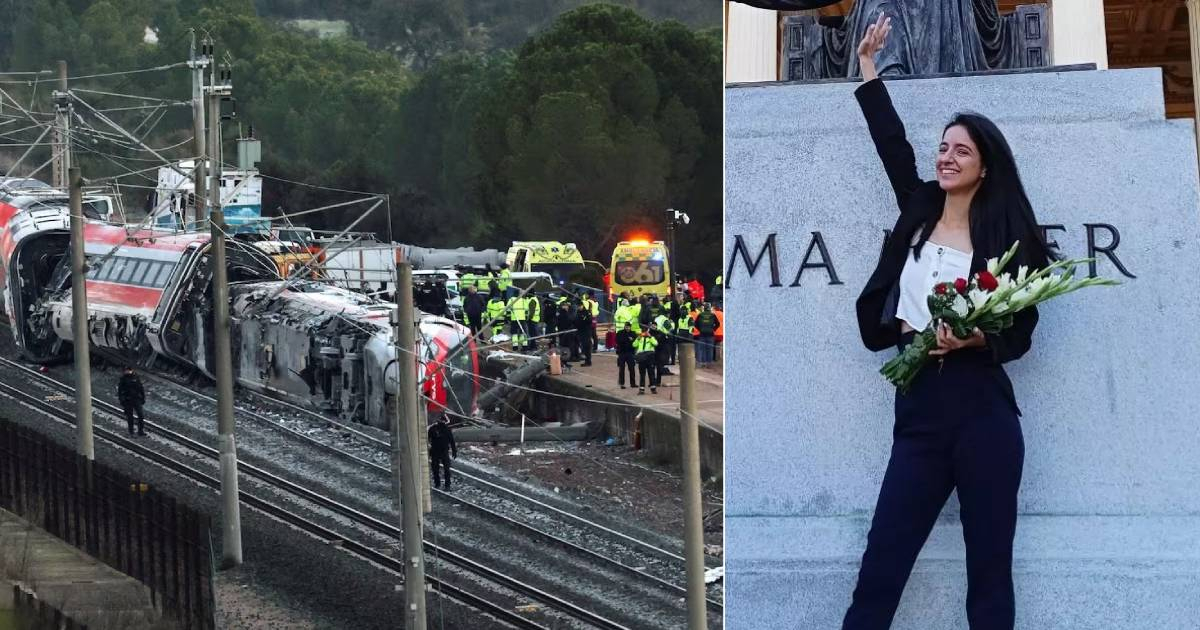
Cuban student and professor Daniela Arteaga Martínez, injured in the serious train accident that occurred in Adamuz, Córdoba, continues her recovery at the Reina Sofía University Hospital, where she successfully underwent surgery for a broken vertebra, as confirmed by the newspaper El Periódico.
Arteaga, a native of Havana and a scholarship recipient from the International University of Andalusia (UNIA) for a master's degree in Education and Audiovisual Communication, was traveling in car 2 of the Alvia Madrid-Huelva train, one of the most affected after the derailment that resulted in more than forty deaths and over a hundred injuries.
According to the Spanish media, the young woman had fractures in several ribs, contusions on her head, and a crushed vertebra due to the impact, which required surgical intervention on Thursday. The operation was successful, and her condition is stable, showing favorable progress.
The director of the UNIA headquarters in Santa María de La Rábida, María de la O Barroso, recounted the hours of anguish experienced until her whereabouts were known. “It was a very difficult time; I couldn't stop thinking about her family, so far away,” she stated to El Periódico while recalling the failed attempts to locate her during the early morning following the accident.
Barroso explained that the university learned that Daniela was alive around 9:30 AM on Monday, when the hospital confirmed her admission. “When they told me she was alive, I was overwhelmed with emotion,” he confessed.
In addition to the physical injuries, the accident left the student without personal belongings or documentation, including her clothes and the visa with which she had arrived in Spain. Her suitcase was left at the scene of the incident and, despite the efforts made with Renfe, it has not yet been recovered.
In response to this situation, UNIA has activated ongoing support. The rector of the institution and academic officials have traveled to Córdoba and are in direct contact with Daniela's family in Cuba. "We feel a special responsibility for students coming from abroad who are alone here," emphasized Barroso.
While she remains hospitalized, the young Cuban has received support from the university community and Cubans residing in Spain, who have come together to assist her in her recovery. In the coming days, a friend from Catalonia will be able to accompany her during her convalescence.
Daniela Arteaga had arrived in Spain just hours before the accident, excited to begin what teachers and classmates describe as the academic project of her life. Today, from a hospital bed, she starts a recovery that will be slow, but with the certainty of having survived one of the largest railway tragedies in recent history in the country.
Filed under: