
Related videos:
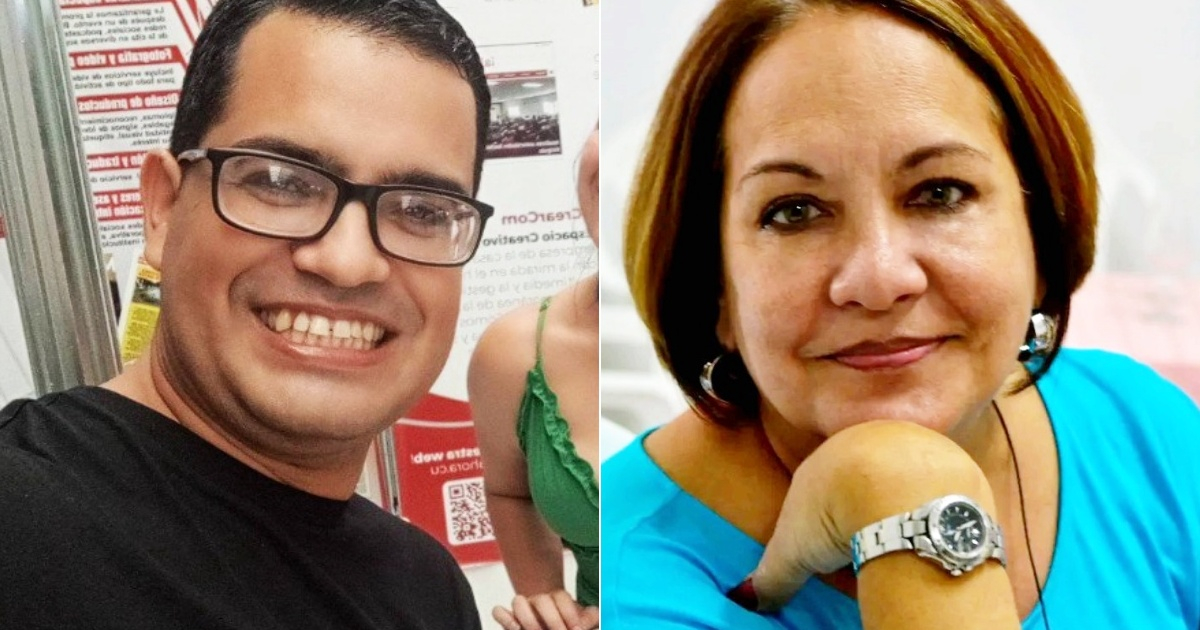
The official journalist Abdiel Bermúdez has publicly reacted to the controversy sparked by a statement from his colleague Arleen Rodríguez Derivet regarding José Martí and the lack of electricity in Cuba, which was ignited after a recorded interview with former Ecuadorian president Rafael Correa went viral months ago.
In a lengthy post on his Facebook profile, Bermúdez took a firm stance in defense of the journalist, whom he acknowledges as a personal friend, while attempting to downplay the impact of the comment that has ignited social media.
"For the know-it-alls, the 'enlightened', the perfect ones, those who never make mistakes... I don't care if they come after me now. I don't mind if they come frantically to bite me, attack me, or 'execute' me... I've already tried that 'medicine'...", he wrote at the beginning of his post.
Far from justifying Arleen's statement, Abdiel admits it was a mistake, but he frames it within what he considers an adverse context, where judgments on social media multiply without nuance or mercy
"My opinion, after watching the interview with Correa: Arleen was mistaken. Perhaps she didn't think much about how she said what she said, and in this networked world, one must tread carefully, because every word carries the risk of reputation assassination, or the flatulence of unconfessed hatred, until we err...", she noted.
Bermúdez also drew on her own experience to empathize with her colleague's situation: "It's what I think, that I have made mistakes too, like everyone else; but that doesn't mean I'm going to speak ill of her."
In a tribute tone, he acknowledged Rodríguez's professional career, highlighting his sensitivity, closeness to the people, and commitment to "the Revolution."
"It has always been [...] a 'showcase' of a journalist in search of the truth, tested by misunderstandings, and fully committed to telling the story of Cuba from the most genuine sensitivity of its people. 'Of all the people,' he said."
Anticipating criticism for alleged privileges, Bermúdez preemptively addressed that concern:
"Let no one come now to refute me by talking about blackouts and supposed privileges. Arleen has not kept silent about her friendship with the president, long before 2018; nor has she stopped stating many of those truths that hurt us as a country in various places."
In a tone more passionate than political, he concluded with a Martian wink:
"And yes, she is also my friend, it’s true, and for friends, I go straight into battle wherever it’s needed, especially if it seems we have the world against us. And I learned that from Martí, so often referenced today: ‘If they ask me which is the most beautiful word, I will say it is “homeland” - and if they ask me for another word almost as beautiful as “homeland,” I will say friendship.’"
Finally, he made it clear that his position does not respond to imposed editorial lines.
"By the way, that 'the order to defend Arleen has been given' doesn't work for me. No one tells me what I can or cannot post on my Facebook profile. And anyone who comes with disrespectful attacks can leave," she concluded.
The origin of the controversy: Martí and the blackouts
The trigger for this communication crisis was a statement by Arleen Rodríguez during an interview with Correa, where she attempted to downplay the seriousness of the blackouts by comparing them to the life of the Cuban independence hero.
“José Martí never knew electric light and he was a genius; he wrote like the gods. I wish I could write a line like Martí with the light on,” said the journalist.
The immediate response from Correa, feeling uncomfortable, was a call to the present: “But Arleen, we are in the 21st century.”
Although the interview was recorded in November, it has gone viral now, as blackouts have intensified in several provinces of the country, exceeding 40 hours in some cases.
In that context, the phrase has been perceived as a mockery of daily suffering and a way to "romanticize darkness," as summarized by multiple internet users.
Abdiel's post has received thousands of interactions, dividing opinions between those who celebrate his loyalty to friendship and those who see his attitude as a form of symbolic cover for the disconnect between the official media elite and the popular reality.
Support: Arleen, the "exhibit" that should not be judged by a mistake
Reactions in support of Abdiel from sectors close to the government quickly followed.
Journalists, broadcasters, and supporters of the regime have defended Arleen as a figure of prestige and commitment.
“I watched the interview as soon as it aired. A small slip doesn't make summer nor winter. [...] Many criticize her just because she stands with her Homeland and the Revolution,” stated journalist Francisnet Díaz Rondón.
Another commentator defended journalists as professionals prone to public mistakes: “Let him who has never made a mistake raise his hand, but let him who has published it in the first person raise his hand.”
Other users mentioned Arleen's "human quality."
"She's human, for goodness' sake, and she can make mistakes"; "To err is human, and it all depends on the perspective from which you look at it"; "Her prestige is so great that a few seconds of error won't tarnish it," have been other opinions.
Critiques: "It's time to stop romanticizing the abnormal."
In contrast, numerous voices questioned the substance of the phrase and Abdiel's defense, not out of malice, but from accumulated fatigue and social indignation.
A commentator warned: “Phrases like that, aimed at justifying the unjustifiable, have brought this country almost to chaos [...] things like that are offensive.”
Another user wrote a widely shared reflection:
"Martí wrote in the dark, yes… but not to make us accustomed to the shadows, rather to teach us to seek the light. It’s easy to confuse sacrifice with comfort when the context is silenced and excuses are ignited."
Someone else pointed out the structural problem:
"The criticism is not for the mistake. The criticism comes from complacency, from the normalization of the pain caused by those blackouts."
In another post, widely circulated on social media in recent hours, broadcaster Laritza Camacho, without mentioning Arleen but clearly referring to the case, stated:
"Keep playing around in the house of the top, but do not play with Martí where his people reside. Martí is perhaps the only light we have left. Respect."
Conclusion: Private Loyalties, Public Responsibilities
Abdiel Bermúdez's support for Arleen Rodríguez highlights a deep dilemma: how to balance personal loyalty with professional responsibility when the entire country is experiencing one of its most draining crises
His defense, although sincere, has reactivated a noticeable rift: that which separates those with microphones, lights, and a platform from those who literally live in the dark.
In a nation where electricity has become a symbol of dignity, comparing Martí to power outages was not just a formal mistake. It was an ethical misstep.
As a user wrote, with painful irony:
"The people cannot be wrong, because each person understands the consequences of making a mistake."
And as power outages continue to occur, along with official justifications and heroic metaphors, millions of Cubans keep waiting—not for a redeeming phrase—but simply for the electricity to return.
Filed under: