
Related videos:
The Cuban government has described the executive order signed this Thursday by President Donald Trump as a "brutal act of aggression." This order establishes a mechanism to block the supply of oil to the island through tariff sanctions on third countries.
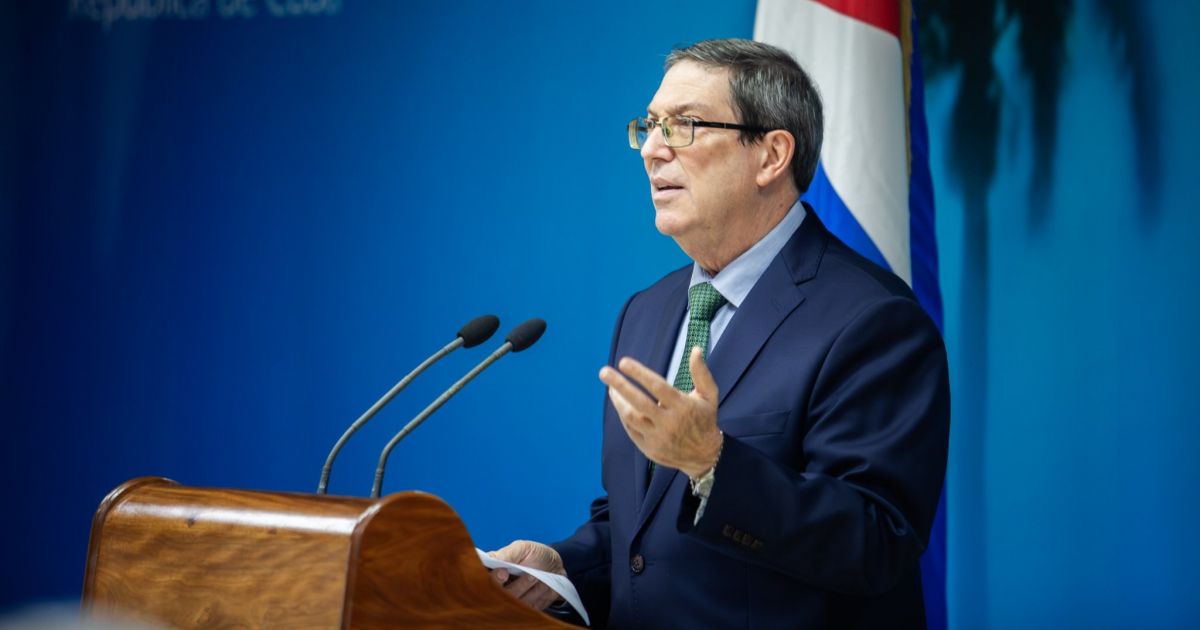
The chancellor Bruno Rodríguez denounced that Washington intends to subject Cuba to "extreme living conditions", and attributed the measure to a political operation based on "lies" and "international blackmail."
“We firmly condemn the new escalation by #USA against #Cuba. Now there is a proposal to impose a total blockade on fuel supplies to our country”, wrote the diplomat at the beginning of his complaint on X.
Rodríguez warned that the narrative used by the White House seeks to portray Cuba as a destabilizing actor in the region, when—according to his perspective—it is Washington that creates instability.
“To justify it, it relies on a lengthy list of lies that aim to portray Cuba as a threat that it is not”, the statement points out, also published by the Ministry of Foreign Affairs (MINREX) on its website.
"Every day there is new evidence that the only threat to peace, security, and stability in the region, and the only malignant influence, is that exerted by the government of the USA against the nations and peoples of Our America," the document adds.
The chancellor also accused the United States of exerting diplomatic pressure to further isolate Cuba.
“The U.S. also resorts to blackmail and coercion to try to get other countries to join its universally condemned blockade policy against Cuba, to which it threatens with the imposition of arbitrary and abusive tariffs if they refuse, in violation of all free trade norms," adds the regime's formal complaint.
"We denounce before the world this brutal act of aggression against Cuba and its people, who for more than 65 years have been subjected to the most prolonged and cruel economic blockade ever imposed on an entire nation, and to which they are now promised extreme living conditions," he concluded.
Carlos Giménez responds
Bruno Rodríguez's reaction did not go unanswered.
The Cuban-American congressman, Carlos Giménez, directly responded to the chancellor on platform X.
“Bruno, you still have time to return to your homeland of Mexico. What President Trump is doing is not a game. He keeps his word. They have little time left. This is until the end.”, wrote the Republican legislator.
Until this note is closed, Miguel Díaz-Canel remains silent. He has not reacted to President Trump's announcement.
A political offensive amid a "national emergency"
The response from the Cuban regime comes after President Donald Trump signed an executive order declaring a “national emergency” due to the alleged threat that Cuba poses to the security and foreign policy of the United States.
The document authorizes the U.S. government to impose tariffs on countries that sell or supply oil to the island.
According to the text, "the policies and actions of the Government of Cuba represent an unusual and extraordinary threat," and Havana is accused of collaborating with "malicious actors" such as Russia, China, Iran, Hamas, and Hezbollah.
The White House claims that Cuba "harbors dangerous adversaries," provides infrastructure for Russian and Chinese intelligence, and offers refuge to terrorist organizations.
It also claims that the communist regime "destabilizes the region through migration and violence," and commits systematic human rights violations.
"The United States has zero tolerance for the depredations of the Cuban communist regime," warns the order, which establishes a system of tariff sanctions to be administered by the Secretaries of Commerce and State.
A measure to provoke the collapse of the regime
The diplomatic and economic offensive is part of a broader strategy driven by Trump, which -as revealed by The Wall Street Journal-aims to accelerate a regime change in Cuba as soon as possible.
U.S. officials reportedly identified a "historic window of opportunity" following the collapse of Venezuelan support and the capture of Nicolás Maduro.
Trump himself has been explicit in his evaluations: “Cuba seems to be on the verge of collapse. I don’t know how they are going to be able to hold on,” he recently stated, alluding to the energy crisis hitting the island, characterized by daily blackouts, halted production, and a severe fuel shortage.
A scenario of maximum tension
This new measure adds to others previously adopted by Trump since his first term, such as including Cuba on the list of state sponsors of terrorism, implementing travel restrictions, and canceling bilateral agreements.
In June 2025, the White House had already toughened its policy towards the island through a national security memorandum.
The internal situation in Cuba, with a crisis-stricken economy, a semi-paralyzed productive apparatus, and increasing social unrest, is now worsening due to the real possibility of running out of fuel supplies.
The EFE agency reported in recent hours that several embassies and international companies are quietly updating their evacuation protocols, fearing a scenario of total collapse.
A measure with global reach
The executive order not only impacts Havana but also serves as a warning to governments such as those of Mexico, Russia, or Algeria, which in recent years have maintained energy exchanges with Cuba.
The U.S. Secretary of Commerce will need to identify the countries involved in these supplies, while the Secretary of State will decide whether sanctions will be imposed.
The legal document is based on the International Emergency Economic Powers Act, the National Emergencies Act, and Title 3 of the United States Code.
It includes provisions to amend the decree based on reprisals or changes in the context, as well as the obligation to report to Congress on actions taken as a result of the declared emergency.
Filed under: