
Related videos:
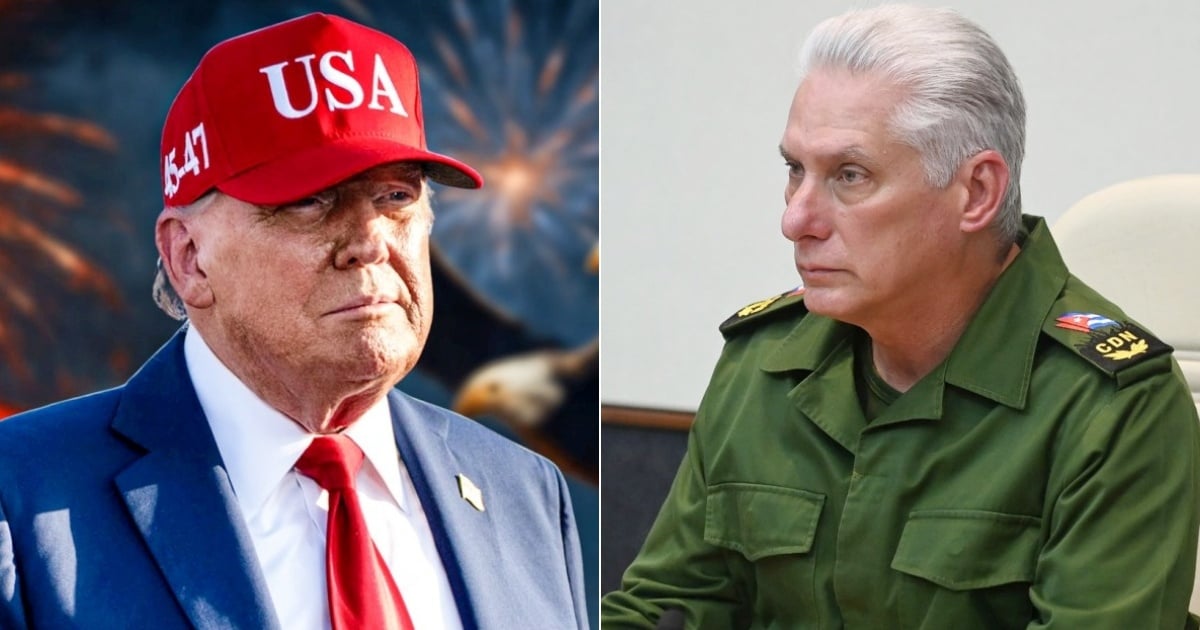
Miguel Díaz-Canel just spoke this Friday about the recent executive order signed by Donald Trump, which seeks to cut off oil supplies to Cuba by imposing tariffs on countries that send fuel to the island.
The Cuban leader has accused the United States of acting under "a false pretext and devoid of arguments", and of wanting to "suffocate the Cuban economy by imposing tariffs on countries that sovereignly trade oil with Cuba."
“Didn't the Secretary of State and his clowns say that the blockade didn't exist? Where are those who bore us with their false stories that it is merely a ‘trade embargo’?”, he questioned, confronting those who claim that "the blockade" does not exist.
Finally -true to his rhetoric- the leader concluded by saying that this new escalation demonstrates “the fascist, criminal, and genocidal nature of a clique that has hijacked the interests of the American people for purely personal purposes.”
A response in line with the previous position of Foreign Minister Bruno Rodríguez
The ruler's reaction comes several hours after the chancellor Bruno Rodríguez denounced what he described as a “brutal act of aggression” by Washington.
Bruno Rodríguez was the first to raise the official voice, warning that the United States seeks to "impose a total blockade on fuel supplies" and subject the country "to extreme living conditions."
Rodríguez accused the White House of resorting to "blackmail" to force third countries to join its isolation policy against Cuba, by threatening "arbitrary and abusive tariffs."
According to the statement issued by MINREX, the measure is based on "a long list of lies that aim to present Cuba as a threat that it is not."
He also insisted that "the only threat to the peace, security, and stability of the region" is the U.S. government itself.
Trump's measure
The executive order signed by Trump declares Cuba an "unusual and extraordinary threat" to the security of the U.S. and authorizes the Secretaries of Commerce and State to impose sanctions on countries that engage in energy exchanges with the island.
The document accuses the Havana regime of facilitating intelligence operations for Russia and China, harboring organizations such as Hamas and Hezbollah, and contributing to regional destabilization through "migration and violence."
This strategy is framed, according to sources cited by The Wall Street Journal, as part of a campaign aimed at accelerating a regime change in Cuba, based on the assumption that "the island is about to fall" and that the time to act is now.
A scenario of high geopolitical tension
The measure also has a global dimension. Governments such as those of Mexico, Russia, or Algeria, which have sent oil to the island in the recent past, could be directly affected by the imposition of sanctions.
The executive order is based on a combination of legal frameworks—the National Emergencies Act, the International Emergency Economic Powers Act, and the U.S. Code—giving it broad scope.
Meanwhile, press reports indicate that foreign embassies and companies are beginning to discreetly review their evacuation plans in response to a potential energy collapse in Cuba.
The crossing between Washington and Havana has reached a new peak of tension.
Díaz-Canel's stance reinforces the Cuban government's narrative of victimization in the face of external aggression.
However, Trump's measure seems to aim beyond mere symbolic pressure.
This is an action designed to strangle the Cuban regime at its most vulnerable point: access to energy sources, while aiming to break the last link of international cooperation that keeps the power structure on the island alive.
UNDER CONSTRUCTION
Filed under: