
Related videos:
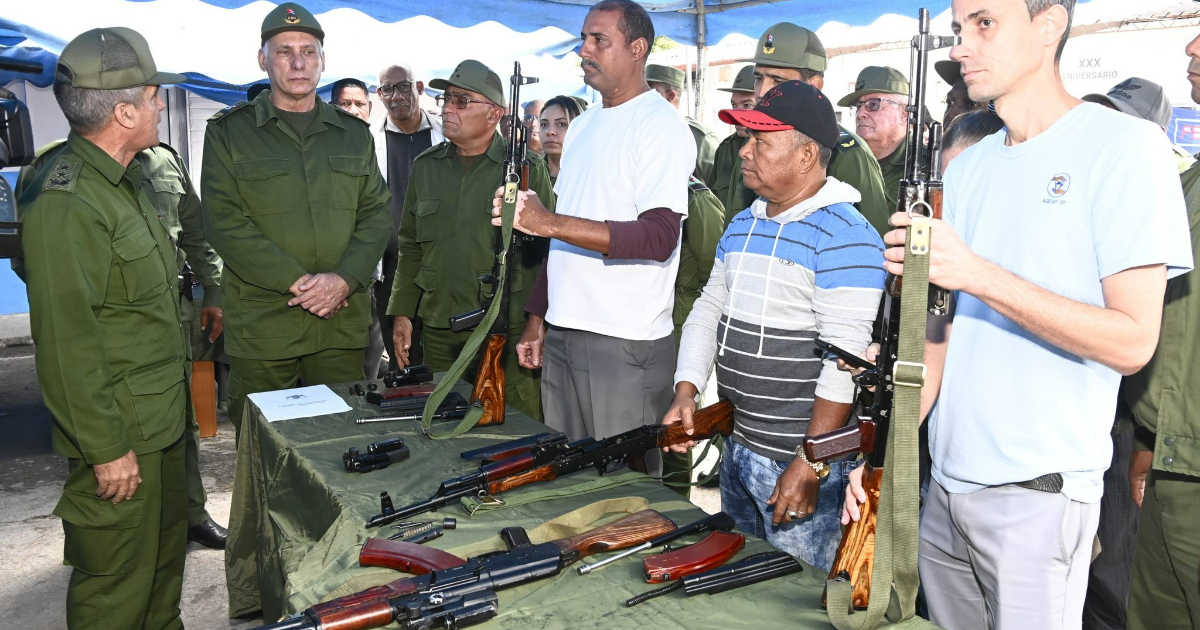
The Cuban leader Miguel Díaz-Canel reappeared this Saturday in an olive green uniform, with a stern expression and a museum rifle a few meters away, at a military event in Tamarindo, Diez de Octubre municipality, as part of the third "National Defense Day" of the month.
The scene, more typical of an 80s movie than of a country in crisis, aimed—according to Presidencia—to “enhance the preparedness of the people under the concept of the War of All the People.”
Surrounded by army generals, ministers of the Interior and the Armed Forces, and a handful of neighbors gathered for the occasion, Díaz-Canel sought to convey firmness in the face of what he described as a "growing aggressiveness of imperialism."
In reality, the event resembled more of a fair of outdated weapons and ideas than a tactical exercise: half-century-old AKM rifles, gas masks from the "trench warfare" era, and a couple of makeshift tents served as the backdrop for the new "war report" from the Communist Party.
“Every Cuban man and woman must have a way, a place, and a means of defense,” stated the field marshal and first secretary of the PCC, as attendees—among them several civilians with a Sunday look—held “means” that would barely survive a gust of wind.
The official news outlets, however, portrayed the event as a demonstration of "revolutionary unity" and "combat readiness against any foreign aggression."
The "field marshal of Tamarindo," as users on social media dubbed him, did not seem particularly enthusiastic: the official photos showed him serious, almost absent, as he listened to explanations about pieces of weaponry that might be better suited for a museum.
Around him, the military hierarchy smiled with discipline, perhaps aware that the true battle facing the country is not fought with rifles, but with blackouts, scarcity, and weariness.
Meanwhile, while Cuba showcases symbolic exercises, the United States continues its technological and strategic deployment in the Caribbean, reinforcing its air and naval presence following the capture of Nicolás Maduro.
The gap between the two scenarios could not be more eloquent: on one side, drones, satellites, and aircraft carriers; on the other, recycled speeches and militia members with wooden rifles.
With this new day of "popular defense," the regime attempts to project control and cohesion. But what was witnessed in Tamarindo was something else: a display of declining power, an increasingly empty ritual where the imaginary enemy serves once again to distract from real hunger and the boredom of yet another weekend of blackouts.
Filed under: