
Related videos:
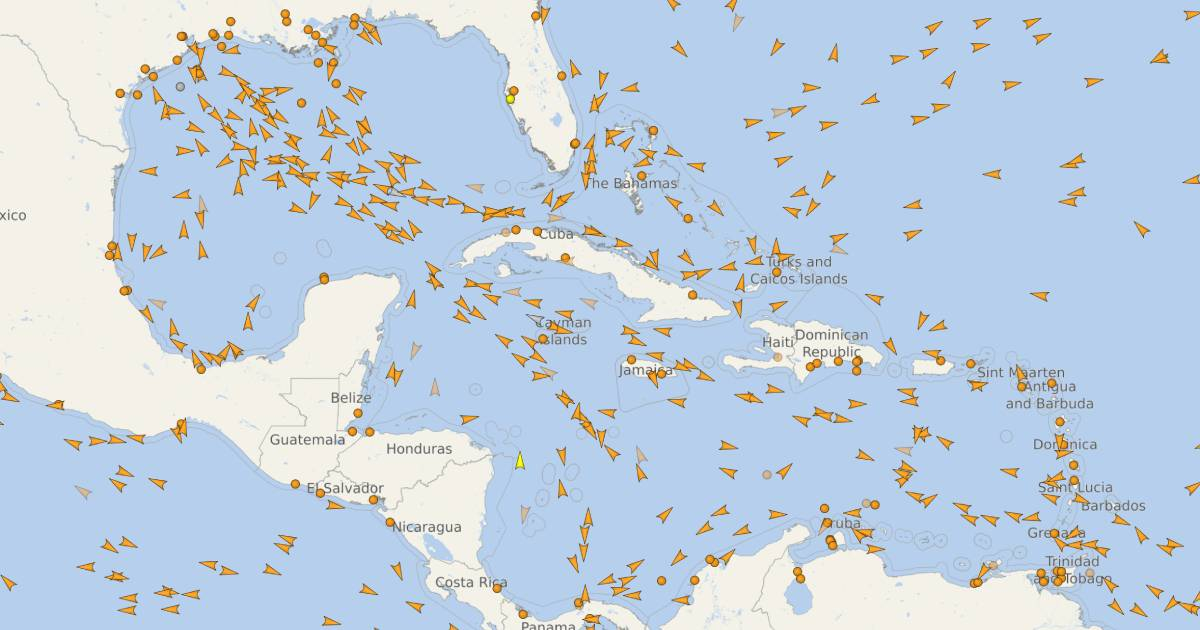
While oil flows continuously through the Caribbean and the Gulf of Mexico, Cuba is virtually absent from those energy routes. Images from the maritime tracker VesselFinder clearly show this, as dozens of tankers loaded with crude navigate around the Island, but very few, if any, are heading to its ports.
In a first view, with the filter for tankers heading to Cuba activated, only two local movements in the region are detected. In a second image, without that filter, the map fills up with oil vessels off the coast of Florida, Central America, northern South America, and the arc of the Antilles, while Cuba appears almost blank, isolated in the midst of a sea saturated with crude oil.
Screenshot/VesselFinder.
The images reflect in real time the impact of the new energy blockade driven by Washington. The President of the United States, Donald Trump, signed an executive order this week declaring a national emergency and paving the way to impose tariffs on countries that sell or supply oil to Cuba, a direct warning to any potential supplier attempting to replace Venezuela.
Screenshot/VesselFinder.
The measure comes at the worst time for the Island. According to data analyzed by the Financial Times based on information from the firm Kpler, Cuba currently has enough oil reserves for only between 15 and 20 days. So far in 2026, it has received only a single shipment of crude oil, coming from Mexico on January 9, while facing a severe shortage of fuel oil, which is essential for sustaining power generation.
The collapse of Venezuelan supply following the capture of Nicolás Maduro, the reduction or suspension of shipments from Mexico, and direct pressure from the United States have left the country with virtually no options.
Surrounded by oil but without access to it, Cuba faces an energy isolation that is already resulting in prolonged blackouts, paralyzed transportation, and an informal market where fuel reaches prices that are unaffordable for most.
Miguel Díaz-Canel himself denounced what he described as an attempt at “total suffocation” by Washington, accusing Trump of trying to deprive the Island of the necessary fuel to sustain the economy and daily life.
The consequences are felt at home. Endless lines, fear of running out of gas or electricity, hospitals and public services operating at their limits. In many areas of the country, daily life unfolds amid blackouts lasting over 20 hours and the uncertainty of how much longer the energy system can endure.
As the United States toughens its strategy and warns that Cuba will no longer receive "neither oil nor money," the island finds itself at a critical point. Isolated from the crude oil that surrounds it, the country is facing a dire scenario in which, once again, the greatest burden falls on the population.
Filed under: