
Related videos:
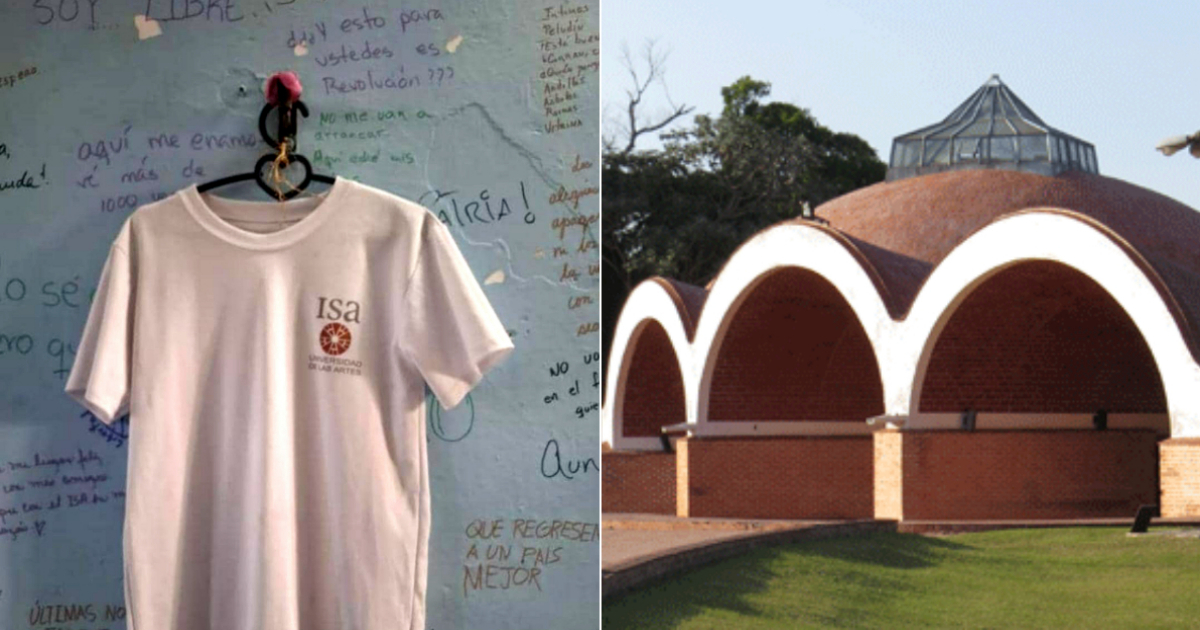
Images sent to the editorial office of CiberCuba revealed a silent protest by students of the Higher Institute of Art (ISA) in Havana, following the indefinite suspension of in-person classes due to the severe energy crisis that Cuba is experiencing.
The measure, adopted by the Ministry of Higher Education, has generated concern and frustration among young people who rely on practical training to complete their academic education.
The photographs depict a nearly empty room in the institution, with tables pushed aside and a white ISA t-shirt hung in the center of a wall covered with handwritten messages. The phrases, scattered and overlapping, reflect a mood of disillusionment, rupture, and loss of expectations.
Among the slogans that stand out clearly are "I AM FREE," "and this is what you call a revolution???" "Here I was deceived," "Last notes from the insilio," and "LET'S RETURN TO A BETTER COUNTRY." The use of the term "insilio" reflects the sense of confinement and exclusion that many young people experience on the island.
One of the messages received by this newsroom, sent on condition of anonymity, describes the action as a way to “raise their voice” against a reality they consider unsustainable.
The sender warned that many students come from all corners of the country, live in university residences, and today do not know if they will be able to graduate. "We don’t know if we will return," he said, while denouncing that their dreams "are going overboard due to a system and officials who do not represent" their generation.
The closure of in-person classes hits art students particularly hard. Fields such as theater, dance, music, and visual arts rely on direct contact, physical work, collective rehearsals, and access to specialized spaces, which cannot be replaced by remote learning methods in a country with severe technological limitations and constant power outages.
Beyond the academic impact, the protest reflects a growing generational discontent.
For many young artists, the ISA is not just a place of study, but a space for life, creation, and cultural resistance. The indefinite suspension of in-person classes symbolizes, for them, something deeper: the interruption of a future project in a country where it is becoming increasingly difficult to envision one.
The ISA: A Tradition of Rebellion Against Political Control
The dissatisfaction expressed today by the students of the Instituto Superior de Arte is connected to a long tradition of critical thought that has made the ISA one of the most uncomfortable academic spaces for the authorities in Cuba since its establishment, particularly in the 1980s.
Unlike other institutions of higher education, the ISA has historically been a hotbed of aesthetic, political, and social debates, where generations of young artists have challenged the limits imposed by the State on creativity and free thought.
For decades, the regime has attempted to "establish order" within the institution through silent purges, ideological surveillance, control over access to scholarships, censorship of works, and the imposition of political figures in leadership roles. However, these efforts have failed to completely eradicate a critical spirit that reemerges cyclically during times of crisis.
One of the most visible episodes occurred after the protests on July 11, 2021, when students from ISA mobilized in support of a detained classmate - the music student Abel González Lescay - challenging the atmosphere of fear imposed in universities across the country.
Since then, far from disappearing, the tension between students and authorities has remained latent. Each new restrictive measure—ranging from academic cuts to unilateral administrative decisions—has reactivated a collective memory of resistance that identifies ISA as a space where art and dissent often intersect.
This legacy contrasts with the presence in the faculty of figures directly linked to power, such as Lis Cuesta Peraza, wife of the leader Miguel Díaz-Canel, who has been incorporated as a professor at the institution, or the singer-songwriter Israel Rojas, invited by the "non-first lady" as a guest speaker in her cultural management course.
For many students and graduates, their inclusion symbolizes yet another attempt by the regime to tame a historically uncomfortable institution, although so far it has not fully succeeded in neutralizing the critical capacity that defines the ISA.
The current protest, far from being an isolated event, confirms that this rebellion is still alive, even in conditions of extreme precariousness.
Filed under: