
Related videos:
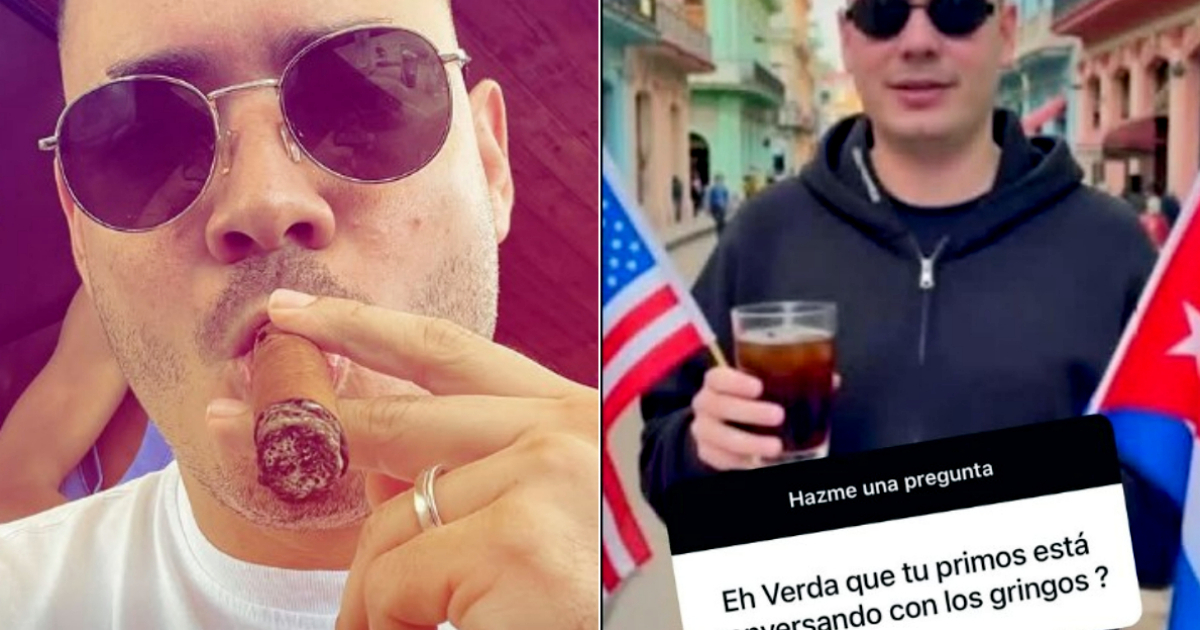
The "businessman" and "young revolutionary" Sandro Castro once again resorted to his usual formula of "Ask me a question" on Instagram to comment on one of the most discussed political rumors in recent weeks.
Through his Instagram account, the grandson of dictator Fidel Castro responded to a question about the alleged conversations between his cousin, Raúl Guillermo Rodríguez Castro —known as “El Cangrejo”— and the United States Secretary of State, Marco Rubio.
The follower was direct in his concern: “Is it true that your cousin is talking to the Americans?” Sandro's response was somewhat vague: “I have no idea,” replied the influencer and expressed his personal opinion: "I think it's false."
The "nietísimo" of the Castros accompanied the message with an image in which he is seen holding a Cuba Libre—his new favorite drink, as he has recently shown after "retiring" the Cristach—while flanked by the flags of the United States and Cuba.
The context is not insignificant. Cuban independent media -including CiberCuba- recently published articles about the revelations from Axios that pointed to alleged discreet contacts between Rubio and “El Cangrejo,” in a setting marked by the maximum pressure policy driven by President Donald Trump and the intensification of the energy crisis on the island.
According to this information, Washington is exploring interlocutors within the core of Cuban power, beyond the formal figure of the designated ruler, the learned "appointed one," Miguel Díaz-Canel Bermúdez.
Raúl Guillermo Rodríguez Castro, grandson of Raúl Castro and historically linked to the security apparatus, is viewed by analysts as part of the circle with effective influence within the military and economic framework of the regime.
His father, the late General Luis Alberto Rodríguez López-Calleja, led GAESA and was regarded as the administrator of the regime’s finances. This is why his son now appears in reports about possible exploratory contacts.
Beyond the political rumors, both Sandro and his cousin carry a reputation linked to nightlife, ostentation, and excesses, cultivated on social media and amplified by images of parties, drinks, yachts, luxury cars, and exclusive settings in Havana.
In popular imagination, both embody a generation of heirs to revolutionary power who enjoy privileges that are hard to reconcile with the official discourse of austerity and sacrifice that the regime preaches to the rest of the country.
This public perception—nurtured both by their own exhibitions and by recurring comments in exile—adds a layer of skepticism whenever their names are linked to state affairs.
Sandro's response does not categorically confirm or deny anything. His "for me, it is false" leaves room for interpretation and fits the ambiguous style he has cultivated on social media: brief comments, a casual tone, and visual hints that often carry symbolism.
The act of holding a Cuba Libre—amid rumors of negotiations with the United States—did not go unnoticed this time either for those who follow the antics of the "king of the night" in Havana.
Meanwhile, other versions that initially circulated on social media and were later reported by the Spanish newspaper ABC pointed to alleged conversations in Mexico led by Alejandro Castro Espín, known as “El Tuerto,” the uncle of Sandro and "El Cangrejo," and son of Raúl Castro.
Although these are unconfirmed rumors, the exchange of names reinforces the perception of internal movements within the family circle of power.
Amid power outages, fuel shortages, and political uncertainty, the Castro name is once again at the center of the debate. Sandro, true to his digital persona, responds without entirely clarifying the mystery. And while the country seeks certainties, he toasts—Cuba Libre in hand—with a phrase that, rather than closing the subject, keeps it open.
Filed under: