
Related videos:
In military and political history, there is a useful criterion for evaluating extreme decisions: does resistance alter the outcome of a conflict, or does it only multiply the human cost?
When the refusal to negotiate does not change the strategic outcome, but instead increases civilian suffering, the epic can transform —over time— into tragic stubbornness.
This historical pattern is particularly revealing when observing the current situation in Cuba following the tightening of U.S. sanctions and, in particular, the blockade of oil and fuels imposed at the end of January.
The drastic reduction in energy supply directly impacts hospitals, transportation, food production, and basic services.
In this context, the central question is not ideological, but rather strategic and humanitarian: Does prolonging the confrontation really alter the structural outcome of the conflict or simply accelerate internal deterioration?
History provides clear examples of both paths.
In 1871, Paris endured months of Prussian siege. Hunger became extreme and sanitary conditions collapsed. When it became evident that the resistance would not break the encirclement or change the military outcome, the National Defense Government accepted the armistice. It was not a glorious decision, but it prevented even greater deterioration.
In 1945, Japan was facing a devastating naval blockade, cities ravaged by bombings, and the imminent threat of invasion. Emperor Hirohito intervened to accept the surrender and spoke of "bearing the unbearable" in order to preserve the nation. The decision involved acknowledging defeat, but it spared millions of additional deaths in a war that had already been strategically lost.
In contrast, Jerusalem in the year 70 AD resisted until total destruction. The refusal to surrender did not change the balance of power against the Roman Empire; the result was the devastation of the city and an irreversible human tragedy. Absolute resistance did not save the cause, but it did raise the human cost to its peak.
The difference between one case and another does not lie in bravery, but in the hierarchy of priorities: preserving lives or maintaining a narrative.
Cuba is not under a conventional military siege. However, the accumulated external pressure—financial sanctions, trade restrictions, and now severe limitations on energy supply—creates a scenario of high internal vulnerability.
With fuel in short supply, productive sectors are coming to a standstill, hospitals are being affected, and public transportation is deteriorating. The impact primarily falls on the population.
But there is an additional element that cannot be overlooked in the analysis: the nature and the outcomes of the political project that has governed the island since 1959. After 67 years in power, the model that emerged from the so-called "Cuban Revolution" has failed to build a sustainable economy or a plural and functional institutional system.
Extreme centralization, the suppression of political freedoms, the subordination of the productive apparatus to state and military control, and the capture of major resources by an elite connected to power have shaped a state that is closed off from itself.
The persistence of the conflict with the United States cannot be analyzed as if it were a temporarily besieged successful project.
The Cuban economy has been showing structural signs of exhaustion for decades: low productivity, chronic dependence on external subsidies, deteriorating infrastructure, massive emigration, and a monetary and exchange rate duality that has caused deep distortions.
Even before the recent intensification of energy sanctions, the country was already facing recurring blackouts, inflation, and shortages.
In this context, the narrative of resistance takes on a different shade. This is not about defending a prosperous or just model against external aggression, but about sustaining a system that, after more than six decades of political monopoly, has failed to provide material prosperity or institutional openness.
When a political project has concentrated all power for 67 years, the responsibility for the current state of the country cannot be solely attributed to external factors.
The official response has resorted to the rhetoric of a besieged city: “no one surrenders here”, heroic resistance, sacrifice as a revolutionary virtue. The issue is not the appeal to national pride, but rather the presentation of political obstinacy as the only possible moral choice, obscuring the debate on deep reforms.
If the resistance does not change Washington's position —which has conditioned any significant relief on structural changes in the political and economic spheres— the question becomes inevitable: What does persistence without adjustments actually change?
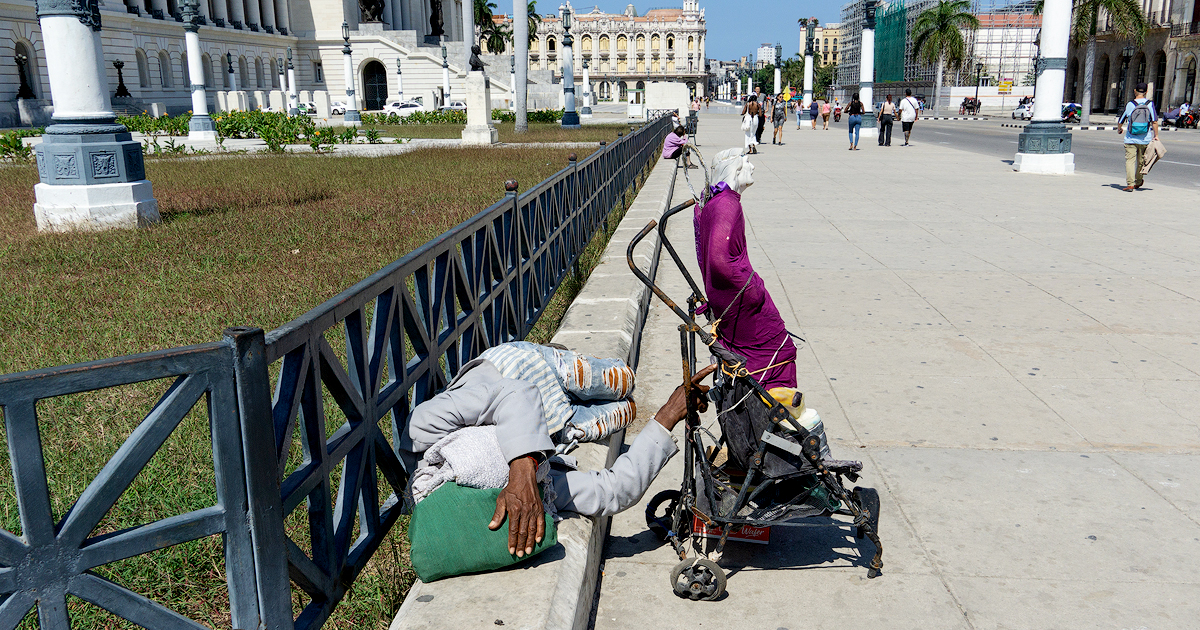
Internally, the cost is tangible. With limited energy, the already weakened economy contracts even further. Scarcity and inequality worsen between those who have access to foreign currency and those who depend solely on the state system. Migration is on the rise. Public services are operating at their limits.
When the continuity of the model does not alter the external outcome but does intensify the internal social cost, history invites a reconsideration of the strategy. Negotiating, reforming, or introducing structural changes does not necessarily mean capitulating; it can, under certain circumstances, be an act of responsibility.
The heroic discourse serves a mobilizing function in contexts of open war. However, it can also become a fallacy when it poses a false dilemma: to resist without concessions or betray sovereignty.
Historical experience shows that there are intermediate paths, where national dignity is preserved without imposing an indefinite and increasing sacrifice on the population.
Even more so, when a political project has had nearly seven decades to prove its viability and has failed to build an economy capable of sustaining itself without extreme controls or structural dependency, resistance ceases to be a defense for the future and becomes a defense of an exhausted statu quo.
Sovereignty is not measured solely by the ability to withstand external pressures, but by the ability to guarantee dignified living conditions for citizens. When hospitals operate with energy limitations and transportation collapses, the debate shifts from being abstract to an ethical issue of governmental responsibility.
History does not automatically absolve those who resisted until the end. It often judges leadership more harshly when, having the power to reduce human suffering, they chose to prolong it in the name of a narrative.
Cuba is facing a strategic crossroads. Persisting in the narrative of siege may provide short-term cohesive discourse. However, if it does not alter the external correlation or improve internal conditions, it risks becoming a resistance that does not change the outcome, but rather deepens suffering.
Ultimately, the value of leadership is not measured by its ability to endure indefinitely, but by its ability to recognize when enduring ceases to be a reasonable option and becomes an unnecessary burden for its own people.
Filed under:
Opinion piece: Las declaraciones y opiniones expresadas en este artículo son de exclusiva responsabilidad de su autor y no representan necesariamente el punto de vista de CiberCuba.