
Related videos:
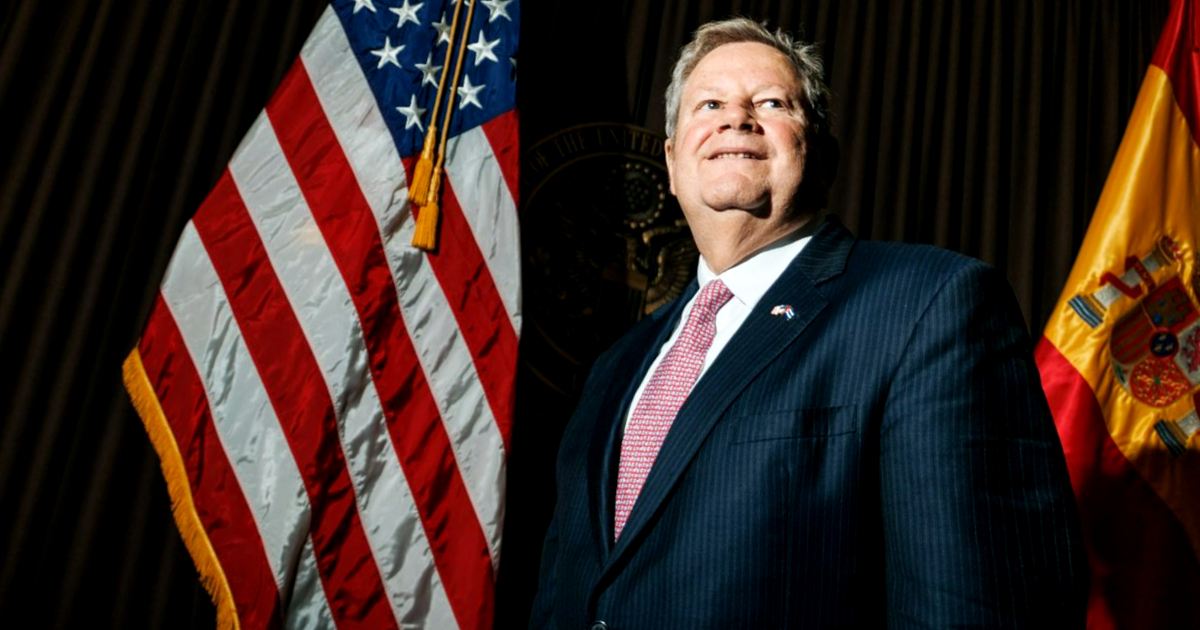
The Chargé d'Affaires of the United States in Havana, Mike Hammer, delivered one of his most direct messages regarding the political situation in Cuba by stating that the regime operates as a dictatorship and emphasizing the need to free all political prisoners.
At the same time, the American diplomat asserted that he perceives a shift in the mood of the Cuban population, characterized by economic strain and a loss of fear.
In a recent interview granted to the Spanish newspaper ABC, the State Department official was firm when asked about those who avoid labeling the Cuban system as a dictatorship.
“If in a country one cannot express oneself freely and they imprison you for holding up a sign, then let them tell me it's not a dictatorship,” he stated. He added a challenge: for those who have doubts to visit the island, walk its streets, and speak with ordinary people, not just with official spokespersons.
The diplomat emphasized that repression is not a rhetorical phenomenon, but a daily reality. He mentioned cases of young people imprisoned and the situation of independent journalists who face constant surveillance.
Furthermore, he questioned the government's priorities amid the energy crisis: while the population endures prolonged blackouts and fuel shortages, security forces have resources to operate.
“The patrols do have gas to move around and follow me, or to go and detain or imprison anyone who says something the regime doesn't like,” he stated. The phrase summarizes one of Washington's central criticisms: that the repressive apparatus remains operational even as basic services collapse.
In parallel, Hammer insisted that the United States prioritizes the release of all political prisoners. This statement comes amid increasing pressure from President Donald Trump's administration on Havana, with energy sanctions and warnings to countries that supply oil to the island.
However, beyond the denunciation, the diplomat introduced an element that points to a transformation in the social climate. According to his account, when he arrived in Cuba in November 2024, there was no open discussion about political changes. Today, he asserts, the perception is different. “People no longer ask if it will happen, but rather when,” he noted.
That perception, although subjective, aligns with a reality marked by a structural economic crisis. Power outages of eight to ten hours a day in several provinces, shortages of food and fuel, deteriorating hospitals, and a massive emigration that has emptied entire neighborhoods. More than one million Cubans have left the country in the last decade, in a nation with fewer than 11 million inhabitants.
Hammer affirmed that he perceives that "Cubans are losing their fear". For the diplomat, the combination of international pressure, economic exhaustion, and increasing access to information has changed the attitude of sectors of the population that for decades avoided expressing criticisms openly.
Nevertheless, the repressive machinery continues to demonstrate its capacity for control. Surveillance of opponents, journalists, and activists remains constant, and any sign of engagement with foreign actors can lead to reprisals.
The contrast between an exhausted society and a closed totalitarian regime defines the current moment. While Washington increases its pressure and openly talks about potential changes, Havana rejects what it perceives as external interference and defends its model.
Hammer's statements once again highlight the issue of human rights as the central point of the debate regarding Cuba's future.
Beyond the geopolitical landscape, the diplomat emphasized that the focus should be on the ordinary citizen: their right to express themselves freely, to choose their leaders, and to live without repression.
Whether the political change materializes in the short term will depend on multiple internal and external factors.
But the direct focus on the nature of the regime and the perception of a change in social sentiment reinforce the idea that the island is experiencing a moment of accumulated tension, where political pressure and economic strain intersect with a citizenry that is increasingly aware of its reality.
Filed under: