
Related videos:
Amid power outages that in several provinces exceed 12 to 16 hours daily, a state office has begun selling solar panels for Cuban pesos.
It is not a specialized store or an energy company, but rather the Postal Service of Cuba in Sancti Spíritus.
According to the official newspaper Granma, the entity -recognized as a National Vanguard collective- “has incorporated the sale of solar panel kits into its commercial offerings in national currency, thereby contributing to the country's efforts to achieve a transformation of the energy matrix.”
The decision, also confirmed by the local broadcaster Radio Vitral, marks an unusual step in the diversification of services by Correos de Cuba, in a context where the electricity crisis has turned any alternative for domestic power generation into a strategic resource for families.
What does Correos sell and to whom?
Master in Sciences Carlos Gotera González, general director of the company in Sancti Spíritus, explained that marketing is a response to the "powers granted to the business sector in Cuba" and to partnerships with different management forms.
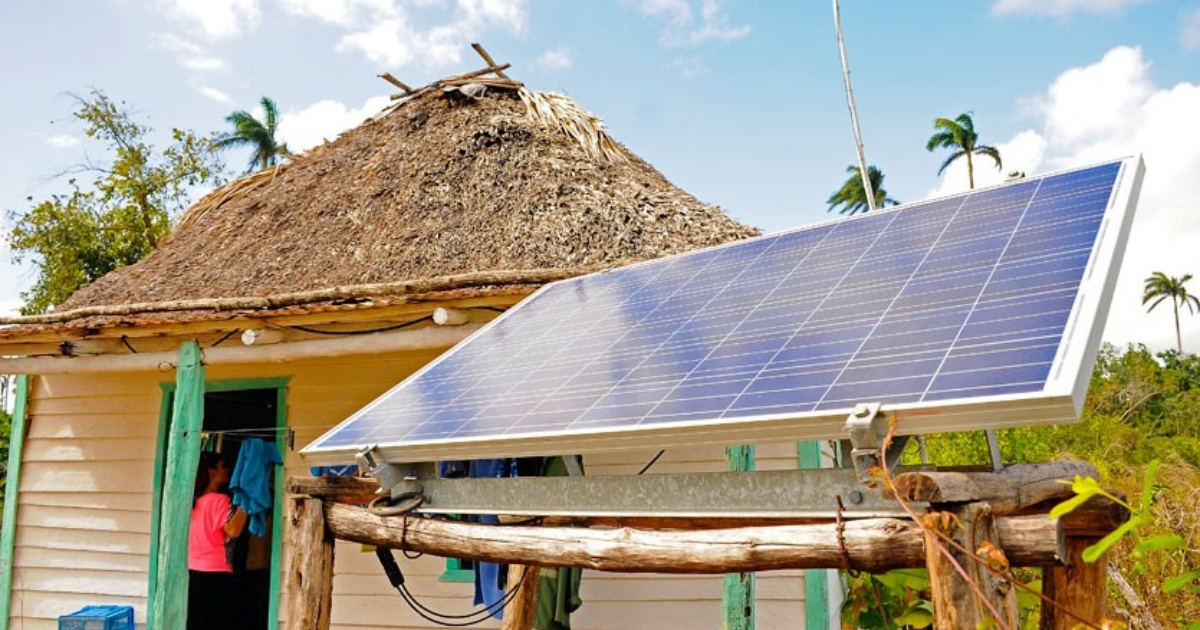
“We are selling solar panel kits with different capacities: 3 kW, 5 kW, 6 kW, and 10 kW. We offer these for both individuals and businesses,” specified Gotera González.
According to the official information, each kit includes the panels based on the selected power, the inverter, the batteries, all necessary wiring, and the metal structure for installation.
The after-sales warranty "varies depending on the purchased power and is backed by a prior contract."
Payment is made entirely in Cuban pesos (CUP), either through electronic channels or in cash.
Interested parties must report to the company's commercial office to coordinate the process with the management.
However, the entity itself clarified that, for the moment, it does not offer installation services, as it does not have specialized personnel for that task.
That is to say, the buyer must handle the technical assembly of the system on their own.
What hasn't been said: Prices and payment options
Although the news has been presented as an expansion of options to access renewable energy without resorting to MLC stores, there are key data points that have not been disclosed.
So far, the espirituana branch has not published the prices of the kits nor specified if it will offer payment facilities or credits.
It has not been clarified whether the sale is limited to residents of Sancti Spíritus or if citizens from other provinces can access the service.
In the comments circulated after the initial information, several readers insisted on those points.
A user pointed out that the option is attractive, but requested that prices be made transparent and images of the offers be displayed.
Another commentator questioned the announcement of the product without detailing costs or possible payment options, while other internet users directly asked how much the kit costs and if it can be purchased on credit.
The absence of prices is not a minor detail in a country where the average state salary hovers around figures that barely cover basic food needs.
The precedent: more than 75 thousand pesos for a module
What is known in the national market is the price of similar systems sold by state-owned companies.
Recently, the Electric Union reported that the 800-watt photovoltaic module being installed in the homes of Heroes and Heroines of Labor is valued at 75,200 Cuban pesos.
That package includes a solar panel, six meters of cable, connectors, and a battery with an output of 1,200 watts, enough to power basic appliances such as a refrigerator, a rice cooker, or a television.
The amount is equivalent to more than 20 monthly salaries of an average state worker.
For most Cuban families, gathering more than 75,000 CUP is virtually impossible without external assistance.
In that program, aimed at workers deemed "prioritized," the company includes the installation in homes and offers payment facilities.
Additionally, the authorities have mentioned options for cash payment or by card, and even "family support," a formula that in practice often translates to remittances sent from abroad.
The official plan aims to benefit over 10,000 workers with compact solar energy systems, and more than 130 modules have already been installed among the more than 200 Heroes of Labor recognized in the country.
Renewable energy in a country in the dark
At the same time, the government has announced tariff exemptions for the importation of panels, batteries, and inverters, tax benefits of up to eight years for those who invest in renewable energy, and the possibility of selling generated electricity to third parties.
In theory, these measures aim to encourage decentralized generation in response to the fuel shortage and the collapse of the national electrical system.
In practice, access to energy autonomy depends on the ability to pay.
In a country where food spoils due to lack of refrigeration and water pumping is disrupted by power outages, a solar panel ceases to be a technological luxury and becomes a basic necessity.
The fact that a post office is now selling photovoltaic kits for Cuban pesos can be interpreted as a sign of institutional adaptation to the crisis.
But as long as the prices and actual access conditions remain unknown, the question persists: Are these systems within reach of most Cubans, or only for those who can gather, once again, tens of thousands of pesos amidst the national darkness?
Filed under: