
Related videos:
The Cuban Company of Airports and Airport Services S.A. (ECASA), affiliated with the Ministry of Transport, launched a public call for advertisers interested in promoting their businesses within the country's airport terminals, amid one of the worst economic and energy crises Cuba has faced in decades.
In a post shared on its official Facebook page, the entity invited potential clients to utilize the available spaces in Cuban airports. "It’s time for your business to soar higher. New clients, new spaces, new opportunities," states the promotional message.
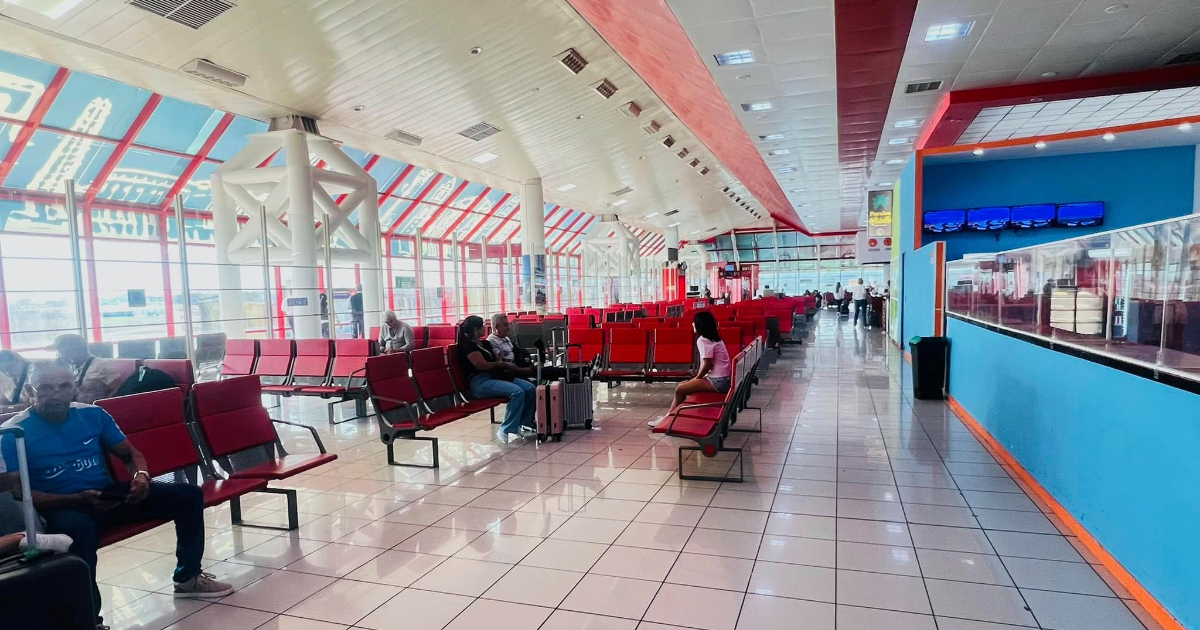
The campaign offers the opportunity to advertise on screens, trolleys, and other media within airport facilities, arguing that they allow access to thousands of travelers and provide visibility to brands and services at strategic transit points.
However, the call takes place in a particularly complex context for national aviation. Cuba is experiencing a structural energy crisis characterized by prolonged blackouts, productive paralysis, and an almost complete dependence on imported oil. The situation worsened following the decline in Venezuelan supply in early January 2026, after the arrest of Nicolás Maduro and the collapse of the preferential crude oil shipping scheme to the Island.
On that stage, there was also the January 29, when President Donald Trump declared a national emergency regarding the Cuban government and activated a mechanism to impose tariffs on countries that supplied oil to Cuba, a measure that increased the uncertainty surrounding the already precarious energy supply.
Although that instrument was eliminated on February 20 following the Supreme Court ruling that declared most tariffs imposed under IEEPA illegal, the White House signed a new order that eliminated the oil tariff but upheld the national emergency regarding Cuba, which means that Washington's legal pressure framework remains active.
As discussed in the assessment of the real scope of the new executive order, although the specific tariff mechanism has been eliminated, other legal tools remain that allow for the regulation of maritime traffic and reinforce control over the supply to the Island.
During this period of high energy uncertainty, the already fragile fuel supply was further compromised. The scarcity has impacted transportation, electricity generation, and air operations, with reports of operational adjustments, reduced frequencies, and logistical tensions in the sector.
International tourism, one of the financial pillars of the regime, has also failed to recover to pre-pandemic levels. The combination of the energy crisis, deterioration of basic services, inflation, and loss of external confidence has weakened the country's ability to maintain a stable flow of travelers.
Official data confirms this decline. According to figures released by the National Statistical Office (ONEI), Cuba received a total of 240,578 visitors in January 2026, which is 24,255 fewer than in the same month of the previous year, representing 90.8% of the 2025 record. In the international visitor segment alone, there were 184,833 arrivals, 11,512 fewer than in the previous January.
The decline was especially notable in strategic markets. Travel from the United States fell from 14,027 to 6,970 visitors, while the Cuban community abroad decreased from 21,015 to 12,574 travelers. Arrivals from France, Spain, and Colombia also dropped. This setback coincides with the worsening fuel crisis following the decline in Venezuelan supply and subsequent U.S. pressure on energy trade with the island, factors that have impacted both air connectivity and hotel operations.
In this scenario, the commercialization of advertising space in airports reflects the urgent need to generate foreign currency revenue amid a prolonged economic contraction. The image of "thousands of travelers" promoted by the campaign stands in stark contrast to a reality characterized by operational limitations, energy uncertainty, and an economy under significant internal and external pressure.
Filed under: